
The idea in plain English
Plain idea
What changes
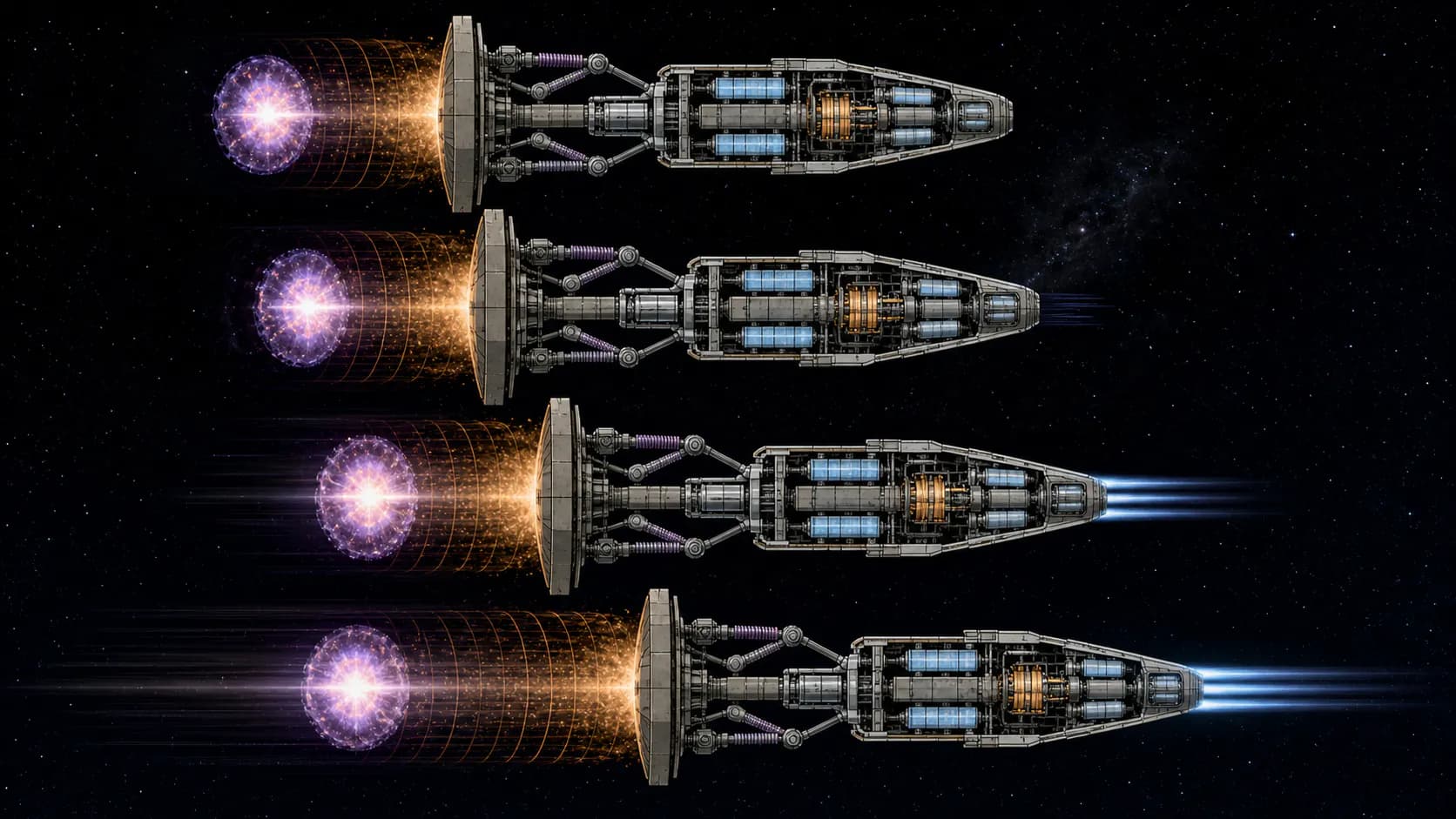
Nuclear-pulse propulsion pushes a spacecraft with a sequence of nuclear explosions instead of one continuous combustion chamber or exhaust stream.
Mechanism
How it operates
Each pulse releases energy behind the vehicle and transfers momentum through a pusher system, sail, or other coupling method. Timing, distance, shielding, shock absorption, and structural fatigue determine whether repeated impulses become controlled acceleration.
Human stakes
Why it matters
The method offers very high impulse using known nuclear physics, but it makes propulsion inseparable from weapons control, launch safety, fallout, treaty obligations, and catastrophic failure modes.
Used in: 1 catalog novel
Related: Spacecraft propulsion · Interstellar travel · Weaponized physics
A few terms make the rest of the explanation easier to follow.
- Pulse unit
- A discrete nuclear explosive or energy package placed and detonated to deliver one controlled increment of momentum.
- Pusher plate
- A massive structure that intercepts pulse products and transfers their momentum into the spacecraft.
- Impulse
- Force applied over time, equal to the resulting change in momentum.
- Shock isolation
- Mechanical systems that spread and soften each violent pulse before it reaches payload or crew.
Use the idea while reading
Turn the definition into three observations
Do not begin by asking whether a novel is “about” nuclear-pulse propulsion. Begin with what changes in the lives of its characters, then use the concept to explain the mechanism underneath that change.
- 01
Notice how each pulse transfers momentum to the craft.
- 02
Notice what protects payload and crew from shock and radiation.
- 03
Notice who builds, controls, transports, and authorizes the nuclear units.
Keep one question open: Does the story treat destructive capacity as a tool, a temptation, or both?
Avoid the shortcut: The ship does not ride one uncontrolled blast. The concept depends on many deliberately shaped and timed pulses plus a structure capable of surviving them.
How it works, step by step
- 1
Release energy outside the vehicle
A pulse unit detonates behind the craft so extreme temperature and pressure do not need to remain inside a conventional engine chamber.
- 2
Capture part of the expanding momentum
Radiation and plasma strike a plate, sail, magnetic field, or other coupling system designed to turn an explosion into directional impulse.
- 3
Smooth the shock
Large dampers or staged structures convert the brief impact into an acceleration the vehicle and occupants can survive.
- 4
Repeat with controlled timing
Thousands of pulses accumulate velocity while guidance, plate erosion, radiation, fatigue, and pulse storage remain within mission limits.
A concrete example
A fast rescue launched from near Earth
A mission can reach a distant target in time only by using thousands of nuclear pulse units assembled in orbit.
01
Each pulse can deliver far more impulse than a small chemical burn, allowing a large payload to accelerate repeatedly.
02
The launch architecture requires manufacturing, transporting, storing, securing, and authorizing weapon-scale devices near inhabited space.
03
A propulsion failure, diversion, treaty dispute, or hostile seizure can threaten people who receive none of the mission's benefit.
The point
Nuclear-pulse propulsion turns known destructive physics into a possible transport system, but its vehicle cannot be separated from the institutions controlling nuclear material and risk.
What is real, and what remains uncertain
First separate what we can observe or build today from what remains a prediction or a fictional extension.
What evidence supports it
Proposed engineering
Nuclear explosions and momentum transfer are established physics, and serious designs have been studied. No full-scale nuclear-pulse spacecraft has flown.
A common misunderstanding
The ship does not ride one uncontrolled blast. The concept depends on many deliberately shaped and timed pulses plus a structure capable of surviving them.
Try this example in your head
A rescue mission can arrive in time only by launching thousands of nuclear pulse units from near Earth. The technology may save one world while normalizing an orbital stockpile of weapons.
Studied, not flown at full scale
Momentum transfer and nuclear energy are established, while complete pulse vehicles remain design studies with unresolved engineering, environmental, legal, and political barriers.
The plate is not the only hard problem
Pulse production, precision deployment, radiation, fallout, erosion, structural fatigue, crew protection, and safe failure all shape feasibility.
How science fiction tests the idea
Stories usually test both the promise of an idea and the trouble it creates.
Its promise
Existing destructive technology can be redirected toward an otherwise unreachable journey.
Its problem
A drive built from explosions carries weapon-scale risk into every stage of its mission.
What to notice in a story
- 01
How each pulse transfers momentum to the craft
- 02
What protects payload and crew from shock and radiation
- 03
Who builds, controls, transports, and authorizes the nuclear units
Novels that use this idea
Questions to keep thinking about
Does the story treat destructive capacity as a tool, a temptation, or both?
Which risks fall on the crew and which fall on people near launch infrastructure?
Can a civilization separate this propulsion system from military power?
Sources and further reading
These references ground the portable lesson; story interpretations remain editorial analysis.