
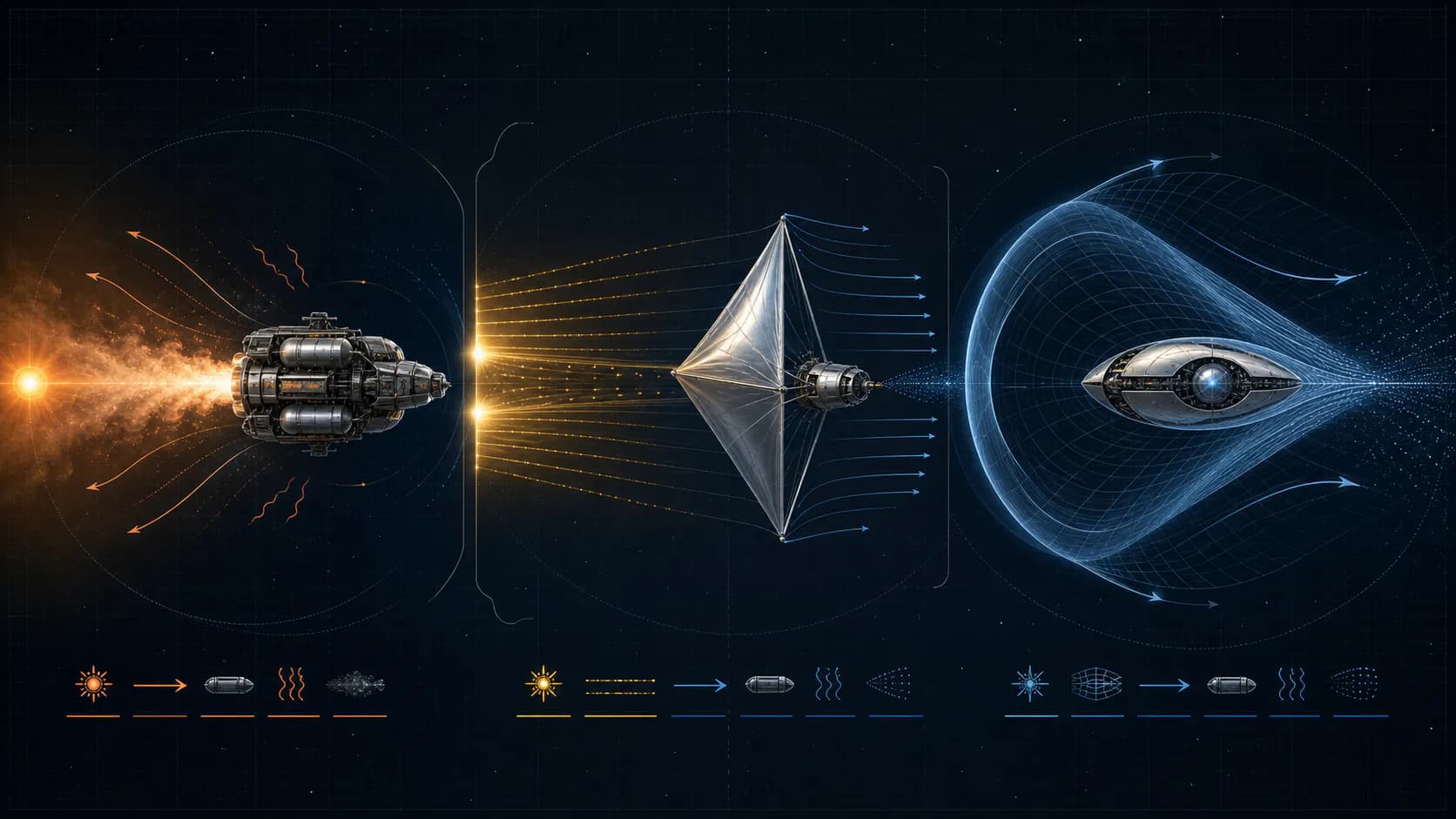
The idea in plain English
Plain idea
What changes
Spacecraft propulsion is how a vehicle changes its motion by exchanging momentum with exhaust, light, an external field, or—in highly speculative stories—spacetime geometry.
Mechanism
How it operates
A reaction drive pushes something backward to push the craft forward. Its performance depends on how much propellant it carries and how fast the exhaust leaves; every design must also supply energy and remove waste heat.
Human stakes
Why it matters
A drive determines who can travel, how long the trip lasts, what payload survives, and what infrastructure must exist. Faster motion can increase radiation, collision, braking, safety, and political costs rather than erasing them.
Used in: 6 catalog novels
Related: Interstellar travel · Nuclear-pulse propulsion · Curvature propulsion
A few terms make the rest of the explanation easier to follow.
- Thrust
- The rate at which a propulsion system changes momentum, determining how strongly a spacecraft accelerates at a given mass.
- Specific impulse
- A measure related to exhaust velocity that compares how effectively a rocket uses propellant.
- Reaction mass
- Material expelled or otherwise used to carry momentum away from a reaction-driven spacecraft.
- Waste heat
- Energy that cannot become useful motion and must be transported away to keep machinery and crew within safe temperatures.
Use the idea while reading
Turn the definition into three observations
Do not begin by asking whether a novel is “about” spacecraft propulsion. Begin with what changes in the lives of its characters, then use the concept to explain the mechanism underneath that change.
- 01
Notice what carries momentum away from or into the craft.
- 02
Notice where the energy and propellant come from.
- 03
Notice how the ship handles heat, acceleration, braking, and failure.
Keep one question open: Which constraint did the new drive solve, and where did the cost move?
Avoid the shortcut: A powerful engine is not the same as an efficient or fast interstellar drive. Thrust, exhaust speed, energy use, propellant, heat, and mission duration are different constraints.
How it works, step by step
- 1
Choose a momentum exchange
A craft can expel matter or radiation, receive momentum from an external beam or sail, interact with a field, or invoke speculative spacetime engineering.
- 2
Supply usable energy
Chemical bonds, nuclear reactions, sunlight, stored electricity, or external infrastructure power the momentum exchange, each with different mass and safety costs.
- 3
Balance thrust and efficiency
High thrust changes velocity quickly; high exhaust speed uses propellant efficiently. Many real systems excel at one and perform modestly at the other.
- 4
Close the mission design
Engine mass, tanks, power, radiators, shielding, payload, reliability, and braking must fit together; improving one number can worsen the complete vehicle.
A concrete example
A high-efficiency engine with too little thrust
A cargo craft receives an electric drive with excellent specific impulse but a small force, powered by a heavy reactor.
01
The craft uses little propellant per unit of momentum, but acceleration takes months because thrust is low compared with vehicle mass.
02
The reactor and power conversion equipment add mass and create heat that requires large radiators.
03
For slow cargo the trade may be excellent; for an emergency departure the same engine may be unusable despite its efficiency.
The point
No drive is simply better. Propulsion choices trade thrust, propellant, energy, heat, infrastructure, mission time, and payload against one another.
What is real, and what remains uncertain
First separate what we can observe or build today from what remains a prediction or a fictional extension.
What evidence supports it
Established physics, uneven engineering maturity
Chemical, electric, nuclear, and sail concepts obey tested momentum and energy rules, though many advanced versions remain unbuilt. Curvature drives are far more speculative.
A common misunderstanding
A powerful engine is not the same as an efficient or fast interstellar drive. Thrust, exhaust speed, energy use, propellant, heat, and mission duration are different constraints.
Try this example in your head
Engineers double a ship's payload and give it a drive with ten times the exhaust speed. The reactor now creates more heat than the radiators can reject. Which improvement actually controls the mission?
Efficiency has several meanings
Specific impulse, energy efficiency, thrust-to-weight ratio, total system mass, and travel time answer different questions and should not be collapsed into one ranking.
The rocket equation still shapes reaction drives
Higher exhaust speed helps, but tanks, engines, power, structure, and payload remain part of the mass that must be accelerated.
How science fiction tests the idea
Stories usually test both the promise of an idea and the trouble it creates.
Its promise
A propulsion breakthrough can turn unreachable worlds into practical destinations.
Its problem
Every drive moves constraints elsewhere, into energy, mass, risk, infrastructure, or spacetime itself.
What to notice in a story
- 01
What carries momentum away from or into the craft
- 02
Where the energy and propellant come from
- 03
How the ship handles heat, acceleration, braking, and failure
Novels that use this idea
Cosmic scale
Dark · Demanding
Death’s End
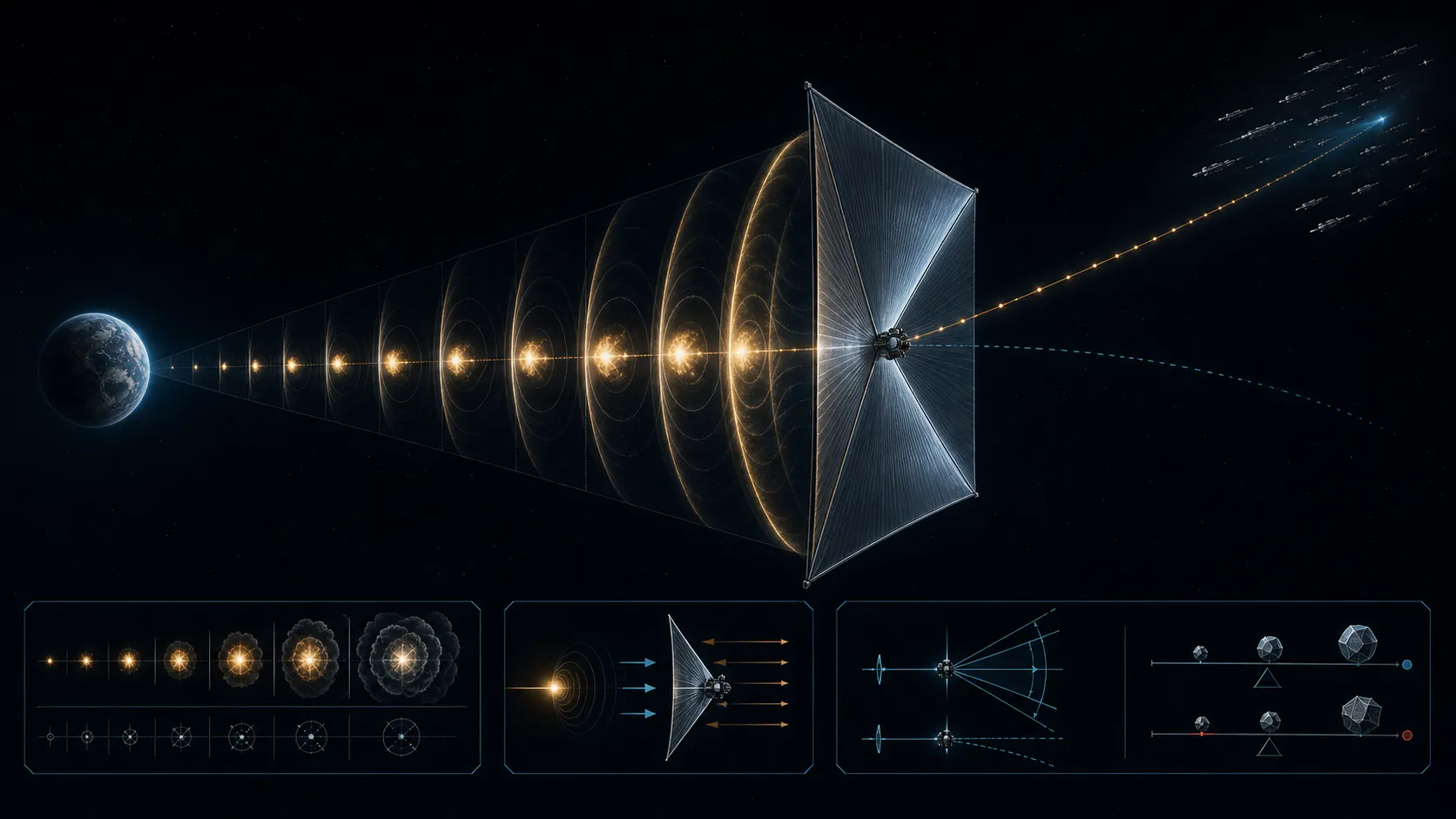
The story compares propulsion by external nuclear pulses with a drive that alters spacetime, exposing how every route to speed carries different constraints.
Visual example · How the Staircase Program turns explosions into velocity
Civilization scale
Hopeful · Layered
Project Hail Mary
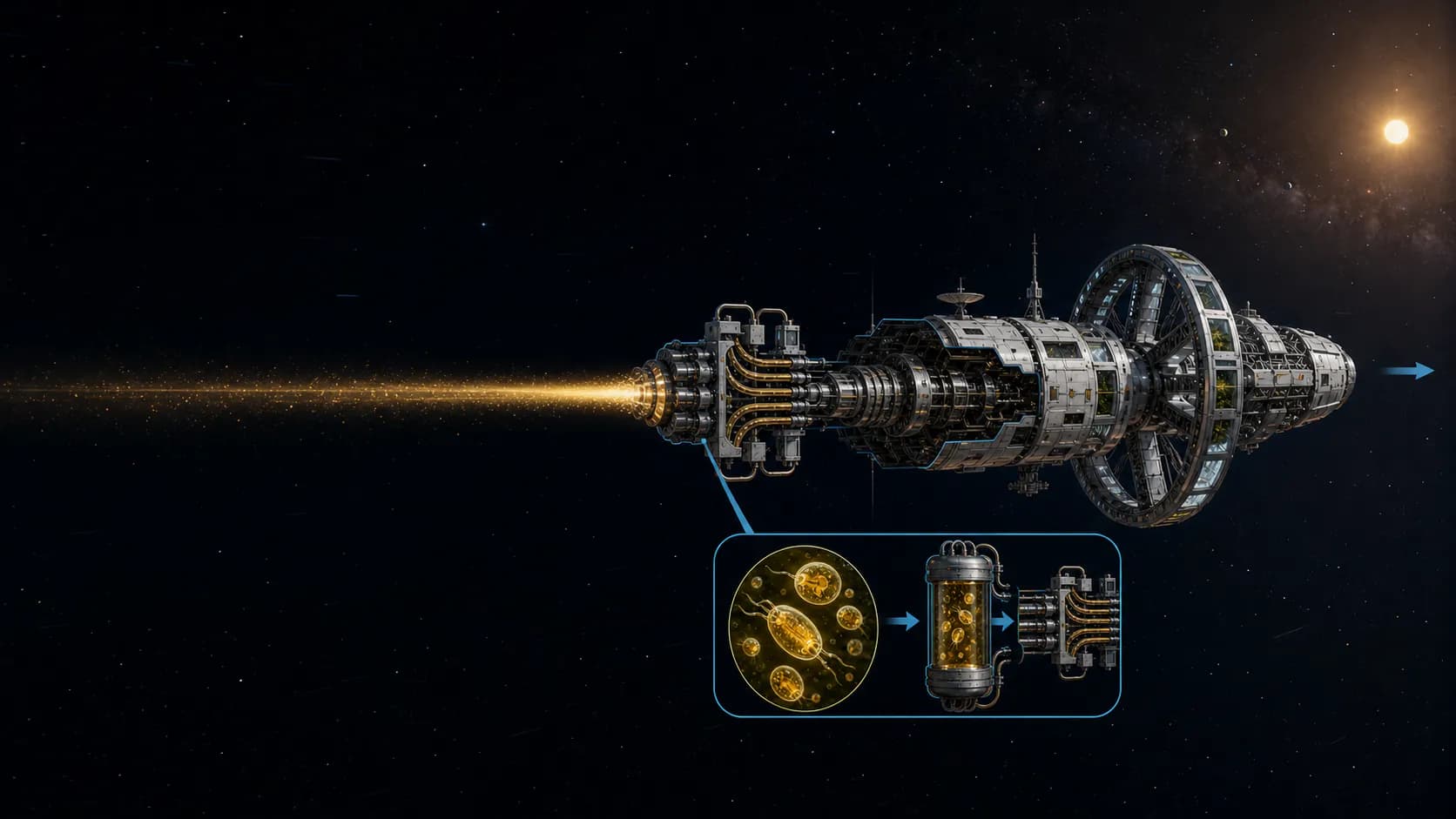
Astrophage's extraordinary energy storage turns the organism causing the crisis into the fuel that makes an interstellar response possible.
Visual example · The crisis organism becomes the mission's engine
Cosmic scale
Cautious · Layered
Pushing Ice
A mining crew chases Saturn's departing moon Janus for a brief look at an alien machine. The chase becomes a one-way journey that turns a shipboard disagreement into a civilization's history.
Civilization scale
Hopeful · Demanding
The Clockwork Rocket
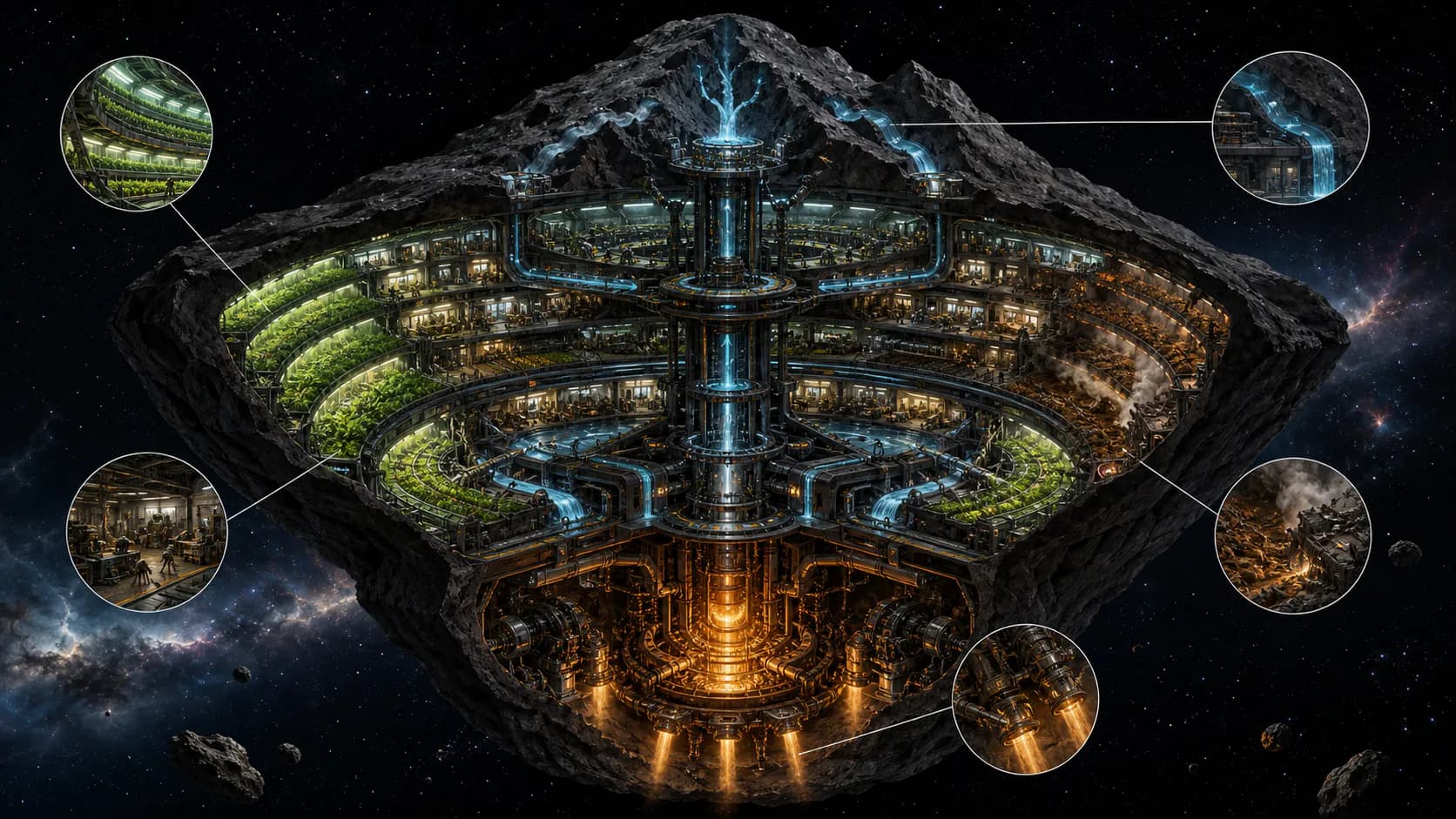
Turning sunstone and an entire mountain into a launch system makes propulsion an infrastructure project whose failures can strand a civilization.
Visual example · A mountain becomes a coupled living system
Societal scale
Balanced · Demanding
The Eternal Flame
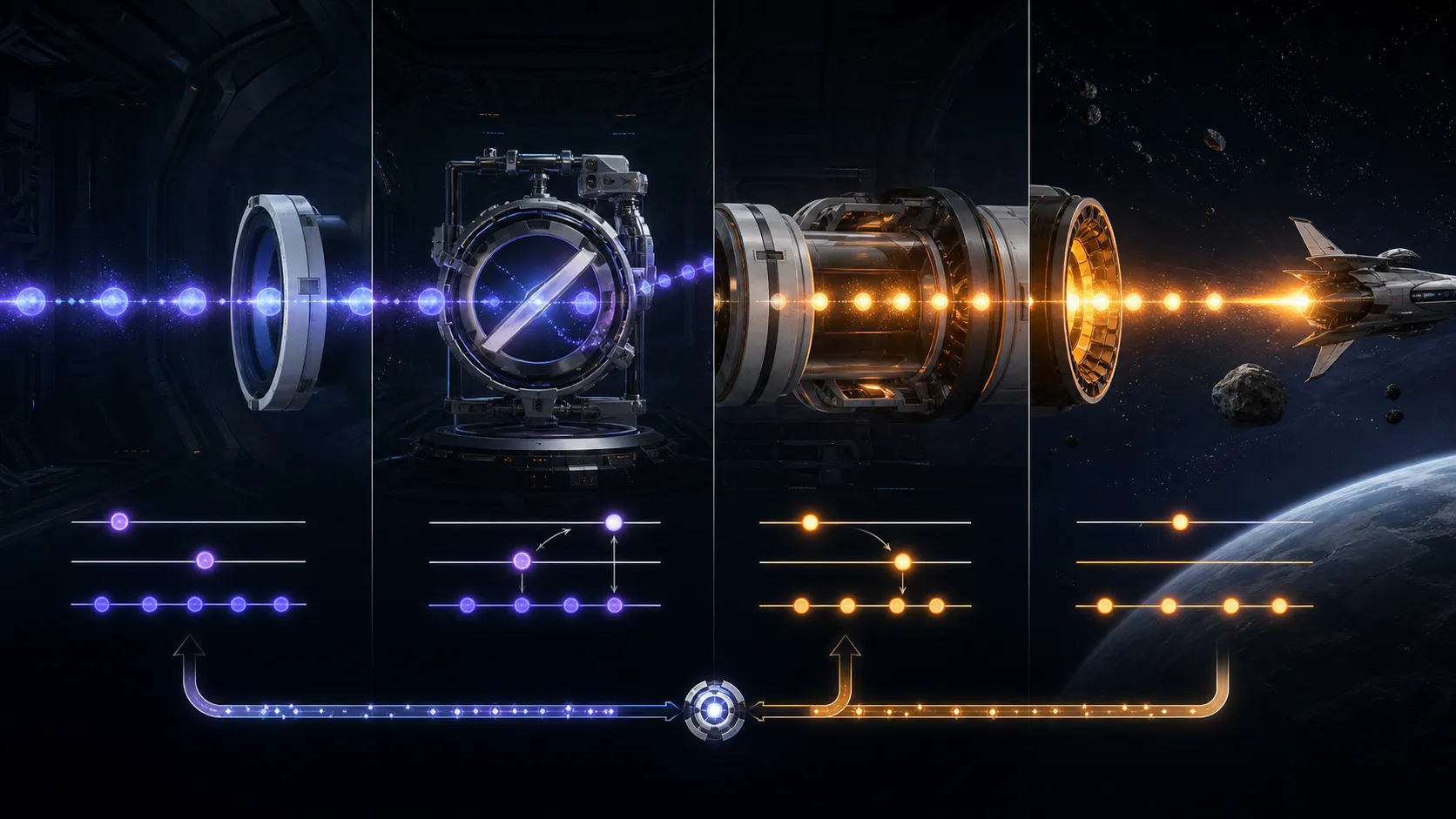
The fuel crisis turns quantum insight into a practical question: whether light can sustain a drive without consuming the ship's future.
Visual example · How quantized light closes the fictional engine cycle
Human scale
Hopeful · Accessible
The Martian
Ion thrust, launch mass, manufactured fuel, and improvised impulses show that every propulsion gain moves cost into time, payload, structure, or risk.
Questions to keep thinking about
Which constraint did the new drive solve, and where did the cost move?
What infrastructure must exist before the ship can depart or arrive?
Who accepts the environmental and strategic risk of the propulsion system?
Sources and further reading
These references ground the portable lesson; story interpretations remain editorial analysis.