
Novel guide
Project Hail Mary
Andy Weir

Story and ideas · Standalone
Project Hail Mary
by Andy Weir
U.S. hardcover · Ballantine Books, 2021 · Publisher details · Cover via Open Library
A scientist wakes alone on a starship with two dead crewmates, no memory, and one impossible assignment: learn why a distant star is surviving the same disaster killing the Sun.
Full-story article
This article discusses the complete story, including the ending.
- Reading time
- About 13 hours
- Length
- 496 pages
- Reading complexity
- Layered
- Several ideas or timelines overlap, but the central path remains visible.
- Science intensity
- 5/5
- Scientific mechanisms are central to understanding the story.
Affiliate links. As an Amazon Associate, we earn from qualifying purchases.
Watch the story
Watch on Scifi Orthogonal
Video guides from our YouTube channel. These discuss the full story and may reveal the ending.
Before you read
Is this book for you?
Start by tracking: Separate what Grace measures now from what he remembers later, and notice how cooperation changes the problem each experiment must solve.
Read this if you enjoy
- Problem-solving science with emotional momentum
- An optimistic first-contact partnership
- A mystery reconstructed through experiments and memory
Why readers may get lost
- Flashbacks repeatedly revise the present mission
- Scientific explanations are central rather than decorative
Keep these anchors in mind
- Ryland Grace
- reconstructs both the mission and himself
- Rocky
- turns contact into practical partnership
- Stratt
- converts a planetary emergency into authority
- Astrophage
- creates the crisis and much of its technology
- The Hail Mary
- functions as laboratory, shelter, and last chance
Layered reading complexity. Several ideas or timelines overlap, but the central path remains visible.
Science intensity 5/5. Scientific mechanisms are central to understanding the story.
The mystery Grace wakes inside
What Project Hail Mary is really about
Ryland Grace wakes alone without his name, his mission, or the reason two crewmates are dead beside him. The novel lets the reader rebuild his situation with him, then uses each recovered memory to change what courage, friendship, and responsibility mean.
The opening situation
Grace wakes up afraid—and completely alone
A man opens his eyes in a clinical room. He cannot remember his name. His body barely works. Two people lie dead beside him, and the machines caring for him cannot explain why.
He survives the fear by asking small questions he can answer. How heavy is this object? Why does it fall that way? What kind of room needs robot arms? The answers are frightening, but they give him something memory cannot yet provide: a next step.
The central question
What if solving the next small problem is the only way to remember who you are—and why everyone needs you?
Project Hail Mary begins as one frightened person's fight to understand the room. Only then does it reveal how many lives depend on him.
The story, in human terms
First, follow the person—not the physics
The opening alternates between the ship and returning memories. These are not two separate plots: every memory explains what Grace must do next in the present.
- 1
Opening
He wakes as a stranger to himself
Grace is weak, frightened, and unable to grieve the two dead people beside him because he cannot remember who they are.
What changes: Simple experiments show that the room is a spacecraft. Survival is no longer about escaping a hospital; he is somewhere far from Earth.
- 2
The memories
He remembers the people waiting at home
Fragments return: his classroom, a strange line near the Sun, and a global crisis that turned ordinary lives into a countdown.
What changes: Something living is draining energy from the Sun. Grace's personal mystery becomes a mission to prevent famine and collapse on Earth.
- 3
The destination
He reaches the one surviving star
Grace wants instructions and companionship. Instead, he realizes he is the only surviving member of the crew and nobody can tell him what to do.
What changes: Tau Ceti is the nearby star that is not dimming. Grace must discover why, preserve the answer, and somehow send it home.
Follow the problem, test, and consequence
How to follow Grace without memorizing every calculation
The science creates suspense, but the readable path is always human: notice what Grace needs, what he tests, what fails, and how the result changes his relationship to Earth, Rocky, or his own past.
Illustrated explanation
Before memory, a measurable world
An original Signal teaching illustration. The falling object anchors the opening mystery; switch lenses to see how Grace, the ship, and scientific infrastructure occupy the same experiment.
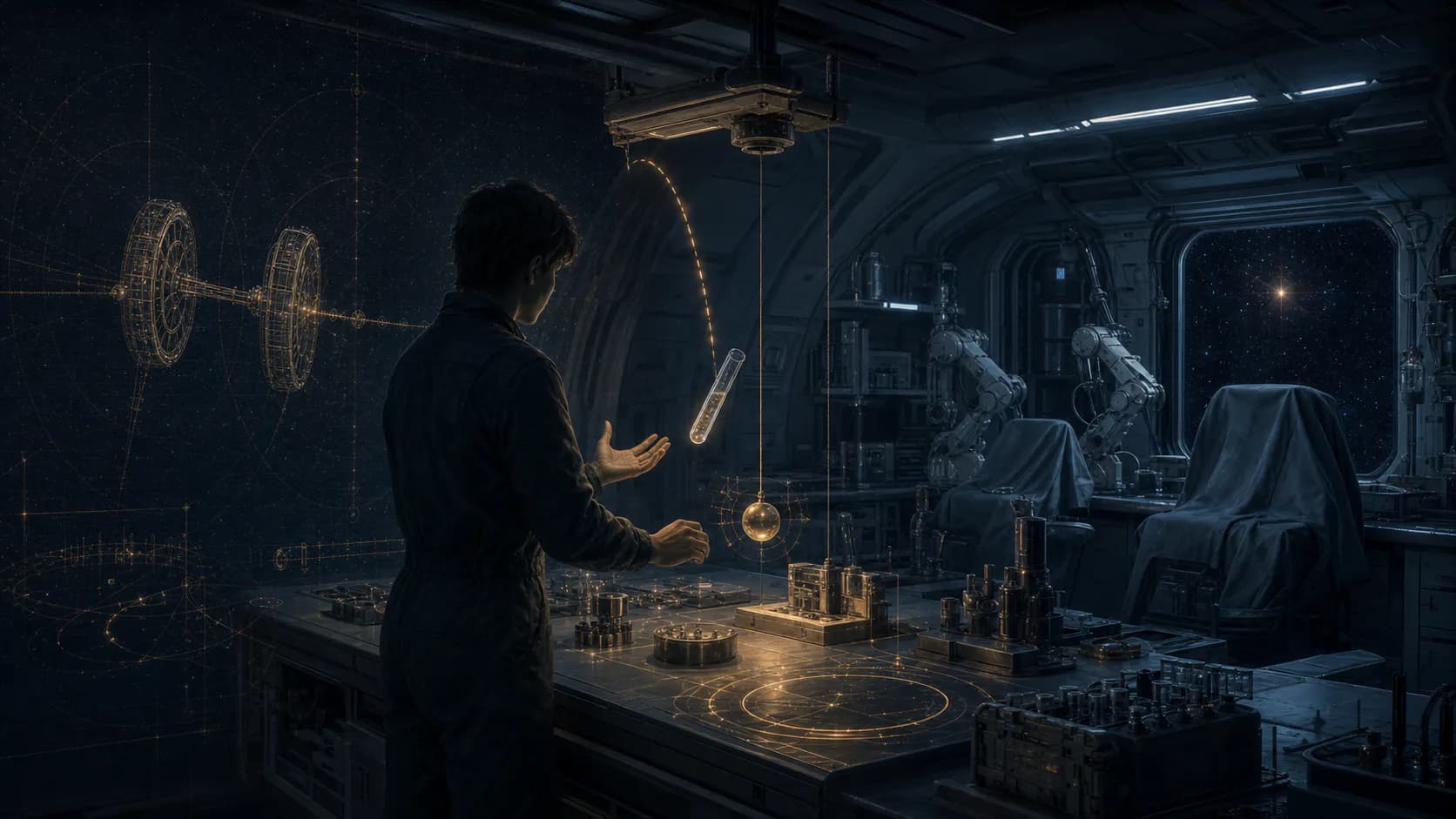
What to notice
- 01
Plot trajectory
A body solves before memory returns
Grace wakes weak and nameless beside two dead crewmates, using small experiments to establish that his room is not on Earth.
In the image: Observation → measurement → location
- 02
Amnesiac scientist and sole surviving crew member
Ryland Grace
He rebuilds his situation from physical evidence while returning memories complicate the person he believes himself to be.
In the image: Skill persists before autobiography
- 03
Interstellar laboratory and one-way rescue mission
Hail Mary
Its rotating design, automated systems, and modular equipment turn experimental science into the crew's only path forward.
In the image: Rotation → gravity → usable laboratory
- 04
Speculative concept
Science as infrastructure
The rescue effort depends on instruments and experiments, but also on a global chain of specialists willing to share methods under pressure.
In the image: One experiment rests on a ship full of inherited tools
How Grace handles fear
Science is his way out of panic
Grace does not solve the whole mission at once. He notices one thing, makes one guess, and creates a test that could prove the guess wrong. A result gives him the next question. That rhythm is the story's clearest route: fear → observation → test → decision.
Optional detailThe two ideas behind the opening missionOpen this only if the climate stakes or the role of Grace's equipment still feel unclear.
Ideas explained
Two ideas are enough for the opening
These concepts explain why Grace's small experiments matter to people he cannot see.
Idea 1
Climate survival
Less sunlight means colder weather and failing harvests. The danger is not a dramatic explosion; it is a future in which more people go hungry every year.
In this story: This is why Grace cannot simply keep himself alive. Every delay on the ship becomes lost time for families on Earth.
How do you care for people who are years away and cannot answer you?
Read the plain-language concept articleIdea 2
Science as infrastructure
Grace looks alone, but every instrument around him carries the work of teachers, engineers, doctors, and researchers on Earth.
In this story: The ship is humanity's help made physical. Grace's job is to continue a chain of work, not perform magic as a lone genius.
Whose invisible work makes one visible breakthrough possible?
Read the plain-language concept articleOptional detailHow the ship crosses interstellar distanceTwo reusable ideas separate the destination problem from the engine that makes the journey possible.
Ideas explained
Distance and propulsion are different problems
One concept explains the gulf; the other explains how a ship pays to cross it.
Idea 1
Interstellar travel
Stars are so far apart that a voyage changes communication, supplies, elapsed time, and the traveler's connection to the society that launched them.
In this story: Grace carries a laboratory to a star that Earth cannot study closely enough from home, then must send useful knowledge back across the same gulf.
What part of home can a one-way mission actually carry with it?
Read the plain-language concept articleIdea 2
Spacecraft propulsion
A drive must turn stored energy into directed momentum. More speed changes the fuel, heat, payload, and safety constraints rather than removing them.
In this story: Astrophage is both the cause of the solar emergency and the energy source that lets the Hail Mary reach Tau Ceti in time to investigate it.
What new dependency appears when the threat also powers the response?
Read the plain-language concept articleIllustrated explanation
The crisis organism becomes the mission's engine
Astrophage stores stellar energy, the ship's systems control its release, and rearward emission gives the Hail Mary the thrust needed for an interstellar laboratory mission.
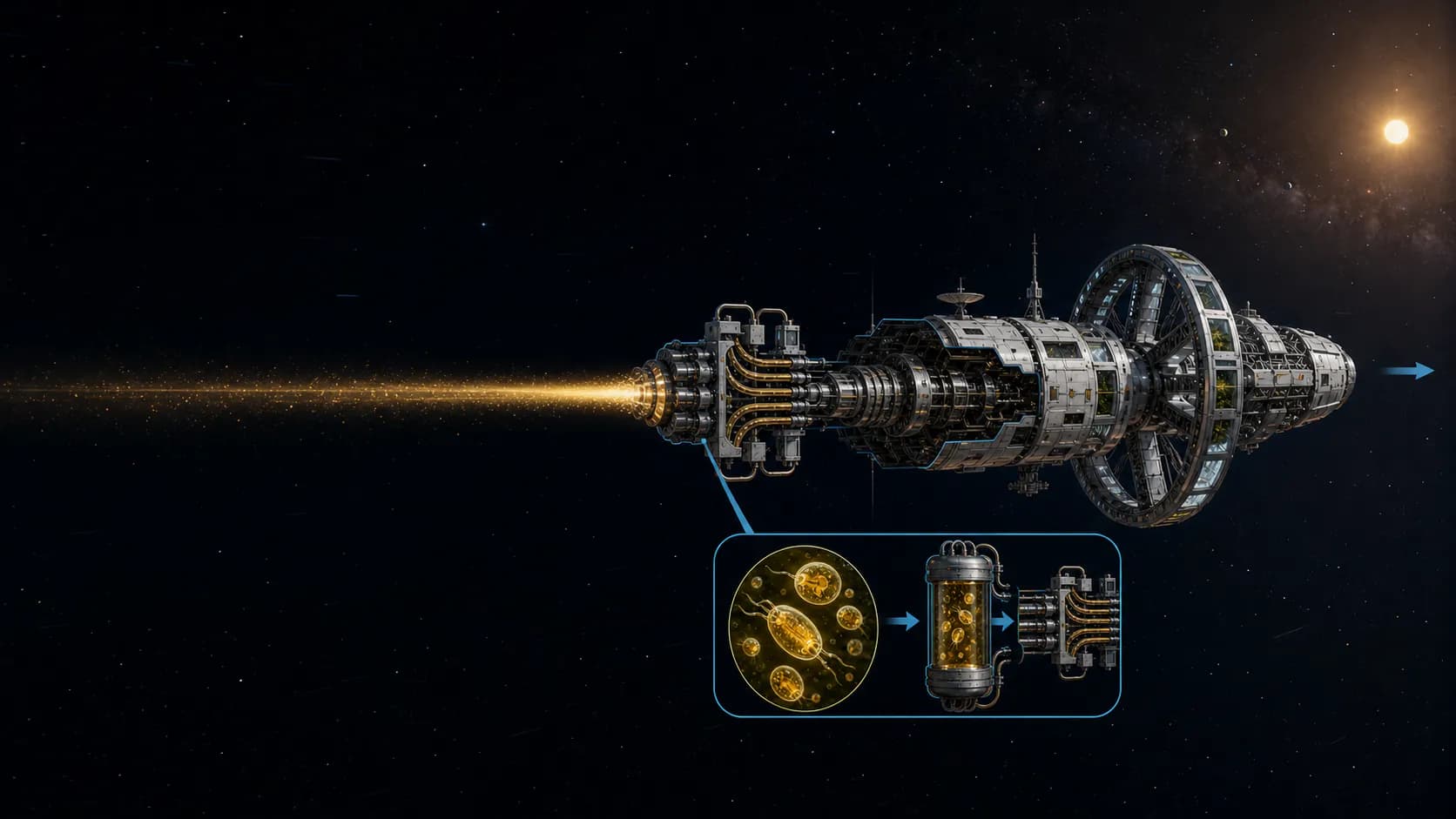
What to notice
- 01
Stellar parasite and energy-dense life form
Astrophage
Its unusual biology threatens Earth's climate while making the journey to investigate that threat possible.
In the image: A living energy store is cultivated and contained.
- 02
Interstellar laboratory and one-way rescue mission
Hail Mary
Its rotating design, automated systems, and modular equipment turn experimental science into the crew's only path forward.
In the image: The ship turns stored energy into a controlled journey.
- 03
Plot trajectory
A line near the Sun becomes a deadline
Recovered memories connect the ship to an organism draining stellar energy and the worsening future awaiting Earth.
In the image: The same organism connects the solar threat to the response.
- 04
Speculative concept
Spacecraft propulsion
Astrophage's extraordinary energy storage turns the organism causing the crisis into the fuel that makes an interstellar response possible.
In the image: Rearward energy emission and forward acceleration form one system.
- 05
Speculative concept
Interstellar travel
A one-way laboratory mission makes stellar distance a problem of stored knowledge, finite supplies, acceleration, and decisions whose results may arrive too late.
In the image: A compact laboratory can now cross the gulf between stars.
The question beneath the plot
The real story is not whether Grace is clever enough
Grace can calculate, improvise, and survive. The harder question is what those abilities are for. At first, science helps him control fear. Later, it becomes a language, a promise, and a way to care for someone whose life is nothing like his own.
Reference guide
Keep the people, systems, and questions connected
These chapter landmarks place the larger cast, scientific clues, and important questions beside the story turn where they matter.
People to remember
Ryland Grace
Amnesiac scientist and sole surviving crew member
He rebuilds his situation from physical evidence while returning memories complicate the person he believes himself to be.
Eva Stratt
Director of the international emergency response
She treats borders, laws, careers, and individual wishes as variables subordinate to the survival timetable.
Rocky
Eridian engineer and fellow survivor
His discipline, memory, and gift for building turn an unprecedented encounter into a working scientific partnership.
Mission, vessel, and living systems
Hail Mary
Interstellar laboratory and one-way rescue mission
Its rotating design, automated systems, and modular equipment turn experimental science into the crew's only path forward.
Astrophage
Stellar parasite and energy-dense life form
Its unusual biology threatens Earth's climate while making the journey to investigate that threat possible.
Project Hail Mary
Humanity's interstellar research program
It concentrates global expertise and industrial capacity on learning why Tau Ceti alone appears to resist the stellar infestation.
Eridians
A civilization facing a parallel stellar emergency
Their unfamiliar senses, materials, and scientific blind spots become sources of both difficulty and complementary knowledge.
Taumoeba
Potential biological control for Astrophage
Its appetite creates hope for two worlds, while its capacity to adapt makes the cure another system that must be understood.
Safe through chapter 4
Memory is evidence with a motive
The flashbacks answer practical questions, but they also edit Grace's self-portrait. Notice which memories arrive when he needs reassurance and which uncertainties they leave untouched. Knowing the mission is not yet the same as knowing why he is on it.
Safe through chapter 8
First contact starts with reversible moves
Models, samples, engine flashes, and distance let both missions exchange information without demanding immediate vulnerability. Each side creates a small test, waits for an answer, and changes the next move based on what the other understood.
Safe through chapter 12
A language can begin as a laboratory
Shared numbers and atomic structures work because each participant can verify them independently. Trust grows alongside vocabulary, especially when mistakes are corrected without humiliation or force.
Safe through chapter 16
Difference is a shared instrument
Human optics, Eridian acoustics, familiar electronics, and unfamiliar materials give the partnership more ways to notice and solve a problem. The novel treats biological difference as complementary capability rather than a ladder of intelligence.
Safe through chapter 23
Remove the heroic story and ask again
Grace's recovered refusal does not erase his work at Tau Ceti. It changes the moral question. Competence under coercion is not the same as chosen courage, and being necessary does not retroactively grant consent.
Progress-safe room
Safe through Chapter 8
Progress-safe room
Safe through Chapter 16
Progress-safe room
Safe through Chapter 24
The middle of the story
The lonely mission becomes a relationship
Meeting Rocky changes the emotional direction of the novel: Grace stops solving only for a distant planet and starts caring for someone beside him.
- 1
Ch. 7–8
A second ship answers
Grace is desperate for company, but the unknown vessel could be dangerous. The other survivor is just as cautious and just as alone.
What changes: Engine flashes and exchanged objects turn mutual fear into the first reversible acts of contact.
- 2
Ch. 8–12
They build a language together
Grace and Rocky cannot share air, senses, or words. Both need to be understood without pretending their bodies work the same way.
What changes: Numbers, clocks, atoms, and patient correction become names, sentences, and a way to work side by side.
- 3
Ch. 12–16
Useful partnership becomes friendship
Each scientist has abilities the other lacks. More importantly, each begins to notice when the other is tired, frightened, or unsafe.
What changes: They stop treating trust as a temporary experiment. Watching over one another becomes part of how they solve problems.
- 4
Ch. 17–21
Two rescue missions become one
Grace wants to save Earth; Rocky wants to save Erid. Neither goal has to become less important for the friendship to matter.
What changes: Their different biology and engineering knowledge combine into a shared search for an answer that could reach both homes.
Illustrated explanation
Build meaning from what both sides can test
An original Signal teaching illustration. Blue and amber separate incompatible atmospheres while clocks, atoms, touch, and sound provide shared reference points.

What to notice
- 01
Plot trajectory
Measurement becomes conversation
Numbers, clocks, atomic structures, and patient correction become the first stable bridge between two sensory worlds.
In the image: Numbers → units → vocabulary → trust
- 02
Amnesiac scientist and sole surviving crew member
Ryland Grace
He rebuilds his situation from physical evidence while returning memories complicate the person he believes himself to be.
In the image: Sight and software become one side of the bridge
- 03
Eridian engineer and fellow survivor
Rocky
His discipline, memory, and gift for building turn an unprecedented encounter into a working scientific partnership.
In the image: Sound, touch, and memory become the other side
- 04
Primary concept
First contact
Contact begins as a practical attempt to compare measurements, then becomes a test of whether curiosity can mature into responsibility.
In the image: Contact advances through reversible exchanges
- 05
Primary concept
Cross-species communication
Shared units, patient correction, and reciprocal care build understanding before either participant can rely on fluent language.
In the image: A shared reference matters more than a shared sense
Optional detailCommunication, trust, and emergency powerThese concepts name the two human tensions behind the partnership and the mission that brought Grace there.
Ideas explained
Two tensions beneath the partnership
The story is clear first; these ideas explain what the characters are doing with trust and power.
Idea 1
Cross-species communication
Understanding begins when both people can point to the same thing and check what the other means.
In this story: Grace and Rocky use shared measurements as a starting point, but patience and care are what turn vocabulary into friendship.
When does exchanging information become knowing another person?
Read the plain-language concept articleIdea 2
Emergency governance
A crisis can make fast, centralized decisions necessary. It can also make one leader forget that people are not equipment.
In this story: Stratt builds the mission at extraordinary speed, while Grace's returning memories reveal the personal cost of treating survival as the only value.
Can a life-saving result excuse taking away someone's choice?
Read the plain-language concept articleThe choice that defines Grace
How the ending completes Grace's story
The biological solution solves the mission problem, but the ending is decided by Grace's recovered memory and the first fully voluntary sacrifice of his journey. The last classroom shows what kind of life that choice creates.
Complete story · ending spoilers
The ending makes Grace choose who he is
The final turns connect the biological solution to the human question: is Grace a hero because he was sent, or because of what he freely chooses when nobody can command him?
- 1
Ch. 21
They find a living answer
Grace and Rocky finally have reason to hope that both worlds can survive.
What changes: Taumoeba eats Astrophage. The mission changes from searching for an explanation to adapting and delivering a cure.
- 2
Ch. 23
Grace remembers that he refused
The brave volunteer he imagined himself to be never existed. He was afraid, said no, and was forced onto the ship by Stratt.
What changes: His achievements remain real, but the mission can no longer define coercion as courage. Grace must decide what kind of person he is now.
- 3
Ch. 28–29
The cure puts Rocky's world in danger
Grace is finally heading home when he learns that adapted Taumoeba can escape Rocky's containment. Erid may still die unless someone warns him.
What changes: Grace sends Earth's samples onward, turns away from home, and spends his remaining fuel to reach Rocky.
- 4
Ch. 29
He makes the choice nobody can force
Returning for Rocky may cost Grace his health, his home, and every familiar human relationship.
What changes: This sacrifice is freely chosen. Friendship gives Grace the chance to become courageous without rewriting the fear that came before it.
- 5
Ch. 30
The scientist becomes a teacher again
Grace lives on Erid, changed by its gravity and dependent on his friends, but still drawn to the curiosity of children.
What changes: News arrives that Earth survived. The cosmic mission ends in a classroom, where saving a world means another generation gets to ask questions.
Illustrated explanation
A cure that keeps evolving
An original Signal teaching illustration. Read left to right: stored stellar energy, predation, nitrogen selection, and the unintended ability to cross a xenonite-like barrier.
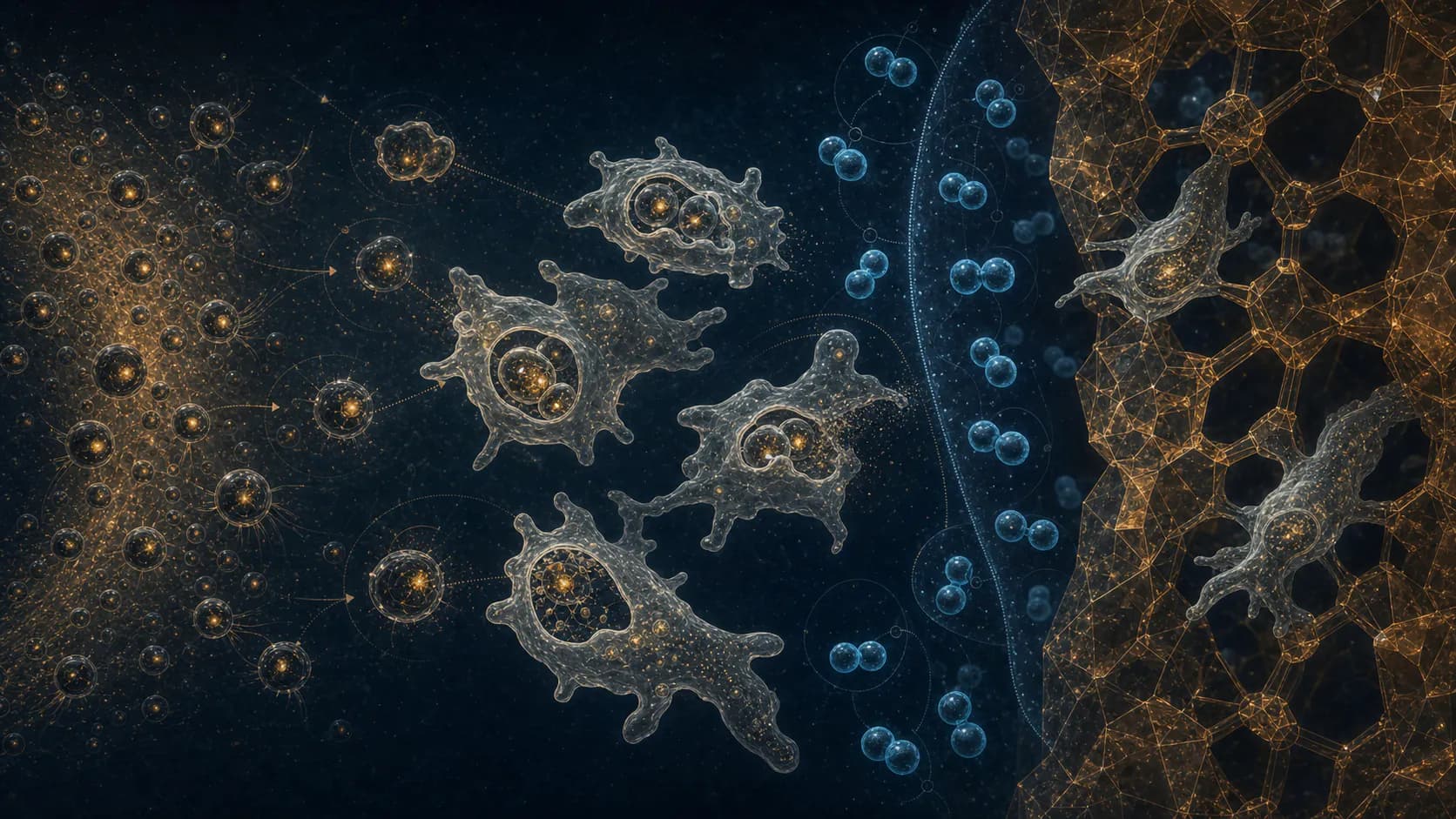
What to notice
- 01
Plot trajectory
The predator inside the sample
The search for Tau Ceti's resistance yields an organism that consumes Astrophage and might be adapted for two different planets.
In the image: Sample → predator → planetary experiment
- 02
Stellar parasite and energy-dense life form
Astrophage
Its unusual biology threatens Earth's climate while making the journey to investigate that threat possible.
In the image: Energy store, fuel, and prey
- 03
Potential biological control for Astrophage
Taumoeba
Its appetite creates hope for two worlds, while its capacity to adapt makes the cure another system that must be understood.
In the image: Predation and adaptation in the same organism
- 04
Primary concept
Climate survival
A dimming star turns an astronomical anomaly into a near-term crisis of food, climate, and collective endurance.
In the image: A planetary climate depends on microbial balance
What the ending means
A blank identity becomes a freely chosen one
The opening asks who Grace was before the coma. The ending answers a better question: who does he decide to be when nobody can make the decision for him? His final identity is neither lone hero nor obedient instrument. It is scientist, friend, and teacher—roles built through repeated care.
Scientific analysis
The cure survives because it can change
Astrophage first appears as both organism and technology: a living process that can be cultivated, stored, and used as fuel. Taumoeba defeats it through ecology rather than superior machinery. Yet adaptation has no loyalty. Breeding for nitrogen resistance also selects for an escape route through xenonite, reminding both scientists that a living solution keeps participating in its own future.
Human analysis
The classroom was always the destination
Grace begins the recovered past as a teacher who prefers direct curiosity to institutional prestige. On Erid, after the scale of the mission and the ambiguity of his heroism have fallen away, he teaches again. The final classroom does not shrink the cosmic story. It reveals why saving a world mattered: so another generation can keep asking questions.
Keep exploring
Follow the idea beyond this ending
The Idea Atlas connects this novel’s central question to the science, philosophy, and other stories that approach it differently.
Open the connected ideaContinue through the catalog
Find another world on the same axis
Beyond the rescue problem
The mission changes when Grace stops treating knowledge as a solo achievement
The calculations make the danger concrete, but the emotional movement comes from learning that discovery, courage, and even identity are built with other people.
These lenses connect the flashback mystery, the first-contact friendship, and the final classroom.
Memory and responsibility
Is Grace responsible for a choice he cannot remember making?
The amnesia initially lets Grace experience himself as the willing hero the mission needs. Recovered memory shows that Stratt forced him aboard after he refused. The facts complicate his self-image without erasing the person making new choices now.
Why this matters: The novel distinguishes inherited responsibility from present agency: character is revealed by what Grace does once he knows the truth.
Grace and Rocky
Why does cooperation succeed before language is complete?
They begin with shared measurements, demonstrations, repetition, and repair. Trust grows from actions that can be checked: exchanging materials, entering danger, admitting mistakes, and returning when withdrawal would be safer.
Why this matters: First contact becomes a practical relationship built through mutual dependence rather than a perfect translation event.
Stratt's authority
Can saving billions justify using one person as a resource?
Stratt coordinates an unprecedented response and makes decisions ordinary institutions might delay. She also removes Grace's ability to refuse the mission and then removes his memory of that coercion.
Why this matters: The success of the mission does not settle the ethics of emergency power; it makes the cost harder to ignore.
Teaching as survival
Why does the novel end with students rather than applause on Earth?
Grace's most durable skill is not a particular formula. It is turning uncertainty into a question another mind can test. On Erid, he helps a new generation inherit both knowledge and curiosity.
Why this matters: Saving a civilization matters because it preserves learners, relationships, and futures—not merely population numbers.
Coordinates on a neighboring axis
Novel guide
The Three-Body Problem
The Three-Body Problem
Cixin Liu
The universe starts counting down inside a scientist’s eyes. To learn why, he must enter a world with three suns—and follow a signal humanity may regret sending.
Novel guide
Contact
Contact
Carl Sagan
When radio astronomer Ellie Arroway finds a prime-number signal from Vega, decoding it gives humanity instructions for a Machine no one can prove is invitation rather than trap.
Novel guide
Children of Ruin
Children of Ruin
Adrian Tchaikovsky
A human-spider expedition follows an old signal to two engineered worlds where uplifted octopuses and an alien organism make contact inseparable from infection.
Content notes
Death and corpses · Climate catastrophe and mass-casualty threat · Coercion and loss of bodily autonomy · Medical distress and serious injury · Suicide mission and self-sacrifice
Editorial record
Research and sources
The story analysis is original. Background sources support the scientific and philosophical explainers connected to this novel.
Last reviewed July 22, 2026