The idea in plain English
Plain idea
What changes
Climate survival is the long work of keeping people and ecosystems alive as heat, water, weather, food systems, and habitable places change.
Mechanism
How it operates
A changing climate shifts averages and extremes, which then interact with infrastructure, wealth, health, migration, and governance. The same physical hazard produces different harm depending on who has protection and choices.
Human stakes
Why it matters
Survival is not only enduring a disaster. It means deciding what to preserve, where to rebuild, who must move, who pays, and whether adaptation reduces or deepens existing inequality.
Used in: 2 catalog novels
Related: First contact · Posthuman identity · Emergency governance
A few terms make the rest of the explanation easier to follow.
- Hazard
- A physical climate event or trend, such as heat, flooding, drought, fire weather, or sea-level rise, that can cause harm.
- Exposure
- The people, ecosystems, infrastructure, and livelihoods located where a climate hazard can reach them.
- Vulnerability
- The conditions that make exposed people or systems more susceptible to harm and less able to cope or adapt.
- Maladaptation
- A response that reduces risk temporarily or for one group while increasing emissions, inequality, or future vulnerability elsewhere.
Use the idea while reading
Turn the definition into three observations
Do not begin by asking whether a novel is “about” climate survival. Begin with what changes in the lives of its characters, then use the concept to explain the mechanism underneath that change.
- 01
Notice which systems fail together rather than in isolation.
- 02
Notice who can relocate, insure, cool, or protect themselves.
- 03
Notice whether emergency measures become lasting forms of government.
Keep one question open: Does the story frame survival as engineering, justice, culture, or all three?
Avoid the shortcut: Climate change is not one uniform rise in temperature or one dramatic storm. It changes probabilities and connected systems over uneven timescales and regions.
How it works, step by step
- 1
A physical baseline shifts
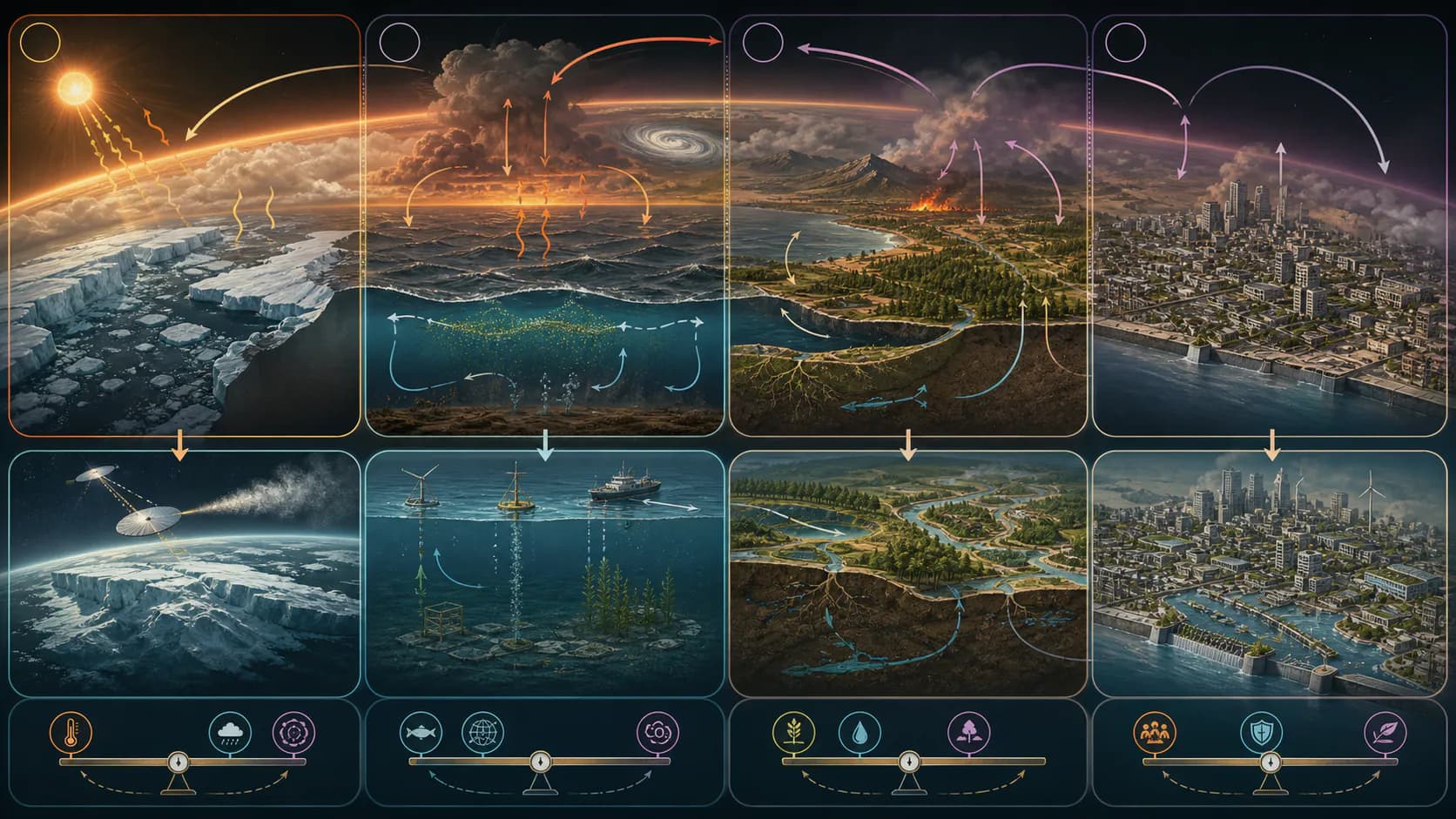
Accumulated greenhouse gases retain additional energy, changing average conditions and the probabilities of extremes across atmosphere, ocean, ice, and land.
- 2
Hazards meet connected systems
Heat, water, food, health, housing, energy, ecosystems, and transport interact, so one shock can create cascading failures rather than an isolated event.
- 3
Exposure and vulnerability shape damage
The same temperature or flood depth produces unequal outcomes because protection, wealth, health, location, insurance, and political voice differ.
- 4
Adaptation changes the risk pathway
Early warning, cooling, restoration, relocation, infrastructure, and social protection can reduce harm, but each response has limits and distributional consequences.
A concrete example
A city prepares for extreme heat
A growing city expects longer heat waves that threaten health, electricity, water, and outdoor work.
01
A forecast and alert system identifies the hazard but cannot protect residents who lack cool buildings, transport, or trusted information.
02
Trees, reflective surfaces, shaded transit, labor rules, clinics, and reliable power reduce different parts of exposure and vulnerability.
03
If investment reaches only wealthy districts, average temperatures may improve while the people at greatest risk remain unprotected.
The point
Climate survival is a system of physical adaptation and social choices. Effective protection changes who is exposed, who can respond, and whether a solution transfers harm.
What is real, and what remains uncertain
First separate what we can observe or build today from what remains a prediction or a fictional extension.
What evidence supports it
Observed science and social adaptation
Human-caused climate change and many adaptation challenges are measured realities. Particular fictional futures extend the severity, timing, and technologies.
A common misunderstanding
Climate change is not one uniform rise in temperature or one dramatic storm. It changes probabilities and connected systems over uneven timescales and regions.
Try this example in your head
A coastal city can protect its wealthy center, relocate every neighborhood, or fund many smaller local defenses. All three plans save lives, but not the same lives or the same community.
Adaptation has limits
Some ecosystems and communities encounter physical, financial, institutional, or cultural thresholds beyond which losses cannot be fully prevented.
Local success can hide transferred risk
A seawall, reservoir, cooling system, or relocation plan may protect one place while shifting water, costs, emissions, or displacement onto another.
How science fiction tests the idea
Stories usually test both the promise of an idea and the trouble it creates.
Its promise
Survival requires coordinated institutions.
Its problem
Survival begins with local, plural forms of care.
What to notice in a story
- 01
Which systems fail together rather than in isolation
- 02
Who can relocate, insure, cool, or protect themselves
- 03
Whether emergency measures become lasting forms of government
Novels that use this idea
Societal scale
Cautious · Layered
Parable of the Sower
Climate change is not a single spectacular disaster but pressure moving through water prices, fire, food, disease, migration, work, policing, and the shrinking number of places where ordinary life remains possible.
Civilization scale
Hopeful · Layered
Project Hail Mary
A dimming star turns an astronomical anomaly into a near-term crisis of food, climate, and collective endurance.
Visual example · A cure that keeps evolving
Questions to keep thinking about
Does the story frame survival as engineering, justice, culture, or all three?
Whose home is treated as expendable?
Which adaptations solve a hazard by transferring it elsewhere?
Sources and further reading
These references ground the portable lesson; story interpretations remain editorial analysis.
Intergovernmental Panel on Climate Change
Climate Change 2022: Impacts, Adaptation and Vulnerability — Summary for Policymakers
MechanismReality checkHuman stakesLimitsIntergovernmental Panel on Climate Change
Climate Change 2023: Synthesis Report — Summary for Policymakers
Reality checkHuman stakesLimits