
Novel guide
Contact
Carl Sagan

Story and ideas · Standalone
Contact
by Carl Sagan
Gallery Books trade paperback · 2019 · Publisher details · Cover via Open Library
When radio astronomer Ellie Arroway finds a prime-number signal from Vega, decoding it gives humanity instructions for a Machine no one can prove is invitation rather than trap.
Full-story article
This article discusses the complete story, including the ending.
- Reading time
- About 10 hours
- Length
- 384 pages
- Reading complexity
- Layered
- Several ideas or timelines overlap, but the central path remains visible.
- Science intensity
- 4/5
- Understanding key mechanisms clarifies important plot turns.
Affiliate links. As an Amazon Associate, we earn from qualifying purchases.
Watch the story
Watch on Scifi Orthogonal
Video guides from our YouTube channel. These discuss the full story and may reveal the ending.
Before you read
Is this book for you?
Start by tracking: Track who can verify each claim, who controls the evidence, and when private conviction becomes a public decision.
Read this if you enjoy
- First contact grounded in scientific institutions
- Debates about evidence, faith, and public trust
- A patient story centered on one astronomer’s need to know
Why readers may get lost
- The story follows institutional consequences as closely as discovery
- Several interpretations remain deliberately unresolved
Keep these anchors in mind
- Ellie Arroway
- protects the demand for testable evidence
- Project Argus
- turns patient listening into a global discovery
- The Message
- reveals instructions in increasingly deep layers
- Palmer Joss
- tests where proof and trust meet
- S. R. Hadden
- recognizes leverage inside uncertainty
Layered reading complexity. Several ideas or timelines overlap, but the central path remains visible.
Science intensity 4/5. Understanding key mechanisms clarifies important plot turns.
Where Ellie's search begins
A listener who needs the universe to answer clearly
Ellie Arroway begins as a disciplined listener looking for evidence that can survive doubt. The story grows from one unusual signal into a global argument about proof, representation, trust, and humanity's place in a much older universe.
The first discovery
Prime numbers rise out of Vega
Eleanor “Ellie” Arroway has spent her career defending a patient, systematic search for extraterrestrial intelligence. At Project Argus, a radio-telescope array in New Mexico, she finally hears a narrow signal from the direction of Vega. Its pulses count prime numbers—an economical way to say that a mind, not an ordinary star, arranged them.
Ellie wants a result that can survive every challenge. Instead, verification makes the discovery larger than any laboratory: governments consider secrecy, broadcasters turn it into spectacle, religious leaders dispute its meaning, and scientists across borders must decide whether cooperation is part of the evidence or a risk to national power.
The central question
How can humanity understand a message from a mind with whom it shares no language, body, history, or institution?
The novel treats first contact as a problem of translation and trust before it becomes a journey. Every deeper layer asks who may interpret the unknown for everyone else.
The story, in human terms
What happens first—and why it matters
Ellie's human route comes before the technical machinery.
- 1
A curious child
Ellie learns that opening a radio can replace fear with a mechanism
Losing her beloved father leaves her wary of dependence and hungry for contact that cannot simply disappear.
What changes: Scientific explanation becomes both her profession and her way of reaching beyond isolation.
- 2
A patient search
She builds a career around listening when others want faster rewards
Ellie needs her colleagues to treat the search as real science, not a sentimental wish or a public-relations project.
What changes: Project Argus gives that persistence enough instruments, time, and checking procedures to catch a rare pattern.
- 3
The signal
A prime-number pulse survives every attempt to explain it away
Wonder arrives with responsibility: Ellie must protect the observation while institutions rush to own its meaning.
What changes: Her private vocation becomes a planetary event, and detection turns into the harder work of communication.
- The reading promise
- A human search for intelligible company that widens into global science, politics, faith, and spacetime
- What Ellie fears
- That evidence will be distorted by power—or that the answer will vanish before it can be shared
- What Ellie wants
- A contact claim strong enough that no authority, prejudice, or private need can decide it alone
- What Ellie needs
- To learn that rigorous doubt and the longing to be met do not have to cancel each other
02 · Story guide
From one pulse train to a choice humanity cannot rehearse
Follow five causal turns from the first verified signal through the decision to build and use the Machine.
The human line
Ellie keeps asking what the evidence permits
The Message does not erase terrestrial disagreement. It gives every institution a new object for old habits: secrecy, competition, evangelism, profit, caution, and genuine collaboration. Ellie’s role is not to be free of hope. It is to keep hope answerable to what the instruments actually show.
Mid-book context
The Message becomes a physical commitment
These turns cover the decoding and construction sections without revealing what the Machine does.
- 1
Nested signals
The team discovers that recognition was only the outer layer
Ellie wants a shared language, but humanity first confronts a returned image of its own violent history and a data stream it cannot yet parse.
What changes: The question changes from who sent the signal to what the sender expects the receivers to do.
- 2
A missing primer
Scientists learn that the Message teaches in stages
No nation has enough context alone, while unequal access makes every delay look like concealment.
What changes: A hidden phase layer supplies a route from mathematics and chemistry into a usable technical vocabulary.
- 3
The Machine
Humanity builds exact components without knowing the purpose
Ellie is excluded from the first crew even though the project grew from her search, forcing her to separate scientific ownership from personal longing.
What changes: Blueprint interpretation becomes industrial action, and abstract uncertainty gains physical mass, cost, and danger.
- 4
Sabotage and succession
An attack kills David Drumlin after he saves Ellie
She inherits the seat she wanted through an act of sacrifice, making the journey inseparable from grief and moral debt.
What changes: A secretly completed Machine in Hokkaido becomes the remaining chance, and five scientists must decide whether to enter it.
Illustrated explanation
How the Message teaches humanity to read deeper
The signal is a palimpsest: mathematical regularity establishes intention, a returned transmission establishes attention, and hidden technical layers teach the vocabulary needed to interpret a Machine.
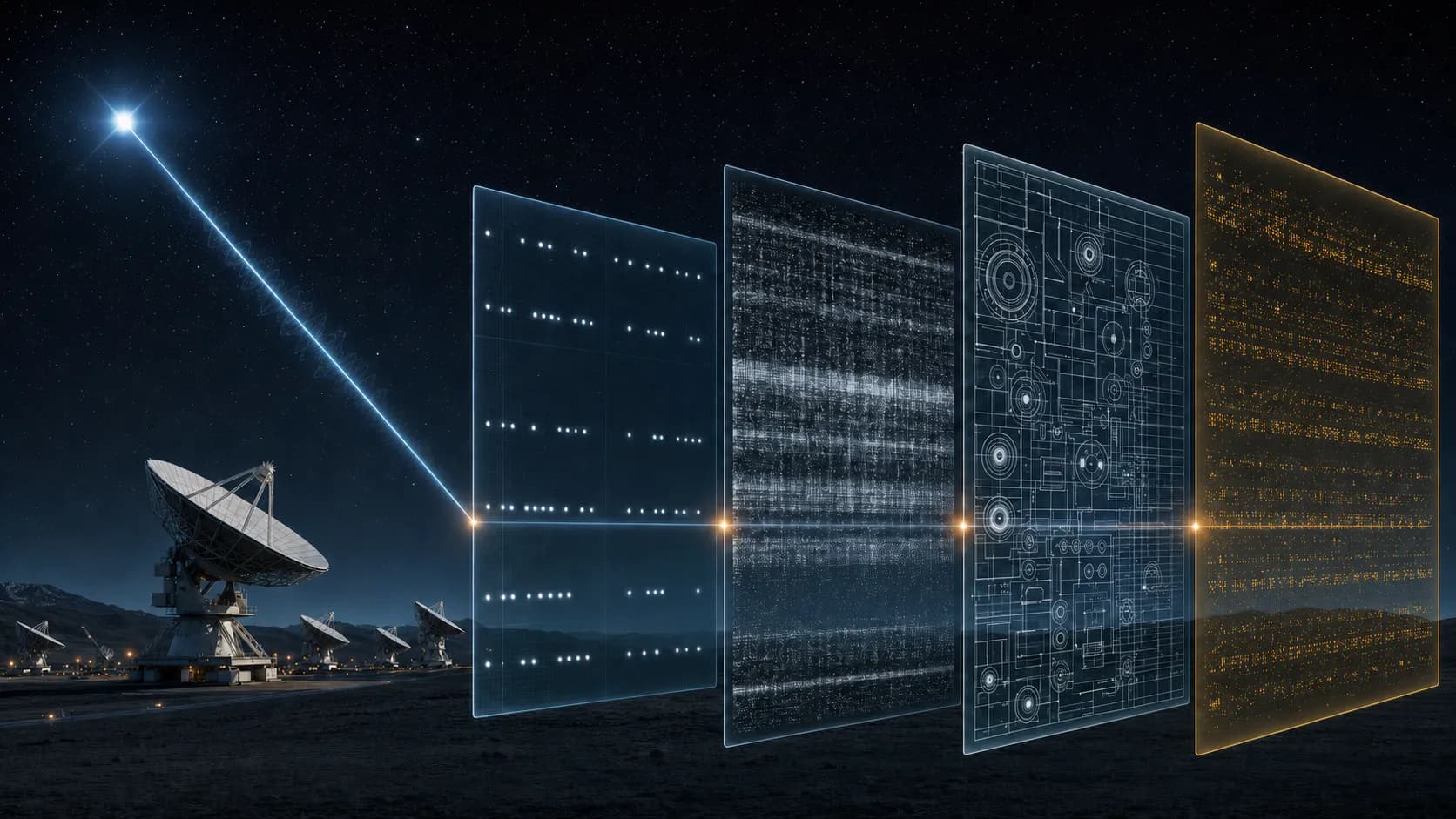
What to notice
- 01
Systematic search for extraterrestrial intelligence
Project Argus
Its telescope array, observers, and checking procedures make the first detection both possible and independently testable.
In the image: A distributed observing system receives and checks the signal.
- 02
Extraterrestrial transmission and decoding challenge
The Vega Message
Its prime-number beacon establishes intention, while deeper layers test whether mathematics and shared physics can become a language.
In the image: Countable pulse groups establish artificial structure before shared language exists.
- 03
Primary concept
Cross-species communication
The Message builds shared reference in layers, beginning with countable regularity and using each decoded structure to teach the vocabulary needed for the next.
In the image: Familiar evidence becomes the bridge toward unfamiliar meaning.
- 04
Plot trajectory
The data begins to describe a Machine
Cross-references and diagrams suggest that the Message is teaching humanity how to assemble a physical device of unknown purpose.
In the image: Geometric instructions make the signal actionable before its purpose is known.
Illustrated explanation
Human industry assembles an unknown invitation
Three countable benzels surround the five-seat capsule. The design is exact enough to build, but no component explains who will control activation or what waits beyond it.
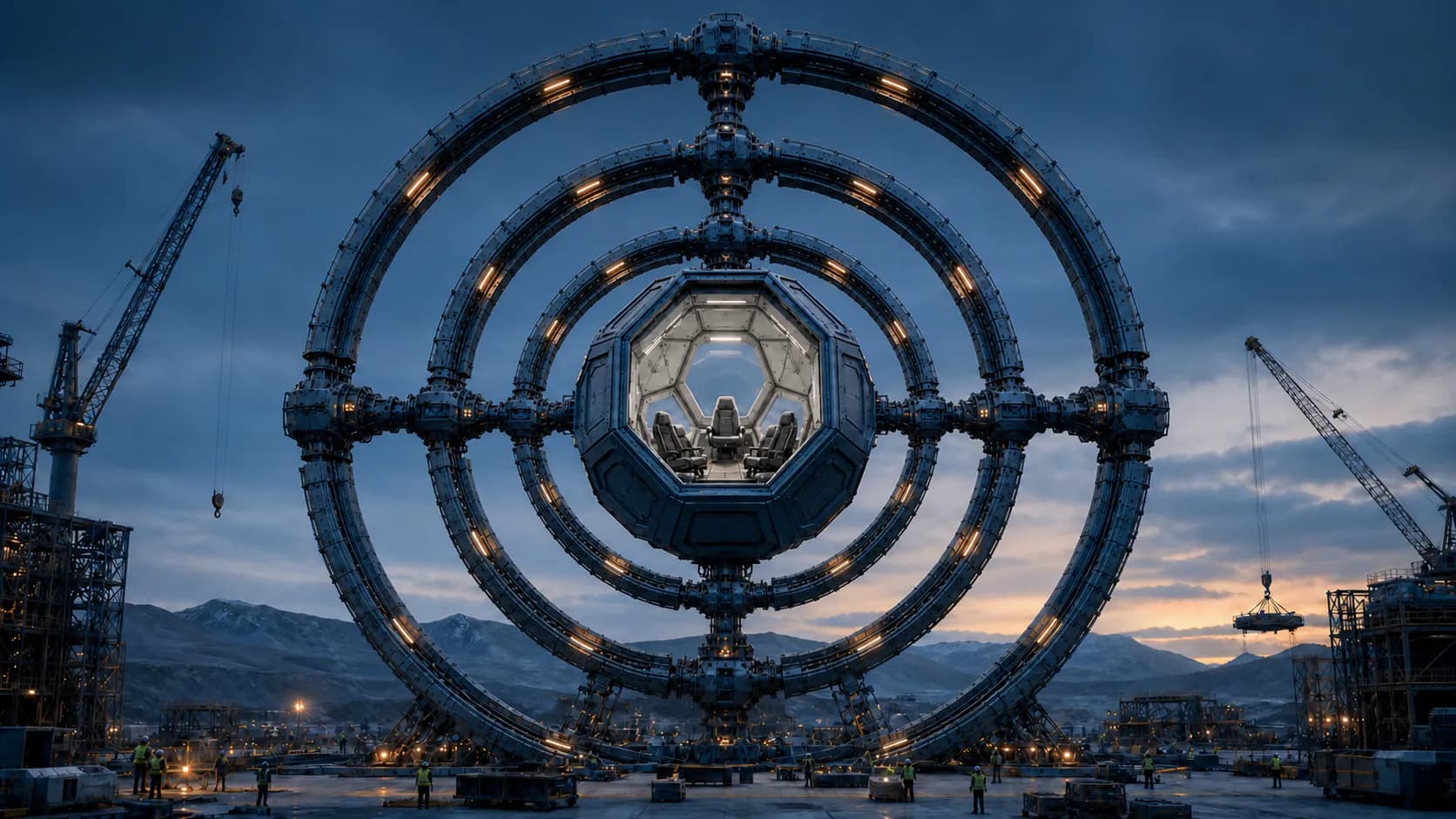
What to notice
- 01
Primary concept
Science as infrastructure
No isolated genius can preserve or interpret the signal alone; telescopes, redundancy, open comparison, institutions, funding, and international trust become part of the discovery itself.
In the image: Construction depends on global materials, labor, verification, and trust.
- 02
Unknown-purpose device encoded in the Message
The Machine
Three rotating benzels surround a five-seat dodecahedron, forcing humanity to build before it can know whether the design is transport, test, or danger.
In the image: Three rotating structures implement instructions whose function remains hidden.
- 03
Multinational scientific delegation
The Five
Ellie, Vaygay, Devi Sukhavati, Abonnema Eda, and Xi Qiaomu enter the Machine carrying different sciences, cultures, and expectations.
In the image: The centered dodecahedron contains one seat for each delegate.
- 04
Plot trajectory
The data begins to describe a Machine
Cross-references and diagrams suggest that the Message is teaching humanity how to assemble a physical device of unknown purpose.
In the image: A decoded plan becomes a commitment before it becomes understanding.
Complete trajectory
Contact changes from evidence into testimony
These turns reveal the Machine's destination and the final conflict over proof.
- 1
The shortcut
The Five pass through tunnels to a galactic transit hub
Ellie’s desire for one other voice expands into evidence of infrastructure older and larger than any single civilization.
What changes: Interstellar distance stops looking like empty separation and starts looking like access controlled by unknown caretakers.
- 2
A familiar face
The encounter borrows forms each traveler can emotionally understand
Ellie meets an apparent version of her dead father and must listen without mistaking a compassionate interface for literal identity.
What changes: Cross-species translation moves from shared mathematics to shared vulnerability, while the visitors are told they are only at an early stage.
- 3
The return
The Five come home with memory but no public proof
Ellie is placed in the position she once resisted: asking others to trust convergent testimony about an unrepeatable event.
What changes: Officials define the journey as failure, and her search turns from outer space toward evidence hidden in the structure of mathematics.
Illustrated explanation
One event produces two incompatible records
The upper path is the Five's convergent experience; the lower record is what Earth can measure. The story's final conflict lies in the gap between testimony and reproducible evidence.

What to notice
- 01
Multinational scientific delegation
The Five
Ellie, Vaygay, Devi Sukhavati, Abonnema Eda, and Xi Qiaomu enter the Machine carrying different sciences, cultures, and expectations.
In the image: Five independent witnesses share the same extraordinary route.
- 02
Primary concept
Traversable wormholes
Wormholes operate as a galactic transit network: the physical shortcut is inseparable from the older civilization that controls its stations, routes, and permission to return.
In the image: Branching shortcuts connect the capsule to a larger transit system.
- 03
Speculative concept
Time travel and temporal displacement
The travelers' day and Earth's twenty minutes expose how unusual paths through spacetime can make witnesses and instruments disagree without either clock feeling broken.
In the image: Earth's clock accumulates much less time than the travelers report.
- 04
Plot trajectory
A shared journey returns as blank evidence
The Five remember a day beyond Earth, but outside clocks record twenty minutes and their media contain no usable proof, allowing officials to call the mission a hoax.
In the image: Blank media let institutions define the public account as failure.
03 · Ideas and visuals
Four ideas turn cosmic wonder into readable consequences
You do not need radio astronomy or relativity. Carry the human consequence beside each mechanism.
Ideas explained
Ideas to carry into the story
Start with the simple mechanism below, then use the technical detail only when it clarifies a decision or consequence.
Idea 1
First contact
A detected intelligence creates a relationship before either side can negotiate rules, verify motives, or correct a misunderstanding.
In this story: The Vega signal reorganizes human institutions even while the sender remains distant and silent.
Who gains authority simply by claiming to interpret the answer?
Read the plain-language concept articleIdea 2
Cross-species communication
Shared meaning can begin with countable patterns, then build vocabulary by connecting new symbols to physical relationships both sides can test.
In this story: The Message is layered so that recognizing one structure provides the tools needed to decode another.
Which layer communicates facts, and which layer communicates an expectation?
Read the plain-language concept articleIdea 3
Science as infrastructure
Science is not only a brilliant conclusion; it is instruments, archives, replication, institutions, critique, labor, funding, and trust sustained over time.
In this story: Project Argus and the World Message Consortium make one detection globally checkable, while Machine construction makes knowledge material.
When does coordination strengthen the evidence, and when does it become control?
Read the plain-language concept articleIdea 4
Traversable wormholes
A hypothetical wormhole shortens the path through spacetime rather than making a traveler locally race faster than light.
In this story: The Machine grants temporary access to a route humanity cannot build, inspect, or reopen on its own.
Is a shortcut freedom if another civilization owns both the map and the gate?
Read the plain-language concept articleOptional detailHow a message can teach its own languageThe crucial move is staged reference, not a universal dictionary.
Communication model
Begin with pattern, then establish shared tests
Prime numbers are useful as an opening claim because a narrow, repeated sequence is difficult to confuse with common astrophysical rhythms. But the sequence says little beyond intentional structure. A richer message must show how symbols relate to quantities, physical constants, chemical relationships, diagrams, or other structures a receiver can independently check.
Contact imagines this as a palimpsest: each successful interpretation changes what the next layer can mean. Communication is therefore not one act of translation. It is a designed curriculum delivered without a teacher present to answer questions.
Optional detailWhy the wormhole is also political infrastructureThe physics shortcut cannot be separated from access and control.
Full-spoiler science lens
The travelers use a network, not a personal superpower
The Five do not create or navigate the spacetime passages. Their capsule is admitted to a mature transit system whose stations and routes were built by others. That distinction matters: the Machine is closer to a receiver attached to an existing network than to an independent starship.
The engineering miracle therefore establishes a dependency. The same civilization that makes distance briefly irrelevant can close the route, limit destinations, erase records, and choose the conditions of the encounter. Travel becomes possible, but autonomy does not arrive with it.
04 · Reading guide
Keep three questions beside the names
Ask what Ellie can verify, who controls the next layer, and which kind of trust the moment demands.
People interpreting the unknown
Eleanor Arroway
Radio astronomer and central viewpoint
Ellie's need for evidence, intellectual independence, and meaningful contact carries the story from childhood radios to Project Argus.
Vasily Lunacharsky
Physicist and international scientific ally
Vaygay helps Ellie separate what the Message actually contains from the fears and ambitions accumulating around it.
Palmer Joss
Religious interlocutor and public moral voice
His exchanges with Ellie force both of them to distinguish evidence, testimony, wonder, and the authority claimed by institutions.
S. R. Hadden
Industrialist, decoder, and private power broker
Hadden uses technical intuition and industrial reach to find possibilities that public institutions overlook, while attaching them to his own legacy.
Signals, institutions, and the Machine
Project Argus
Systematic search for extraterrestrial intelligence
Its telescope array, observers, and checking procedures make the first detection both possible and independently testable.
The Vega Message
Extraterrestrial transmission and decoding challenge
Its prime-number beacon establishes intention, while deeper layers test whether mathematics and shared physics can become a language.
World Message Consortium
Planetary decoding and governance coalition
The Consortium turns redundant observation and international disagreement into a shared process for preserving and interpreting the signal.
The Machine
Unknown-purpose device encoded in the Message
Three rotating benzels surround a five-seat dodecahedron, forcing humanity to build before it can know whether the design is transport, test, or danger.
The Five
Multinational scientific delegation
Ellie, Vaygay, Devi Sukhavati, Abonnema Eda, and Xi Qiaomu enter the Machine carrying different sciences, cultures, and expectations.
Reader lens · chapter 4
Verification enlarges the problem
Once other observatories confirm the signal, the scientific question becomes stronger and the social situation becomes less controllable. Notice how quickly people move from “is it artificial?” to “what does it mean for us?” without waiting for the signal to supply that answer.
Reader lens · chapter 7
Redundancy is both technical and political
Multiple receivers protect against interference, error, and loss. They also prevent one state from making the only copy of reality. Track every attempt to widen or narrow access to the Message; information policy has become part of the scientific method.
Reader lens · chapter 10
Ellie and Joss disagree about standards, not wonder
Both characters take awe seriously. Their conflict concerns what claims awe can justify and what kind of evidence a powerful being ought to leave. The conversation will matter again when one of them possesses an experience that cannot be independently reproduced.
Reader lens · chapter 14
The primer turns decoding into teaching
A codebook shared in advance would be impossible. The Message instead constructs a ladder from relationships humans can verify toward unfamiliar instructions. Ask what has been genuinely translated and what the builders are still inferring from layout and context.
Reader lens · chapter 17
The delegation is an argument about humanity
The Five are not merely passengers with useful credentials. Their different nations, sciences, and traditions embody the claim that no single government or worldview should stand in for the species. Notice what each chooses to carry when certainty runs out.
Reader lens · chapter 20 · full spoilers
A familiar form can be honest without being literal
The interface does not claim that Ellie’s father has simply returned. It acknowledges that raw otherness may communicate nothing at all. The ethical question is whether compassionate translation clarifies the encounter or manipulates the person receiving it.
Reader lens · chapter 21 · full spoilers
Testimony becomes data with contested ownership
The travelers can compare details among themselves, but officials control recordings, public statements, and professional consequences. Ask whether the absence of instrument evidence disproves the journey, merely lowers confidence, or creates a political opportunity to define what happened.
Progress-safe room
Safe through Chapter 6
Progress-safe room
Safe through Chapter 14
Progress-safe room
Safe through Chapter 21
05 · Ending explained
The skeptic returns as a witness—and keeps searching
This section reveals the galactic encounter, the public denial, Ellie's family history, and the final mathematical discovery.
The ending mechanism
The Machine gives experience without compulsory belief
The dodecahedron carries the Five through a network of spacetime passages to a hub near the Galactic Center. Each traveler is met through a form drawn from memory; Ellie’s interlocutor appears as Theodore, the father whose death shaped her need for reliable connection. The being explains that its civilization maintains inherited infrastructure and is still studying a deeper order embedded in the universe.
Back in Hokkaido, only twenty minutes have elapsed and every recording is blank. The Vega transmission stops at activation in a way officials call causally impossible, so Michael Kitz frames the journey as a coordinated hoax and threatens the travelers into silence. Their agreement with one another is real evidence, but it is not the publicly reproducible evidence Ellie has always demanded.
Full debrief
The final answer is not located at Vega
Ellie returns to Argus and searches the digits of pi for the “artist’s signature” suggested during the encounter. After her mother dies, a letter reveals that John Staughton—whom Ellie rejected as an intrusive stepfather—was her biological father. The discovery complicates the ideal father-image used at the Station: the emotional truth that made communication possible was built from love, grief, error, and incomplete family knowledge.
Then a deep base-eleven computation produces a non-random field of zeros and ones forming a circle. The result is not another message traveling from one civilization to another. It is presented as structure placed inside mathematics itself, accessible in principle from anywhere in the universe. Contact therefore widens its title one final time: from radio contact, to physical encounter, to the possibility that intelligibility is woven into reality.
- What the Message proves
- Another intelligence can detect Earth, design a curriculum for its receivers, and offer access to unknown infrastructure
- What the journey cannot prove publicly
- Blank recordings and unequal elapsed time leave extraordinary testimony without a repeatable external trace
- What Palmer Joss contributes
- Belief in Ellie's honesty without demanding that personal trust become compulsory evidence for everyone
- What pi changes
- The search for a sender becomes a search for intentional structure available to every mathematical observer
Keep exploring
Follow the idea beyond this ending
The Idea Atlas connects this novel’s central question to the science, philosophy, and other stories that approach it differently.
Open the connected ideaContinue through the catalog
Find another world on the same axis
More than a message from space
Contact keeps changing what counts as evidence
Ellie's journey is often described as a conflict between science and faith. The novel is more interesting when both are treated as practices for deciding what to trust, what to share, and how much uncertainty a claim can honestly carry.
These lenses show why the story continues after the signal is decoded and after the Machine works.
Ellie's formation
Why does personal loss matter to a cosmic investigation?
Ellie's curiosity grows beside the early death of her father and the discovery that family knowledge can be incomplete. Her hunger for signals is therefore intellectual and emotional: she wants a universe in which important absences can still answer.
Why this matters: The scale of the search does not erase private grief; it gives that grief a disciplined method for reaching outward.
Institutions of proof
Who gets to turn a discovery into public knowledge?
A signal can be independently checked, but building the Machine requires governments, engineers, security systems, money, and international negotiation. Each institution adds capacity while also filtering who may speak and what counts as an acceptable risk.
Why this matters: Science appears as a public infrastructure, not a solitary moment of genius.
The five travelers
Why send a group rather than one representative?
No single traveler can stand for humanity's languages, nations, histories, or ways of knowing. Their shared testimony gives the encounter social depth, even though it still cannot supply the external record institutions demand.
Why this matters: Representation becomes an acknowledged limitation rather than a claim that one hero can speak for Earth.
The final pattern
Why move from an alien builder to mathematics itself?
The structure hidden deep in pi cannot be owned by a planet or accessed only by one Machine. It relocates wonder from a privileged meeting to a pattern any sufficiently patient intelligence might discover.
Why this matters: The ending keeps inquiry open and makes humility, not possession of the answer, the final scientific virtue.
Coordinates on a neighboring axis
Novel guide
Project Hail Mary
Project Hail Mary
Andy Weir
A scientist wakes alone on a starship with two dead crewmates, no memory, and one impossible assignment: learn why a distant star is surviving the same disaster killing the Sun.
Novel guide
The Three-Body Problem
The Three-Body Problem
Cixin Liu
The universe starts counting down inside a scientist’s eyes. To learn why, he must enter a world with three suns—and follow a signal humanity may regret sending.
Novel guide
Blindsight
Blindsight
Peter Watts
After alien probes map Earth and vanish, a man who reads people without feeling close to them joins a radically altered crew sent to meet an intelligence that may not need awareness at all.
Content notes
Death and grief · Terrorist violence and death · Religious conflict · Sexism in scientific institutions · Political intimidation
Editorial record
Research and sources
The story analysis is original. Background sources support the scientific and philosophical explainers connected to this novel.
Last reviewed July 22, 2026