
Novel guide
Blindsight
Peter Watts

Story and ideas · Firefall · Volume 1
Blindsight
by Peter Watts
Tor Essentials trade paperback · introduction by Elizabeth Bear · 2020 · Publisher details · Cover via Open Library
After alien probes map Earth and vanish, a man who reads people without feeling close to them joins a radically altered crew sent to meet an intelligence that may not need awareness at all.
Full-story article
This article discusses the complete story, including the ending.
- Reading time
- About 10 hours
- Length
- 384 pages
- Reading complexity
- Demanding
- Dense terminology, structure, or viewpoint changes reward slower, attentive reading.
- Science intensity
- 5/5
- Scientific mechanisms are central to understanding the story.
Affiliate links. As an Amazon Associate, we earn from qualifying purchases.
Watch the story
Watch on Scifi Orthogonal
Video guides from our YouTube channel. These discuss the full story and may reveal the ending.
Before you read
Is this book for you?
Start by tracking: Follow what each specialist can perceive and ask whether successful behavior proves that anyone understands or experiences it.
Read this if you enjoy
- First contact that behaves like philosophical horror
- Cognitive science and posthuman minds
- Alien intelligence without reassuring human motives
Why readers may get lost
- Dense biological and cognitive terminology
- A radically specialized crew introduced quickly
- Siri reports emotion from an unusual distance
Keep these anchors in mind
- Siri
- synthesizes everyone else’s expertise
- Sarasti
- predicts, commands, and studies the crew
- James and the Gang
- translate language through partitioned minds
- Szpindel
- interprets biology and unfamiliar bodies
- Bates
- handles tactical danger
- Theseus
- coordinates the mission
- Rorschach
- responds without familiar social meaning
Demanding reading complexity. Dense terminology, structure, or viewpoint changes reward slower, attentive reading.
Science intensity 5/5. Scientific mechanisms are central to understanding the story.
01 · Overview
A first-contact mission led by people who already feel alien to one another
Begin with Siri Keeton: a man trained to turn other people's expertise into a usable model while remaining uncertain whether observation is the same as understanding.
Where the story begins
The sky takes a picture of Earth
A grid of alien probes surrounds the planet, records it, and burns away. When a distant listening post detects another signal and is destroyed, the ship Theseus carries a small contact team toward a hidden source near a dark object beyond the familiar Solar System.
Siri Keeton joins as the synthesist. Childhood surgery ended his seizures but changed the way he experiences other people. He can study a room, learn its rules, and report what its specialists mean without feeling naturally inside their social world. That distance makes him useful. It also makes him fear that he is an instrument pretending to be a person.
The central question
What if intelligence can speak, plan, and defeat us without anyone being present inside it?
Blindsight makes first contact inseparable from a human problem: behavior is observable, but another mind's experience is not. The crew must act before it can settle what kind of intelligence it has found.
- The reading promise
- A claustrophobic expedition that turns an alien mystery into a challenge to human awareness
- Whose story
- Siri, the observer who can explain a group more easily than he can belong to one
- What to track
- What each specialist can perceive, who controls the experiment, and what counts as evidence of understanding
- Story structure
- Three named sections: Theseus, Rorschach, and Charybdis
Series flight path
Firefall
Blindsight opens the Firefall sequence. Echopraxia follows overlapping events elsewhere in this future, but this companion treats the present novel's three named sections as a complete reading path.
Volume 1 · You are here
BlindsightDemanding
Volume 2
EchopraxiaDemanding
02 · Story map
Five turns from being observed to questioning the observer
The crew list is dense because every member represents a different way of processing reality. Follow Siri's changing job: witness, translator, experimental subject, then survivor.
The story, in human terms
The mission-safe route
- 1
A life rebuilt
Siri learns people as systems
After surgery changes his emotional access to others, Siri wants to remain useful and fears that intimacy will expose how much of his social fluency is learned procedure.
What changes: He becomes a synthesist: the person who watches specialists, finds the shape of their work, and translates it for the people making decisions.
- 2
Firefall
Earth discovers it has already been observed
The probes offer no relationship and no explanation—only proof that something elsewhere can inspect a whole world and leave.
What changes: A distant anomalous signal becomes too important to study passively, so humanity assembles a contact mission from unusually modified minds.
- 3
The diversion
Theseus follows a destroyed listening post
Siri wakes among specialists whose senses, bodies, personalities, and instincts make ordinary teamwork impossible to take for granted.
What changes: The mission shifts from answering a signal to approaching the hidden system capable of erasing the instrument that detected it.
Illustrated explanation
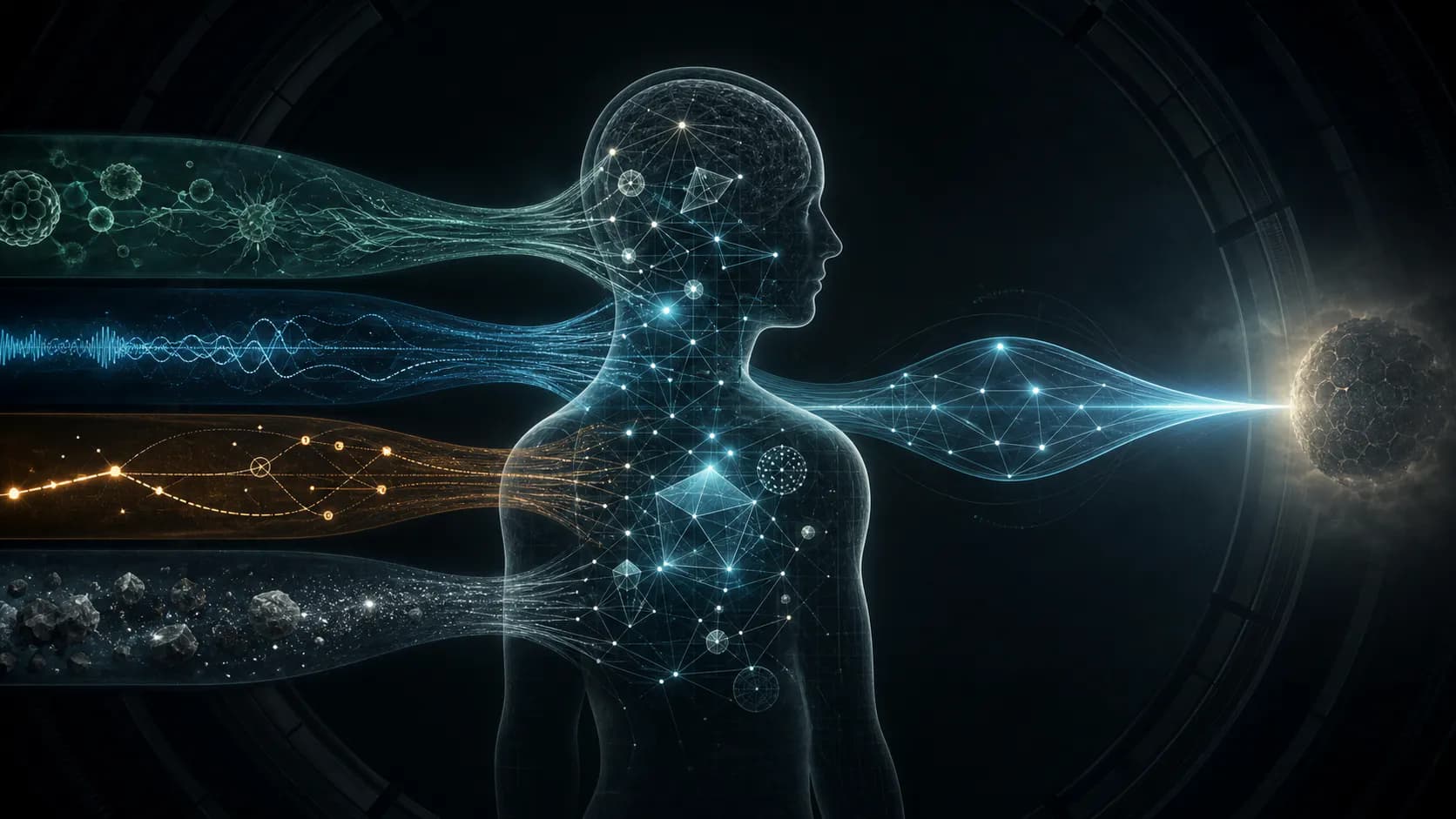
A synthesist maps people without becoming them
Biological, linguistic, tactical, and physical evidence converge inside one observer, then leave as a compact model another decision-maker can use.
What to notice
- 01
Synthesist and narrator
Siri Keeton
Siri observes specialists and translates their work into a model others can use, even when emotional participation remains difficult for him.
In the image: Siri occupies the junction between specialists and command.
- 02
Primary concept
Posthuman identity
Altered bodies and partitioned minds make specialization productive while leaving every crew member unsure where a coherent human self begins or ends.
In the image: His altered cognition makes translation both a profession and a way of being a person.
- 03
Plot trajectory
A contact team is sent beyond the original signal
After the remote Burns-Caulfield installation is destroyed, Theseus follows the evidence toward a dark object and a hidden source near it.
In the image: The integrated model points the mission toward an unknown target.
Rorschach · development spoilers
Conversation turns into an experiment
- 1
A structure answers
The crew receives fluent language from Rorschach
Susan James and the personalities sharing her body want to establish reference, while Siri watches whether confidence is outrunning evidence.
What changes: The crew tests the reply itself and finds that correct language may be generated from patterns without a speaker who understands them.
- 2
The crew goes inside
Observation becomes injury and capture
Szpindel, Bates, and the others must work where radiation, magnetic fields, and unfamiliar geometry attack the senses they rely on.
What changes: A captured inhabitant gives the team a concrete cognition to study instead of an artifact they can only interrogate from outside.
- 3
Competence separates from awareness
The scramblers outperform the story humans tell about intelligence
Siri recognizes an uncomfortable resemblance between their efficient rule use and the procedures he built to navigate other people.
What changes: The mission's question changes from whether the aliens are intelligent to whether consciousness has any survival value at all.
Illustrated explanation
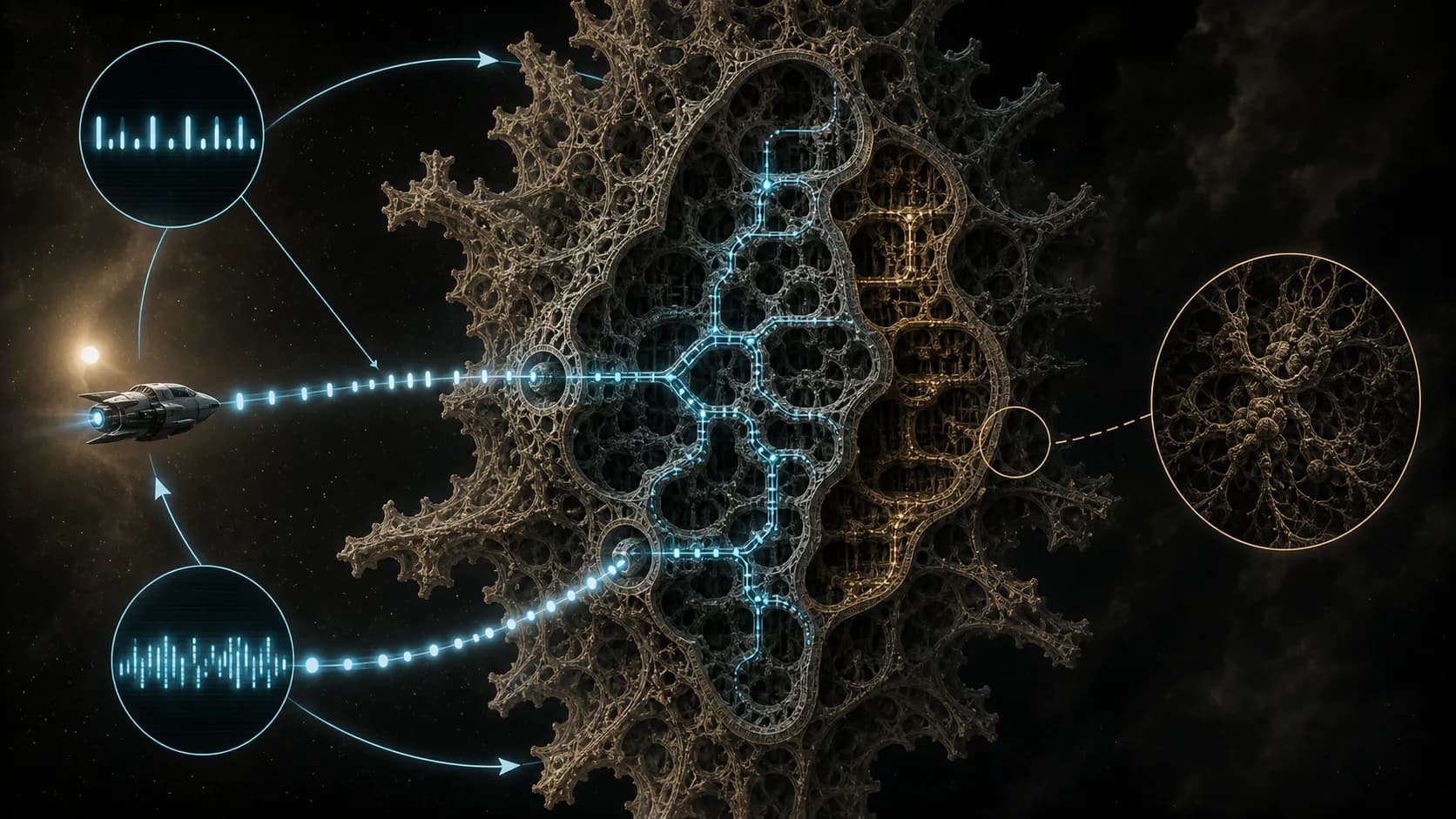
A reply can be fluent without sharing meaning
The blue loop accepts a signal, routes it through learned rules, and returns a polished response; the amber region of reference and experience never joins that loop.
What to notice
- 01
Extraterrestrial artifact near Big Ben
Rorschach
A vast active structure answers signals, reshapes itself, and forces the crew to distinguish communication from comprehension.
In the image: The artifact transforms incoming patterns through a vast internal structure.
- 02
Speculative concept
Cross-species communication
Grammatical fluency becomes evidence of pattern matching without proving shared reference, intention, or experience.
In the image: Repeated exchange creates fluency before it establishes shared reference.
- 03
Plot trajectory
The artifact answers without proving understanding
The crew exchanges increasingly sophisticated language with Rorschach while tests suggest that its responses may be generated without shared meaning.
In the image: The crew tests whether the words connect to anything the sender understands.
Charybdis · complete spoilers
The chain of command becomes part of the result
- 1
The instrument breaks
Sarasti forces Siri into a new way of seeing
Siri is subjected to brutal manipulation intended to make his conscious model catch up with information his body has already registered.
What changes: The violence reveals that Sarasti has treated the crew's minds—including Siri's—as experimental equipment rather than consenting partners.
- 2
Authority is exposed
The Captain stood behind the commander
The crew learns that even Sarasti was an interface for the intelligence governing Theseus.
What changes: Human, vampire, and machine no longer form a clean hierarchy; each becomes a processing layer inside the mission's final decision.
- 3
A witness escapes
Theseus destroys Rorschach while Siri carries the account home
Siri survives with no community left to receive or correct his interpretation, yet he keeps transmitting it.
What changes: The novel's last hope is not that consciousness wins, but that awareness can turn events into testimony before Earth becomes something else.
03 · Ideas and visuals
Three distinctions make the difficult parts readable
The terminology is dense, but the core mechanisms are concrete: successful behavior is not proof of experience, fluent language is not proof of meaning, and an observer can be part of the system being observed.
Ideas explained
Ideas to carry into the story
Carry these questions into the mission rather than trying to decode every technical noun on first appearance.
Idea 1
Consciousness and intelligence
Intelligence is the capacity to model, adapt, and solve. Consciousness is felt experience: there is something it is like to be the system doing the work. We can observe the first far more directly than the second.
In this story: Siri, the ship, Rorschach, and the scramblers provide different combinations of competence, self-report, and apparent inner life.
What does awareness add to each decision—and what does it slow down?
Read the plain-language concept articleIdea 2
First contact
Contact begins when one side's behavior changes the other, even if they never establish mutual recognition or a trustworthy conversation.
In this story: The Fireflies, the destroyed listening post, and Rorschach each create consequential contact without confirming a shared social encounter.
At what point does evidence of design become evidence of someone?
Read the plain-language concept articleIdea 3
Posthuman identity
A person can remain biologically human while surgery, implants, genetic reconstruction, or partitioned cognition change which capacities count as the self.
In this story: The crew's modifications make each member exceptionally capable while complicating consent, intimacy, and command.
Is specialization expanding these people or turning them into components?
Read the plain-language concept articleCommunication test
Syntax can travel farther than meaning
A system can study which symbols tend to follow other symbols and produce a convincing continuation. That proves sensitivity to structure. It does not by itself prove that any symbol refers to an object, memory, intention, or feeling for the sender.
Rorschach makes this gap operationally dangerous. If the crew mistakes pattern completion for a social partner, it may trust a performance. If it assumes no experience exists, it may turn an encounter into an attack without recognizing a subject.
Illustrated explanation
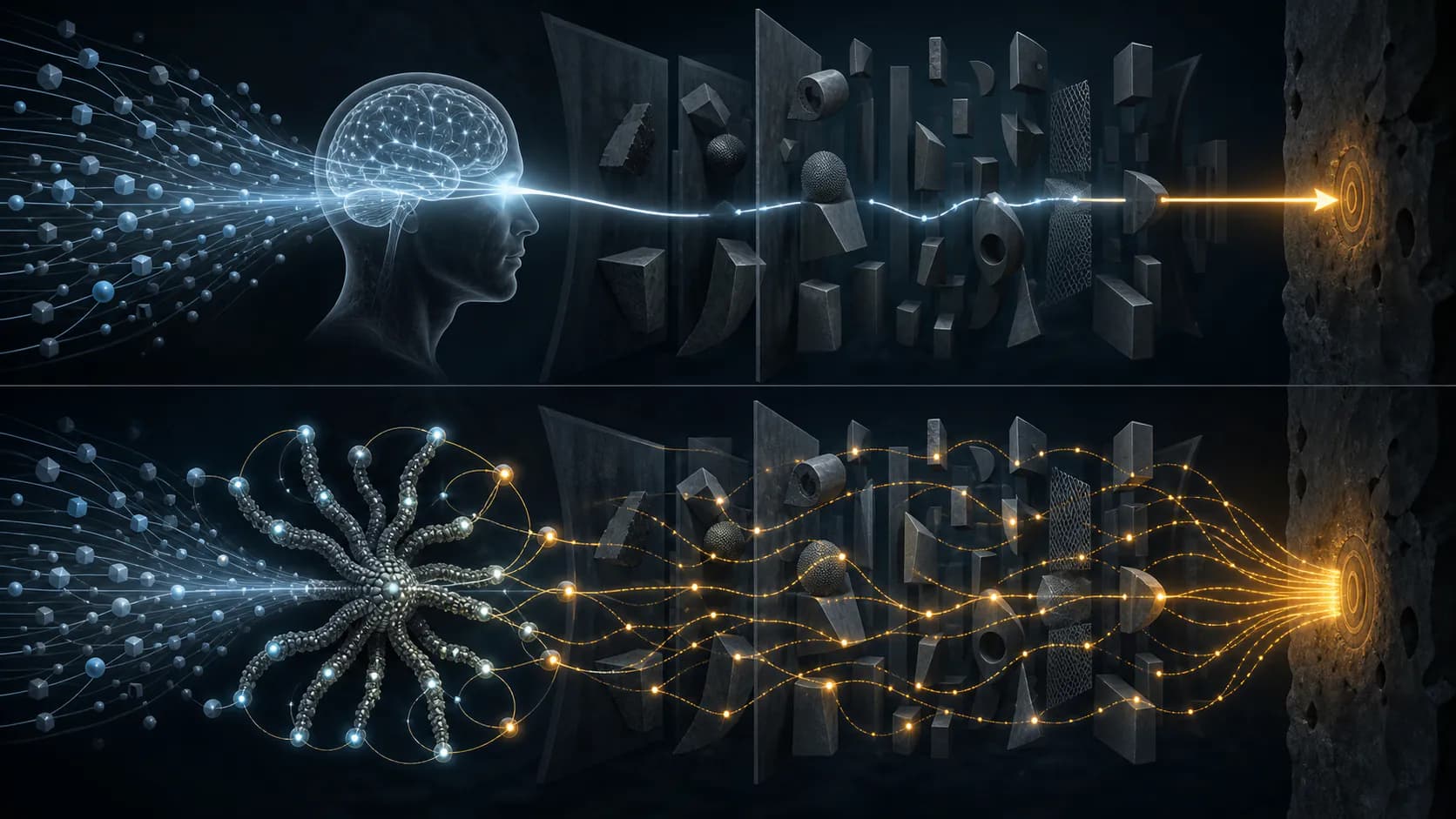
When awareness becomes the slower route
The upper path compresses perception through one serial focus before acting; the lower system distributes sensing and response across many loops at once.
What to notice
- 01
Primary concept
Consciousness and intelligence
The novel separates adaptive competence from felt experience, then asks whether awareness improves survival or merely narrates work already done elsewhere.
In the image: Awareness integrates a story of the problem but limits how much enters focus at once.
- 02
Inhabitants of Rorschach
Scramblers
Radially organized organisms display extraordinary adaptive performance under conditions that overwhelm conscious human processing.
In the image: The radially organized system coordinates many local responses without one visible center.
- 03
Plot trajectory
A captive system solves without deliberating
Study of the captured inhabitants reveals densely parallel behavior that challenges the crew's assumption that flexible intelligence requires awareness.
In the image: Experiment reveals flexible problem solving across parallel pathways.
Optional detailWhy the scrambler comparison mattersA full-spoiler look at the mechanism rather than the creature design.
The scramblers distribute perception and action across many fast loops. Conscious humans compress competing inputs through a narrow focus, then build a narrative that makes the choice feel unified and owned. The illustration does not declare one architecture universally superior. It shows why the mission's particular environment rewards parallel response and punishes a slow central witness.
04 · Reading guide
Use roles and section gates instead of memorizing every term
The three sections already provide the most reliable checkpoints. Keep the human question beside the machinery: what can this person perceive, what do they need, and who is using that capacity?
The contact team
Siri Keeton
Synthesist and narrator
Siri observes specialists and translates their work into a model others can use, even when emotional participation remains difficult for him.
Jukka Sarasti
Vampire mission commander
Sarasti uses predatory perception and unsettling authority to direct a crew whose reactions are part of the evidence he studies.
Susan James
Linguist and plural mind
Susan and the other personalities sharing her body analyze language as a coordinated team of distinct cognitive specialists.
Isaac Szpindel
Biologist and sensor specialist
Extensive neural interfaces let Szpindel examine environments and organisms through senses far beyond an unmodified human range.
Amanda Bates
Military specialist
Bates supplies tactical judgment, remote combat systems, and a disciplined concern for threats the scientific mission may provoke.
Ship and encountered systems
Theseus
Machine-governed exploration vessel
Theseus carries, wakes, equips, and directs its specialist crew while keeping much of its own authority outside their view.
Rorschach
Extraterrestrial artifact near Big Ben
A vast active structure answers signals, reshapes itself, and forces the crew to distinguish communication from comprehension.
Scramblers
Inhabitants of Rorschach
Radially organized organisms display extraordinary adaptive performance under conditions that overwhelm conscious human processing.
Reader lens · after Theseus
Separate the observer from the authority
Siri reports what the group is doing, but he does not command it. Sarasti appears to command, but the ship supplies the mission's timing, movement, and information environment. Notice which decisions each layer can explain and which it merely executes.
Reader lens · after Rorschach
Ask what each test actually establishes
A fluent reply establishes pattern sensitivity. Navigation establishes environmental modeling. Deception establishes a model of another system's likely response. None automatically establishes felt experience, and the absence of proof is not proof of absence.
Progress-safe room
Safe through Section 1 · Theseus
Progress-safe room
Safe through Section 2 · Rorschach
05 · Ending explained
Why the detached observer becomes the story's remaining moral instrument
The mission's outcome turns Siri's limits as an observer into the reason his testimony still matters.
The ending mechanism
The mission wins an encounter and loses control of its conclusion
Theseus commits itself and its antimatter to Rorschach. The strike destroys both systems, leaving Siri on a long return trajectory with a narrow channel home. His report is necessarily incomplete: the specialists who generated the evidence are dead, and the ship that designed the final experiment cannot explain itself.
Signals from Earth suggest that resurrected vampires are escaping constraint as human institutions change or fail. Siri may be transmitting toward a civilization in which the conscious, socially familiar version of humanity is no longer dominant. The warning therefore travels in two directions: outward from the alien encounter and backward toward the species that sent him.
- Rorschach
- A responsive system whose intelligence does not yield decisive evidence of subjective experience.
- The scramblers
- A concrete model of fast, flexible cognition distributed outside one conscious bottleneck.
- The Captain
- Proof that the human chain of command was nested inside a machine decision system.
- Siri's report
- An uncertain reconstruction that preserves meaning precisely because bare survival cannot.
Keep exploring
Follow the idea beyond this ending
The Idea Atlas connects this novel’s central question to the science, philosophy, and other stories that approach it differently.
Open the connected ideaContinue through the catalog
Find another world on the same axis
What else the encounter reveals
The novel is not only asking whether consciousness is useful
Rorschach supplies the terrifying comparison, but the story also asks what happens to trust, responsibility, and human connection when every mind becomes a specialized instrument.
Use these four lenses after the main plot is clear. They connect the biological arguments to the crew's damaged ways of living with one another.
Siri as narrator
Can a person who doubts his own empathy still bear moral witness?
Siri translates experts by watching them from a distance, and the narration repeatedly warns that his models may omit the inner life he cannot easily perceive. That limitation makes the report uncertain, but it also makes him unusually alert to the difference between behavior and experience.
Why this matters: The book's final witness matters because he admits the gap between a useful model and another being's interior life.
The crew as a system
Why is everyone so radically specialized?
Each crew member extends one capability while surrendering ordinary integration: strategy, language, pattern recognition, biology, or social interpretation. Their collective power resembles a distributed intelligence assembled by mission design rather than friendship.
Why this matters: Humanity confronts Rorschach with its own partial move beyond the unified, ordinary self.
Communication without meeting
What if fluent language is only environmental mimicry?
Rorschach responds with patterns that draw human interpretation without establishing a shared speaker, world, or intention. The crew's need to find meaning may reveal as much about human social cognition as about the alien system.
Why this matters: First contact becomes a test of when evidence justifies treating a response as communication rather than sophisticated reaction.
Vampire power
Why does the human future feel dangerous before the aliens arrive?
Sarasti is both commander and reconstructed predator, kept useful by technical control. The signals from Earth suggest that institutions may lose control of the capability they revived.
Why this matters: The story's threat is evolutionary and political as well as alien: optimization can displace the vulnerable minds that created it.
Coordinates on a neighboring axis
Novel guide
Echopraxia
Echopraxia
Peter Watts
An unmodified biologist is forced aboard a mission with hive minds, soldiers who switch off awareness, and a vampire whose plans intersect an alien intelligence.
Novel guide
Project Hail Mary
Project Hail Mary
Andy Weir
A scientist wakes alone on a starship with two dead crewmates, no memory, and one impossible assignment: learn why a distant star is surviving the same disaster killing the Sun.
Novel guide
The Three-Body Problem
The Three-Body Problem
Cixin Liu
The universe starts counting down inside a scientist’s eyes. To learn why, he must enter a world with three suns—and follow a signal humanity may regret sending.
Content notes
Violence and death · Childhood brain surgery and medical trauma · Body horror · Sexualized violence and assault · Psychological manipulation · Predation and blood
Editorial record
Research and sources
The story analysis is original. Background sources support the scientific and philosophical explainers connected to this novel.
Last reviewed July 22, 2026