The idea in plain English
Plain idea
What changes
Information asymmetry exists when one side in a decision knows something important that the other side cannot easily observe or verify.
Mechanism
How it operates
Hidden capability, risk, intention, or quality changes incentives. The informed side can select what to reveal, while the uninformed side relies on signals, reputation, contracts, surveillance, or worst-case assumptions.
Human stakes
Why it matters
Secrecy can protect a vulnerable plan and also prevent consent or accountability. People may make rational choices from their own evidence while the overall system produces mistrust, manipulation, or catastrophe.
Used in: 19 catalog novels
Related: Strategic deterrence · Scientific blockade · Emergency governance
A few terms make the rest of the explanation easier to follow.
- Private information
- Relevant knowledge held by one participant that other participants cannot directly observe or verify.
- Adverse selection
- A pattern in which hidden quality or risk causes worse options to become disproportionately common in an exchange.
- Signal
- An observable and sometimes costly action intended to convey otherwise hidden information.
- Screening
- A choice or test designed by the less-informed side to make different hidden types reveal themselves.
Use the idea while reading
Turn the definition into three observations
Do not begin by asking whether a novel is “about” information asymmetry. Begin with what changes in the lives of its characters, then use the concept to explain the mechanism underneath that change.
- 01
Notice which fact, intention, or capability is unevenly distributed.
- 02
Notice how each side signals reliability without revealing everything.
- 03
Notice who can audit a claim and what happens if verification comes too late.
Keep one question open: Does secrecy protect the plan or protect the decision-maker?
Avoid the shortcut: Asymmetry does not mean one side knows everything and the other knows nothing. A small hidden fact can reshape a decision when it concerns motive, danger, or capability.
How it works, step by step
- 1
Locate the hidden variable
Quality, risk, capability, intention, effort, or failure probability matters to a decision but is distributed unevenly between participants.
- 2
Observe changed incentives
The informed side may conceal, exaggerate, or selectively disclose, while the less-informed side prices uncertainty or assumes a dangerous worst case.
- 3
Use signals, screening, or audits
Participants create warranties, tests, costly commitments, contracts, independent inspection, or surveillance to make claims more credible.
- 4
Account for strategic response
Once a test or signal becomes known, actors adapt to it, so a reliable institution must monitor whether the evidence still distinguishes what it claims.
A concrete example
A mission director hides a failure risk
A director knows a spacecraft has a ten-percent launch failure risk, while the crew knows about an unapproved repair that could delay departure.
01
The director understates risk to preserve the schedule; the crew hides the repair because disclosure may remove them from the mission.
02
Both choices can look individually rational while preventing an informed decision about launch, consent, and responsibility.
03
Independent inspection and protected reporting could reveal the facts, but only if neither side can punish truthful disclosure into silence.
The point
Information asymmetry changes behavior before anyone lies. Trustworthy decisions require mechanisms that reveal relevant knowledge and protect the people who surface it.
What is real, and what remains uncertain
First separate what we can observe or build today from what remains a prediction or a fictional extension.
What evidence supports it
Established economic and strategic concept
Unequal information shapes markets, medicine, politics, security, and everyday relationships. Science fiction expands its scale and technological reach.
A common misunderstanding
Asymmetry does not mean one side knows everything and the other knows nothing. A small hidden fact can reshape a decision when it concerns motive, danger, or capability.
Try this example in your head
A mission director knows a spacecraft has a ten-percent failure risk but tells the crew only that launch is necessary. The crew knows a repair is possible but hides it to avoid reassignment.
No participant knows everything
Asymmetry usually concerns a particular fact rather than one omniscient side, and each participant may hold different private information.
More disclosure can create danger
Transparency may expose privacy, security, or strategic vulnerabilities, so the goal is accountable access rather than publication of every fact.
How science fiction tests the idea
Stories usually test both the promise of an idea and the trouble it creates.
Its promise
Private knowledge can protect a plan from surveillance and interference.
Its problem
Secrecy can make public oversight impossible and concentrate dangerous power.
What to notice in a story
- 01
Which fact, intention, or capability is unevenly distributed
- 02
How each side signals reliability without revealing everything
- 03
Who can audit a claim and what happens if verification comes too late
Novels that use this idea
Societal scale
Dark · Accessible
1984
A records clerk who rewrites the past begins a private rebellion and learns that the Party wants more than obedience: it wants control over what reality can mean.
Societal scale
Cautious · Layered
A Memory Called Empire
Mahit's outdated imago, inaccessible mail, unfamiliar protocols, hidden station orders, civic surveillance, and competing succession plans make political survival depend on who can interpret which channel.
Societal scale
Dark · Demanding
Altered Carbon
A stored soldier is transmitted into a stranger's body to investigate a rich man's death in a society where immortality is real only for people who can afford its infrastructure.

Civilization scale
Cautious · Demanding
Ancillary Justice
Compartmentalized memories and contradictory command access let different parts of one imperial system act from incompatible accounts of the same events.
Visual example · A distributed ruler can become a civil war
Cosmic scale
Dark · Demanding
Blindsight
The crew, its commander, the ship, and the alien artifact each act on models that the others cannot fully audit, making secrecy part of the experimental design.
Civilization scale
Balanced · Layered
Caliban's War
A vanished child, a Martian marine's impossible battlefield report, and a political struggle on Earth pull the Rocinante toward another protomolecule crisis.
Cosmic scale
Hopeful · Layered
Contact
Governments, scientists, religious leaders, and private industry receive different portions of the Message and pursue different consequences before anyone knows the sender's intent.
Civilization scale
Dark · Demanding
Dune
Training, secret plans, ecological knowledge, and prescient glimpses give different actors radically unequal maps of the same apparent contest.
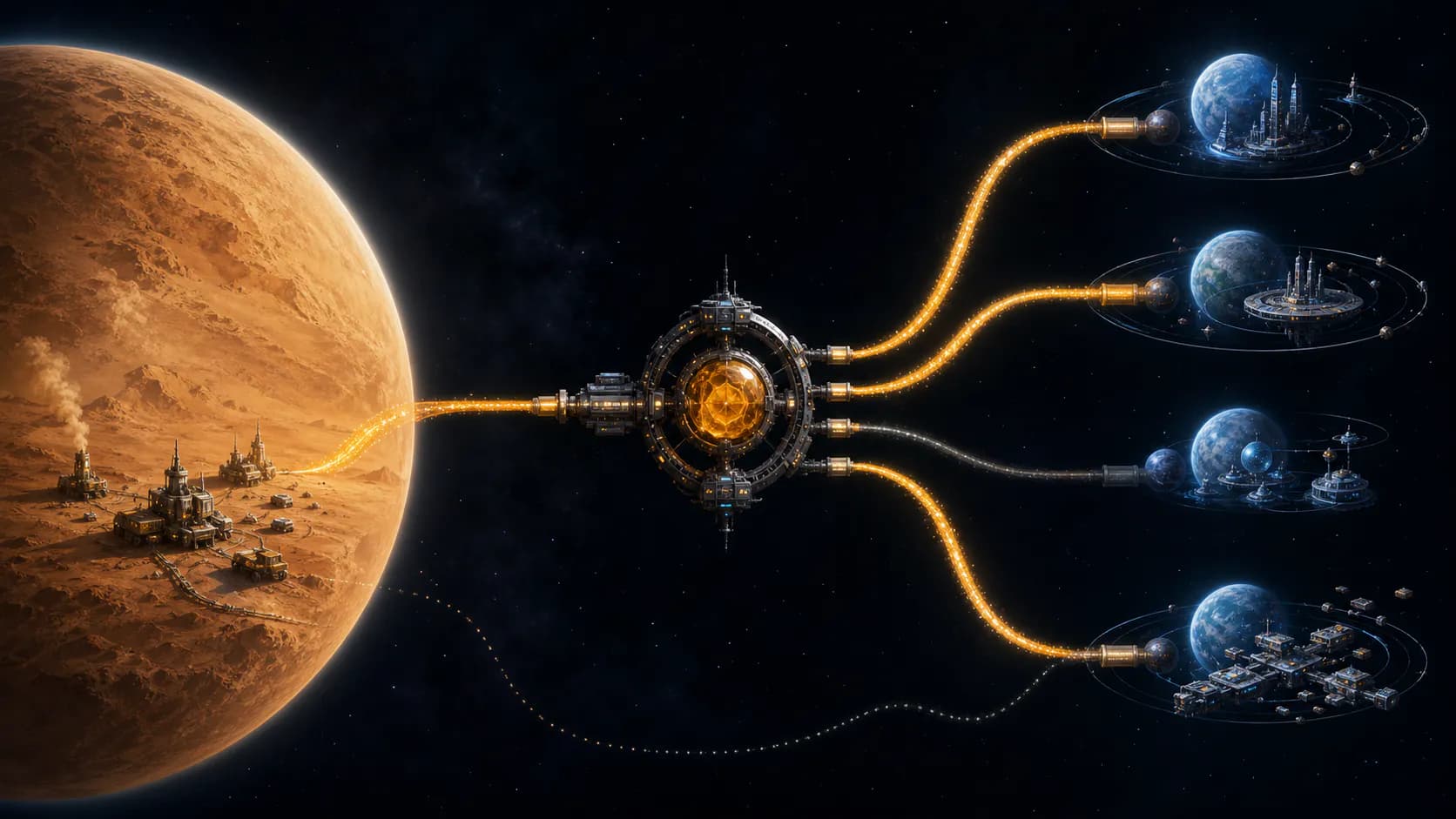
Visual example · One planet is the empire's supply chokepoint
Civilization scale
Dark · Accessible
Ender's Game
A six-year-old boy is sent to an orbital war school because adults believe he can save Earth. Every apparent game teaches him to win while hiding what his victories really cost.
Civilization scale
Dark · Layered
Foundation and Empire
The Seldon Plan survives the Empire's greatest general, then fails in front of a conqueror who can change the emotions that mass prediction assumes will average out.
Civilization scale
Dark · Layered
Nemesis Games
With the Rocinante crew scattered across the solar system, four private journeys expose a coordinated attack designed to break the old political order.
Societal scale
Dark · Demanding
Neuromancer
A burned-out data thief gets his nervous system repaired for one final run, only to discover that the employer directing the heist is an artificial mind seeking merger.
Civilization scale
Cautious · Demanding
Second Foundation
Two searches hunt the hidden guardians of the Seldon Plan, only to discover that every apparent victory may be the belief those guardians needed their pursuers to hold.
Civilization scale
Hopeful · Demanding
The Arrows of Time
Information arriving from a possible future grants extraordinary leverage to those who authenticate, schedule, or suppress it while everyone else must act under unequal certainty.
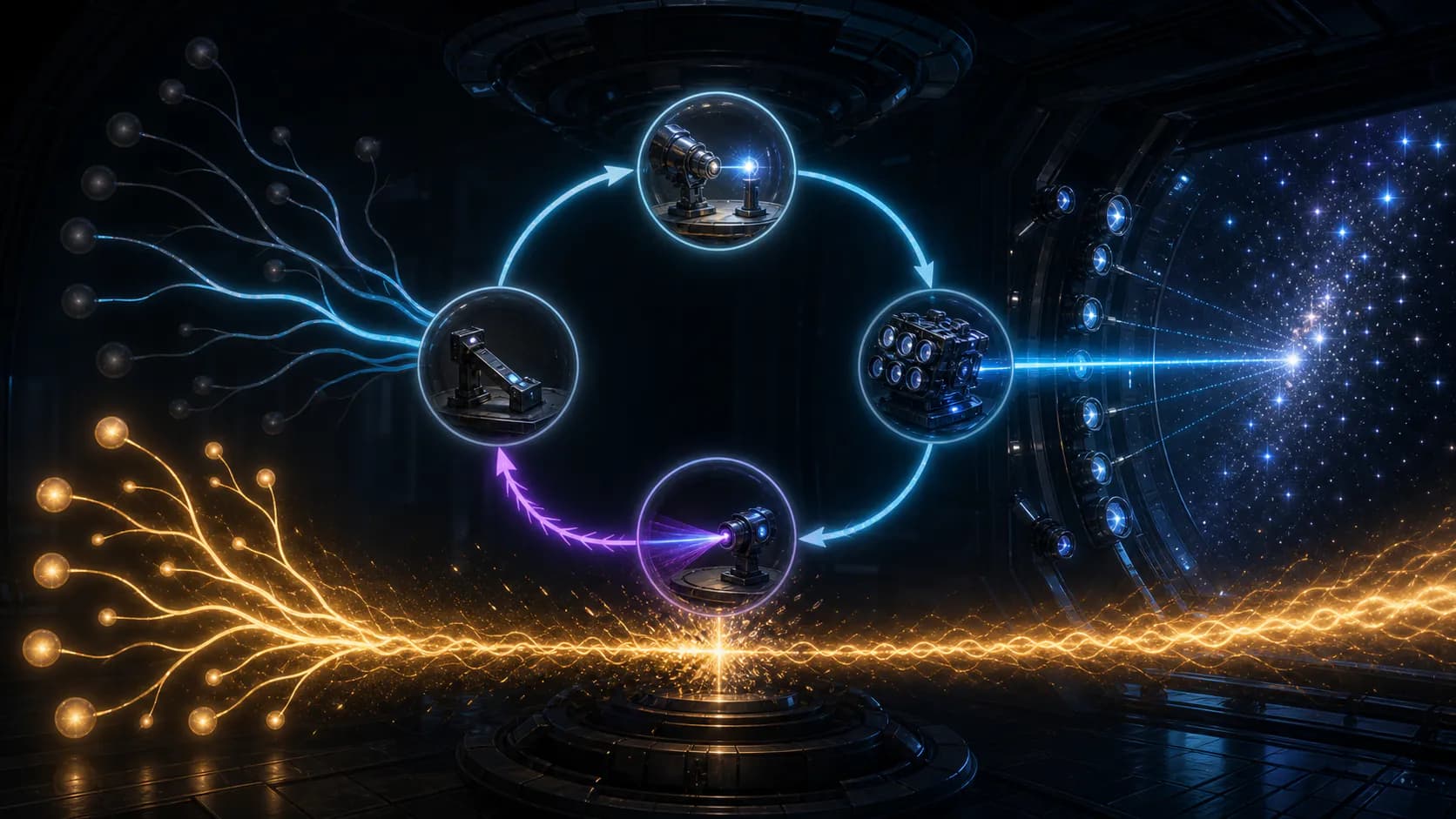
Visual example · A shortcut to future answers can close the present
Cosmic scale
Dark · Demanding
The Dark Forest
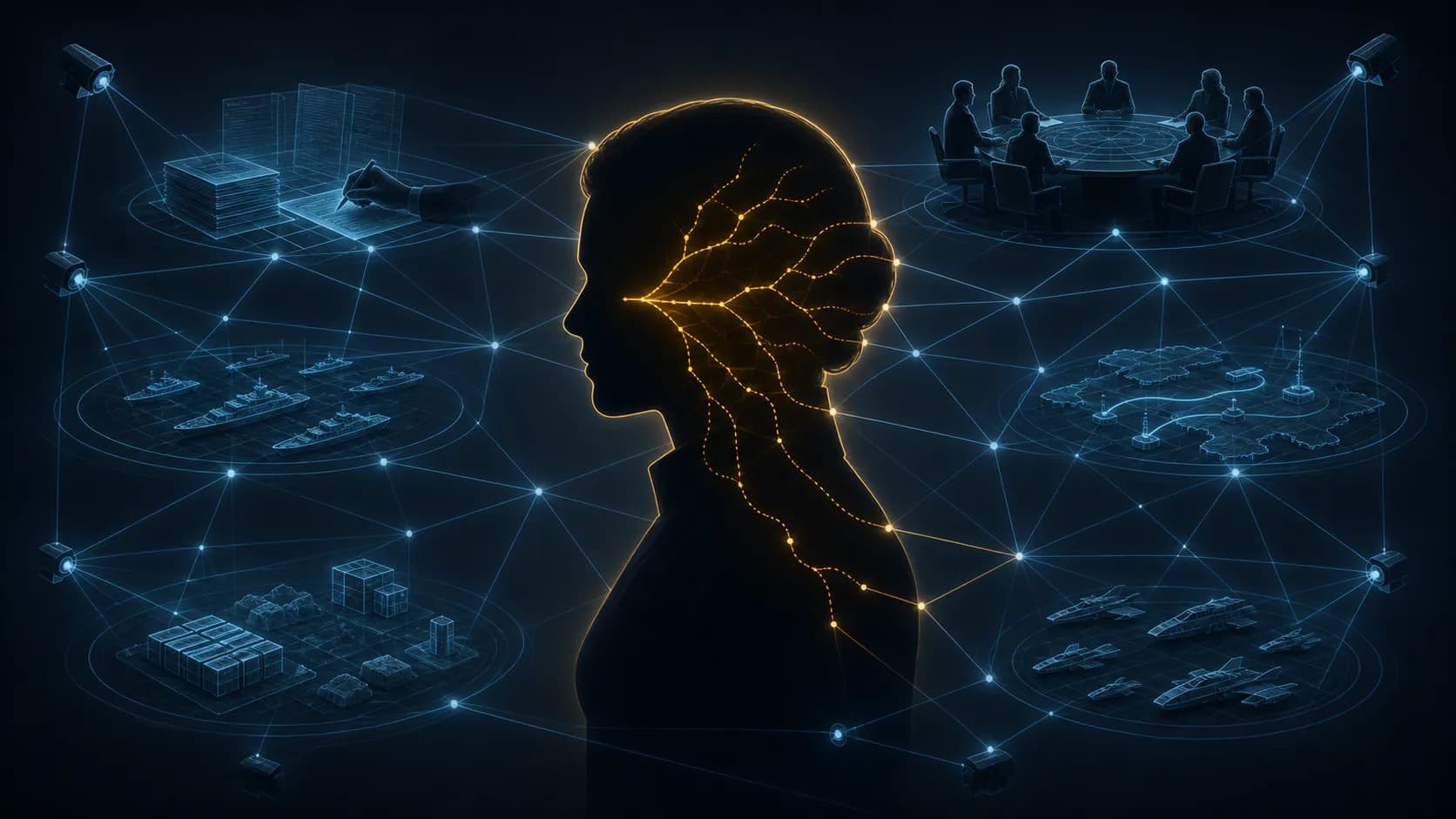
Private human thought creates the narrow information gap on which Wallfacer strategy depends.
Visual example · The one blind spot in a watched world
Societal scale
Balanced · Demanding
The Dispossessed
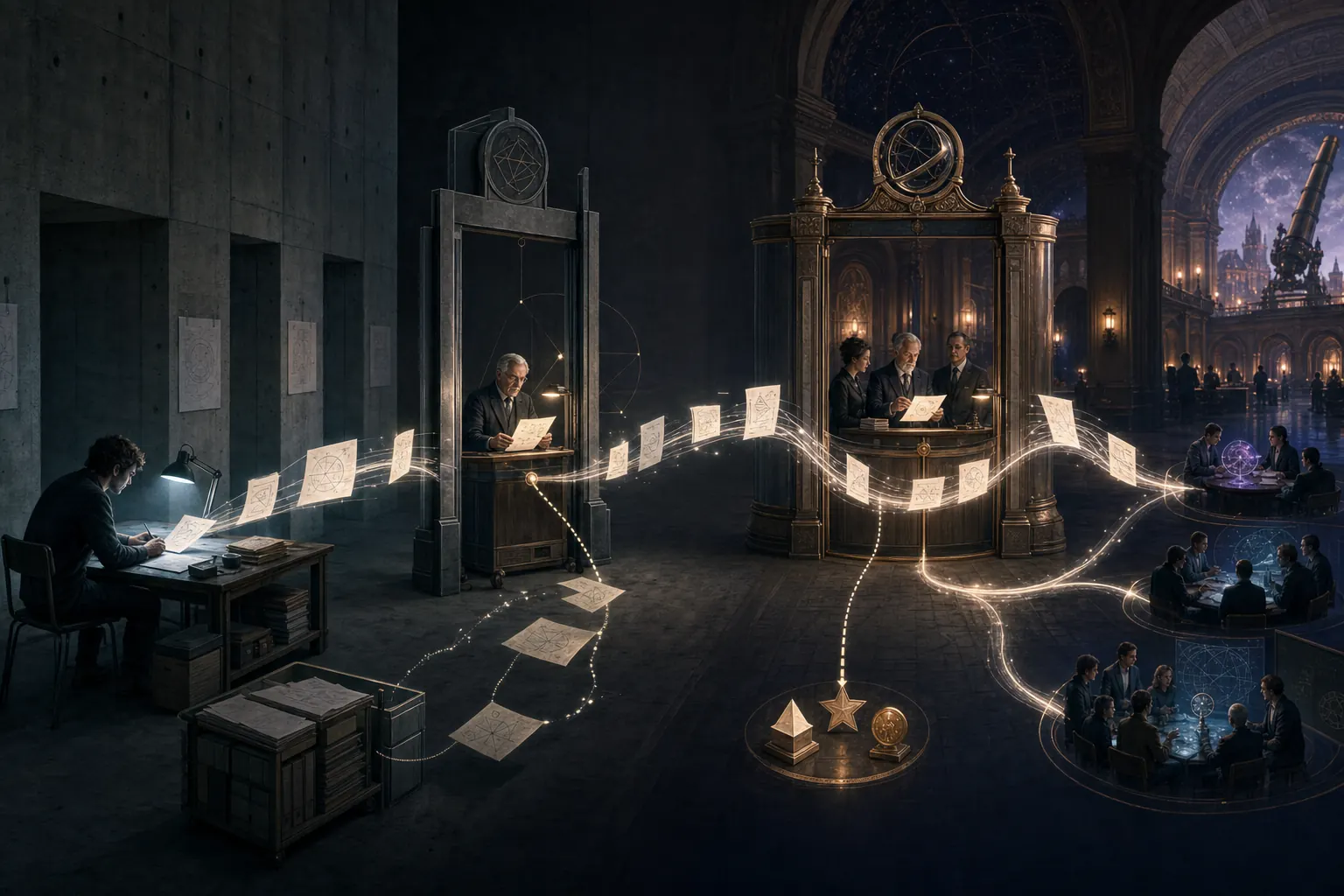
Physicists, coordinators, governments, and diplomats gain leverage by deciding which papers, institutions, motives, and audiences Shevek is allowed to see.
Visual example · A free idea still needs institutional passage
Cosmic scale
Cautious · Demanding
The Fall of Hyperion
As war reaches Hyperion, a new Keats cybrid dreams the pilgrims' fates and helps expose that humanity's instant-travel network is also the TechnoCore's hidden body.
Civilization scale
Dark · Demanding
There Is No Antimemetics Division
Researchers fight ideas that erase their own traces from memory, leaving marriages, institutions, and an entire war dependent on evidence nobody can remember creating.
Cosmic scale
Cautious · Demanding
Tiamat's Wrath
With Holden imprisoned and the Rocinante crew dispersed, a hidden resistance confronts Laconia while experiments awaken the force that destroyed the gate builders.
Questions to keep thinking about
Does secrecy protect the plan or protect the decision-maker?
What choice would the less-informed side make with full knowledge?
Can trust be designed when disclosure itself creates danger?
Sources and further reading
These references ground the portable lesson; story interpretations remain editorial analysis.