Novel guide
The Dark Forest
Cixin Liu

Story and ideas · Remembrance of Earth’s Past · Volume 2
The Dark Forest
by Cixin Liu
Tor trade paperback · translated by Joel Martinsen · 2016 · Publisher details · Cover via Open Library
Humanity can prepare for an invasion everyone can see, but its only secure hiding place may be a single private mind.
Full-story article
This article discusses the complete story, including the ending.
- Reading time
- About 14 hours
- Length
- 528 pages
- Reading complexity
- Demanding
- Dense terminology, structure, or viewpoint changes reward slower, attentive reading.
- Science intensity
- 5/5
- Scientific mechanisms are central to understanding the story.
Affiliate links. As an Amazon Associate, we earn from qualifying purchases.
Watch the story
Watch on Scifi Orthogonal
Video guides from our YouTube channel. These discuss the full story and may reveal the ending.
Before you read
Is this book for you?
Start by tracking: Track who knows what, what each plan makes an observer believe, and how every strategy transfers risk to someone else.
Read this if you enjoy
- Strategic science fiction across centuries
- Civilizations acting under radical uncertainty
- The political cost of deterrence and secrecy
Why readers may get lost
- It begins as volume two of an ongoing trilogy
- Plans are intentionally obscured from allies and readers
- Large time jumps repeatedly replace the social world
Keep these anchors in mind
- Luo Ji
- begins outside strategy and becomes its central uncertainty
- The Wallfacers
- hide purpose inside private thought
- The sophons
- make public preparation visible to Trisolaris
- Zhang Beihai
- turns long-term belief into irreversible action
- Dark forest deterrence
- converts exposure into leverage
Demanding reading complexity. Dense terminology, structure, or viewpoint changes reward slower, attentive reading.
Science intensity 5/5. Scientific mechanisms are central to understanding the story.
The strategic problem
A war fought inside the one place surveillance cannot reach
Trisolaris can watch Earth's external activity through the sophons, but it cannot directly inspect a private human intention. The novel builds its defense strategy around that narrow gap, then asks what secrecy does to the people and institutions forced to depend on it.
Where the strategy begins
Everyone can see the invasion coming
The Trisolaran fleet is still centuries away, yet sophons can report almost everything humanity does. Governments therefore face an unusual war: the deadline is far beyond any present lifetime, but the enemy can watch nearly every preparation.
The exception is private thought. The Wallfacer Project gives four people extraordinary authority and asks them to design plans whose true purpose remains inside their minds. Luo Ji, an unambitious sociologist, is selected without being told why—and immediately becomes the target of assassination.
The central question
Can a secret remain a strategy when the whole world knows you are hiding one?
The novel turns surveillance into a problem of trust. Every public action may be a feint, every apparent failure may be intentional, and every private relationship may be caught inside planetary planning.
- The reading promise
- A centuries-long strategic thriller about secrecy, survival, and belief
- What to track
- Who knows what, what each plan makes others believe, and who pays its cost
- The human anchor
- Luo Ji and Zhang Beihai choose radically different ways to carry the future
- The question underneath
- Can fear create peace without becoming a permanent form of violence?
Series flight path
Remembrance of Earth’s Past
This is volume two of the canonical trilogy. It transforms the first book’s discovery into a long strategic contest, while Death’s End follows the civilization built under that contest’s consequences.
Volume 1
The Three-Body ProblemDemanding
Volume 2 · You are here
The Dark ForestDemanding
Volume 3
Death’s EndDemanding
02 · Story map
Nine turns from watched plans to cosmic leverage
Read each turn as cause and consequence: a hidden plan creates evidence, and that evidence changes the next strategy.
The story, in human terms
The opening position
Humanity has time, but not privacy. Two choices establish the book’s central contrast.
- 1
A watched planet
Preparation becomes performance
The approaching fleet will take roughly four centuries to arrive, while sophons observe meetings, laboratories, and machines in real time.
What changes: Earth must build for people not yet born and hide intentions without hiding activity.
- 2
An unwanted strategist
Luo Ji is made a Wallfacer
Three leaders accept the project as a recognizable military command. Luo Ji wants neither the office nor the burden and cannot explain why the enemy fears him.
What changes: His refusal itself becomes strategically ambiguous, and his private life becomes public infrastructure.
Illustrated explanation
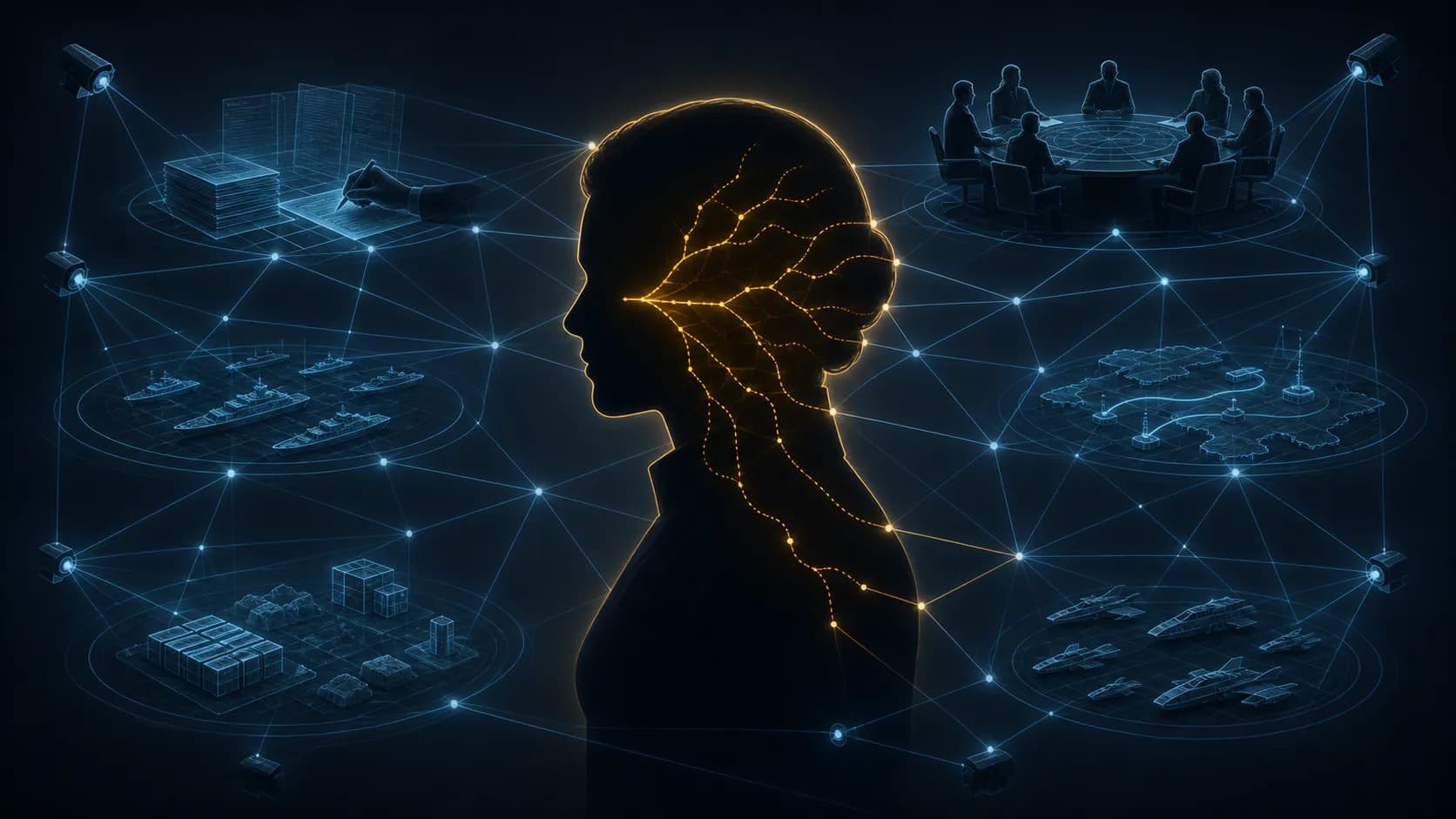
The one blind spot in a watched world
Sophons observe actions and resources; the Wallfacer Project tries to preserve purpose inside private thought.
What to notice
- 01
Trisolaran surveillance network
Sophon
Sophons make public preparation transparent while leaving unspoken thought outside direct observation.
In the image: Observation surrounds every public action.
- 02
Reluctant Wallfacer and cosmic sociologist
Luo Ji
He must discover why Trisolaris fears him and turn an abstract principle into credible leverage.
In the image: Unspoken intention remains opaque.
- 03
Primary concept
Information asymmetry
Private human thought creates the narrow information gap on which Wallfacer strategy depends.
In the image: Plans branch outward, leaving clues but not certainty.
Mid-book context
Plans hidden inside plans
- 1
Counter-reading
Wallbreakers expose the visible plans
Human collaborators study each Wallfacer’s psychology and resources until a concealed objective can be stated aloud.
What changes: Secrecy proves fragile when institutions, habits, and moral limits leave patterns an observer can read.
- 2
A life under authority
Luo Ji tries to withdraw into happiness
His protected domestic life with Zhuang Yan feels private, but it exists because the project can mobilize people as well as machines.
What changes: Love, coercion, and strategy become inseparable when the state can turn intimacy into motivation.
- 3
A different long game
Zhang Beihai prepares the people who will inherit the war
He treats confidence, fleet culture, and political reliability as technologies that must survive hibernation and generational change.
What changes: The survival problem shifts from building ships to shaping who will command them centuries later.
Complete trajectory
Confidence breaks, then becomes a weapon
- 1
The future
Prosperity mistakes power for safety
Luo Ji wakes in a transformed age whose fleet and cities make the old crisis feel nearly solved.
What changes: Civilizational optimism concentrates nearly every ship into one ceremonial encounter.
- 2
The probe
The droplet destroys the fleet
A single object crosses the formation with effortless speed and strength, turning a triumphal reception into catastrophe.
What changes: Humanity learns that visible technological scale is not the same as strategic parity.
- 3
Deep space
The surviving ships enter a dark forest of their own
Separated from Earth and unable to support everyone indefinitely, crews must decide whether cooperation can survive scarcity and uncertainty.
What changes: The cosmic theory becomes immediate human conduct in the Battle of Darkness.
- 4
The spell
A destroyed star validates Luo Ji’s idea
Coordinates he once broadcast as an experiment correspond to a star later eliminated by an unknown civilization.
What changes: A philosophical suspicion becomes evidence that exposure itself can be fatal.
- 5
The standoff
Luo Ji makes Trisolaris share Earth’s risk
He links his death to a broadcast that would reveal both worlds, then faces the sophons alone with a threat they believe he will carry out.
What changes: The invasion pauses because uncertainty about one person’s resolve becomes credible deterrence.
03 · Ideas and visuals
Turn strategic machinery into three understandable models
Each image isolates a causal mechanism: hidden intent, a technological gap, and deterrence through shared exposure.
Ideas explained
Ideas to carry into the story
The science matters because it changes what people can know and what threats they can believe.
Idea 1
Information asymmetry
Sophons can observe actions but cannot directly read an unspoken human plan. The gap is narrow, yet the entire Wallfacer Project is built inside it.
In this story: Every resource request becomes a clue, so a Wallfacer must sometimes hide a plan even from the people carrying it out.
Can a democracy oversee a strategy whose purpose cannot be disclosed?
Read the plain-language concept articleIdea 2
Cosmic sociology
Civilizations may grow rapidly, while interstellar distance prevents timely conversation and certainty about intentions.
In this story: Luo Ji’s field asks how distance and limited information might shape contact. The answer remains one of the novel’s central mysteries.
Does expecting hostility protect a civilization—or teach it to become hostile?
Read the plain-language concept articleIdea 3
Strategic deterrence
A threat deters only when the opponent believes both the capability and the willingness to use it are real.
In this story: Luo Ji’s final leverage depends less on superior hardware than on Trisolaris’s estimate of his character.
What kind of peace is created by a credible promise of mutual death?
Read the plain-language concept articleIllustrated explanation
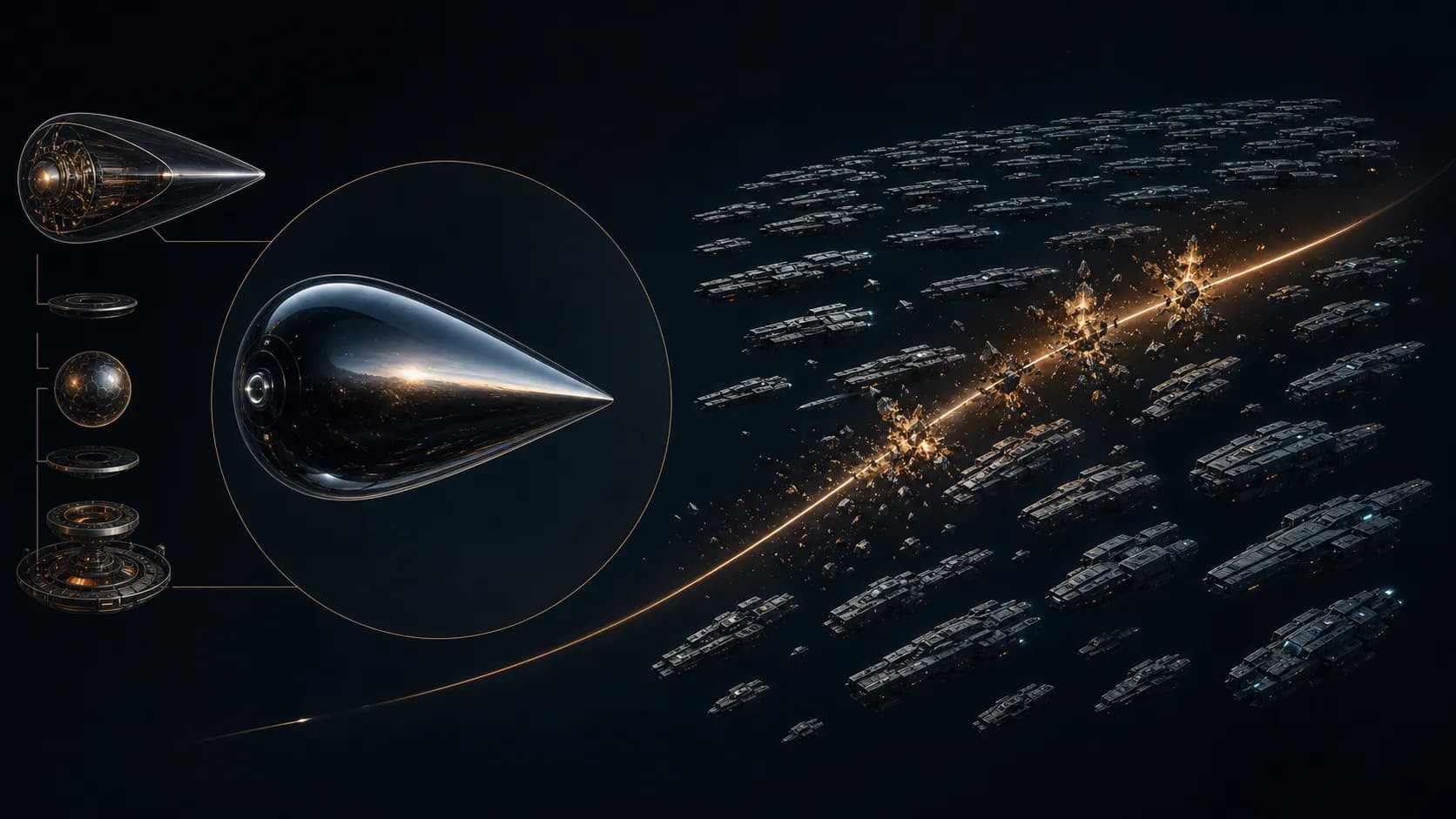
A tiny probe measures the technology gap
The encounter contrasts visible industrial scale with control of matter that the fleet cannot resist.
What to notice
- 01
Trisolaran probe and fleet-killing weapon
The droplet
Its strong-interaction material and maneuverability reveal the true scale of the technology gap.
In the image: Small size conceals strong-interaction material.
- 02
Plot trajectory
One probe ends an age of confidence
The droplet crosses the fleet formation and destroys nearly every ship with no effective resistance.
In the image: The path through formation becomes the lesson.
- 03
Speculative concept
Scientific blockade
The sophon lock preserves a material capability gap even while humanity develops impressive applied engineering.
In the image: Frozen fundamentals leave applied engineering behind.
Illustrated explanation
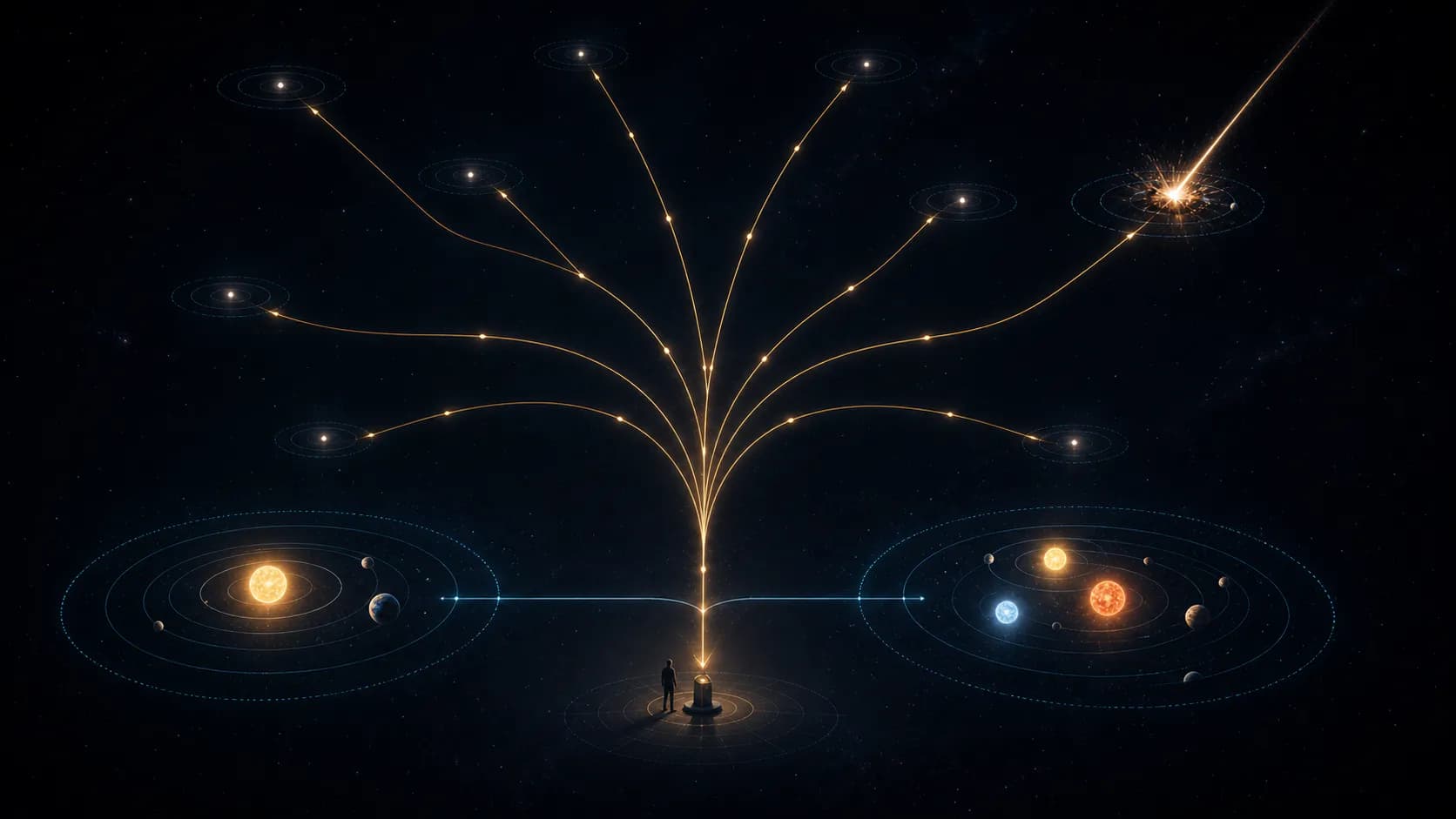
How shared exposure creates deterrence
A coordinate broadcast would place both nearby worlds at risk from unknown observers, making one threat bind two opponents.
What to notice
- 01
Reluctant Wallfacer and cosmic sociologist
Luo Ji
He must discover why Trisolaris fears him and turn an abstract principle into credible leverage.
In the image: Credibility depends on one person's resolve.
- 02
Primary concept
Strategic deterrence
Peace becomes possible when exposing one civilization would credibly bring unacceptable danger to both.
In the image: The trigger links survival outcomes.
- 03
Plot trajectory
A broadcast star is destroyed
The elimination of Luo Ji's test star provides evidence that exposed coordinates attract lethal attention.
In the image: A destroyed star demonstrates the danger of exposure.
Science made human
The droplet is a comparison, not just a weapon
Its destruction of the fleet measures the distance between appearance and capability. Humanity sees familiar size, smooth material, and a manageable trajectory; the encounter reveals unfamiliar control of matter. The scene collapses centuries of confidence into one empirical result.
04 · Reading guide
Know where you are, what matters, and what can wait
The novel crosses centuries and institutions. This guide follows its seven dated sections rather than inventing chapter numbers for a structure that readers do not experience that way.
People carrying the strategy
Luo Ji
Reluctant Wallfacer and cosmic sociologist
He must discover why Trisolaris fears him and turn an abstract principle into credible leverage.
Zhang Beihai
Long-horizon fleet strategist
He shapes personnel and institutions toward survival while concealing his judgment of Earth's prospects.
Zhuang Yan
Artist and center of Luo Ji's private life
Her relationship with Luo Ji is real yet created inside the coercive resources of a planetary strategy.
Ding Yi
Physicist at the probe encounter
He recognizes the droplet's impossible material properties just before its strategic purpose becomes clear.
Bill Hines
Wallfacer focused on belief and the brain
He treats confidence in victory as a strategic technology that might be installed in human minds.
Keiko Yamasuki
Neuroscientist and Wallbreaker
Her intimate knowledge of Hines's work lets her expose the hidden direction of his plan.
Institutions, ships, and weapons
Planetary Defense Council
Coordinator of Earth's long defense
It gives Wallfacers resources while trying to govern plans it is structurally unable to inspect.
Wallfacer Project
Defense built around hidden intent
Four individuals receive unusual authority because their thoughts cannot be directly observed by sophons.
The droplet
Trisolaran probe and fleet-killing weapon
Its strong-interaction material and maneuverability reveal the true scale of the technology gap.
Natural Selection
Vessel taken beyond Earth's command
Zhang Beihai uses it to begin an escape that tests whether independent human survival is possible.
Blue Space
Surviving deep-space human vessel
Its crew adapts to a strategic environment no longer governed by Earth's institutions.
Bronze Age
Surviving vessel that returns toward Earth
Its experience and reception expose the moral distance between planetary society and deep-space survival.
Reader lens · Year 8
Read the Wallfacers as theories of human motivation
Their hardware matters, but each plan also assumes something about fear, loyalty, sacrifice, and obedience. When a Wallbreaker explains a plan, ask which human assumption made its machinery legible.
Reader lens · Year 20
Hibernation moves responsibility without removing it
A decision-maker can leap over decades, but institutions and ordinary lives must inhabit the time skipped. Track who experiences the waiting, who inherits old authority, and which promises survive their makers.
Progress-safe room
Safe through Section 2 · Year 8
Progress-safe room
Safe through Section 5 · Year 205
05 · Ending explained
Why a conversation at a grave can stop an invasion
The final confrontation works because Luo Ji turns a theory into a threat that both civilizations can verify.
The mechanism
Luo Ji turns location into a hostage
The destruction of the test star shows that broadcasting precise coordinates can invite an unknown third civilization to eliminate the exposed system. Luo Ji arranges for a Solar System broadcast to activate if he dies. Because Earth and Trisolaris are close enough for one exposure to reveal the other, the threat binds their survival together.
His leverage works at the instant when Trisolaris believes he understands both the cosmic rule and the personal resolve to invoke it. The standoff is therefore technological, sociological, and intimate at once.
- Why the star mattered
- Its destruction supplies evidence that a location broadcast can become a death sentence.
- Why Earth is leverage
- The two home systems are close enough that revealing one endangers both.
- Why Luo Ji matters
- The opponent believes he understands the rule and will accept death rather than surrender.
- What peace begins
- A deterrence era founded on mutual exposure, not reconciliation or trust.
Keep exploring
Follow the idea beyond this ending
The Idea Atlas connects this novel’s central question to the science, philosophy, and other stories that approach it differently.
Open the connected ideaContinue through the catalog
Find another world on the same axis
The strategy beneath the spectacle
The novel turns loneliness into a theory of civilization
Fleets, hibernation, and weapons enlarge the stage, but the central movement is Luo Ji learning that private intention can carry public consequences when trust is impossible.
These lenses explain why the final deterrence is prepared by personal failures and institutional experiments long before the graveyard conversation.
Luo Ji's refusal
Why begin with someone who does not want responsibility?
The Wallfacer system gives Luo Ji extraordinary freedom because his inner plan cannot be observed. He uses that freedom evasively before recognizing that avoidance itself leaves other people carrying the risk.
Why this matters: His later credibility depends on a movement from protected detachment toward willingness to share the threatened fate.
The Wallfacer project
Can secrecy protect a society without hollowing out accountability?
Humanity needs plans the sophons cannot read, but citizens and institutions must support those plans without knowing their real purpose. The arrangement protects strategy while inviting waste, manipulation, and distrust.
Why this matters: Information asymmetry appears as both the only available defense and a danger to the society being defended.
The droplet
Why does technological confidence collapse so completely?
The future fleet looks powerful within the standards humanity used to build it. The droplet demonstrates a different command of matter and makes numerical superiority irrelevant in minutes.
Why this matters: The defeat exposes the danger of measuring an opponent only with categories produced by one's own development path.
Deterrence
Is the final peace a moral achievement?
Luo Ji prevents invasion by making destruction of both worlds a credible consequence. No friendship, shared law, or changed desire is required; only common recognition of unacceptable loss.
Why this matters: The ending offers stability while leaving readers inside its fear, fragility, and dependence on one person's resolve.
Coordinates on a neighboring axis
Novel guide
The Three-Body Problem
The Three-Body Problem
Cixin Liu
The universe starts counting down inside a scientist’s eyes. To learn why, he must enter a world with three suns—and follow a signal humanity may regret sending.
Novel guide
Death’s End
Death’s End
Cixin Liu
Across centuries of borrowed time, one aerospace engineer inherits decisions that ask whether compassion can protect a civilization—or expose it.
Novel guide
The Killing Star
The Killing Star
Charles Pellegrino and George Zebrowski
A near-light-speed attack erases human civilization before anyone can respond. The scattered survivors must learn why an unknown species wants every last witness gone.
Content notes
Political violence, suicide, and murder · Mass death and existential threat · Authoritarian emergency politics · Coercive institutional power
Editorial record
Research and sources
The story analysis is original. Background sources support the scientific and philosophical explainers connected to this novel.
Last reviewed July 22, 2026