
Novel guide
Dune
Frank Herbert
Story and ideas · Dune Chronicles · Volume 1
Dune
by Frank Herbert
Ace deluxe hardcover · 2019 · Publisher details
Paul Atreides arrives on a desert world knowing his family has entered a trap—and discovers that surviving it may turn him into the future he fears.
Full-story article
This article discusses the complete story, including the ending.
- Reading time
- About 17 hours
- Length
- 688 pages
- Reading complexity
- Demanding
- Dense terminology, structure, or viewpoint changes reward slower, attentive reading.
- Science intensity
- 4/5
- Understanding key mechanisms clarifies important plot turns.
Affiliate links. As an Amazon Associate, we earn from qualifying purchases.
Before you read
Is this book for you?
Start by tracking: Track water, spice, hidden knowledge, and every institution that claims the authority to see or plan farther than others.
Read this if you enjoy
- Political intrigue shaped by ecology
- A coming-of-age story suspicious of heroic destiny
- World-building where every resource carries power
Why readers may get lost
- Many houses, institutions, and invented terms arrive early
- Prophecy is simultaneously belief, technology, and manipulation
- Interior viewpoints reveal competing plans
Keep these anchors in mind
- Paul Atreides
- inherits training, danger, and competing futures
- Jessica
- balances motherhood with Bene Gesserit design
- Duke Leto
- tries to govern honorably inside a trap
- The Fremen
- hold the survival knowledge outsiders exploit
- Spice
- connects ecology, empire, wealth, and foresight
Demanding reading complexity. Dense terminology, structure, or viewpoint changes reward slower, attentive reading.
Science intensity 4/5. Understanding key mechanisms clarifies important plot turns.
01 · Overview
A boy enters a trap built from politics, scarcity, and expectation
Scifi Orthogonal is a reading companion, not the novel. Begin with Paul as a person under pressure; the empire, ecology, and prophecy become clearer once his immediate need is visible.
Where the story begins
Paul knows the move is dangerous, but not what it will make of him
Paul Atreides has been trained to observe, remember, fight, and control fear. He still wants something simpler: to be ready enough that his abilities will protect the family he loves. When the Emperor orders House Atreides to govern Arrakis, Paul sees the contradiction. The desert planet supplies the spice that keeps the Imperium connected, yet its previous rulers are the Atreides family's enemies.
Arrakis turns every hidden system into a daily fact. Water must be recovered from the body. Political loyalty must be distinguished from purchased obedience. Spice wealth depends on work performed beneath the threat of enormous sandworms. The Fremen, dismissed by outsiders as scattered desert people, understand a world the empire only extracts.
The central question
Can Paul survive the role prepared for him without becoming trapped inside it?
The novel's central danger is larger than assassination. Training, ancestry, imperial strategy, and planted belief all offer Paul power by telling him who he is supposed to become.
The story, in human terms
The opening route
These three turns give you enough human and causal footing before the terminology thickens.
- 1
A test at home
Pain measures whether fear rules Paul
Paul wants recognition as someone capable of protecting himself and his family, but the test treats his body and identity as evidence in someone else's program.
What changes: He learns that the adults around him are evaluating not only his skill but what kind of human they believe he may be.
- 2
The move to Arrakis
His family accepts a prize that looks like a trap
Paul wants to trust Duke Leto's judgment while recognizing signs that the imperial assignment has been designed to isolate them.
What changes: The story moves from private training to a political environment where every servant, machine, and custom may carry divided loyalty.
- 3
The desert economy
Spice production reveals the value of a life
Paul watches his father risk equipment and profit to rescue workers from a sandworm, even as the household needs every advantage it can keep.
What changes: Leadership becomes a conflict between humane obligation and a system that rewards extraction, speed, and expendability.
Illustrated explanation
Water survival is a shared accounting system
Personal recovery, atmospheric collection, sealed architecture, treatment, and communal storage connect one traveler's body to the settlement's long future.
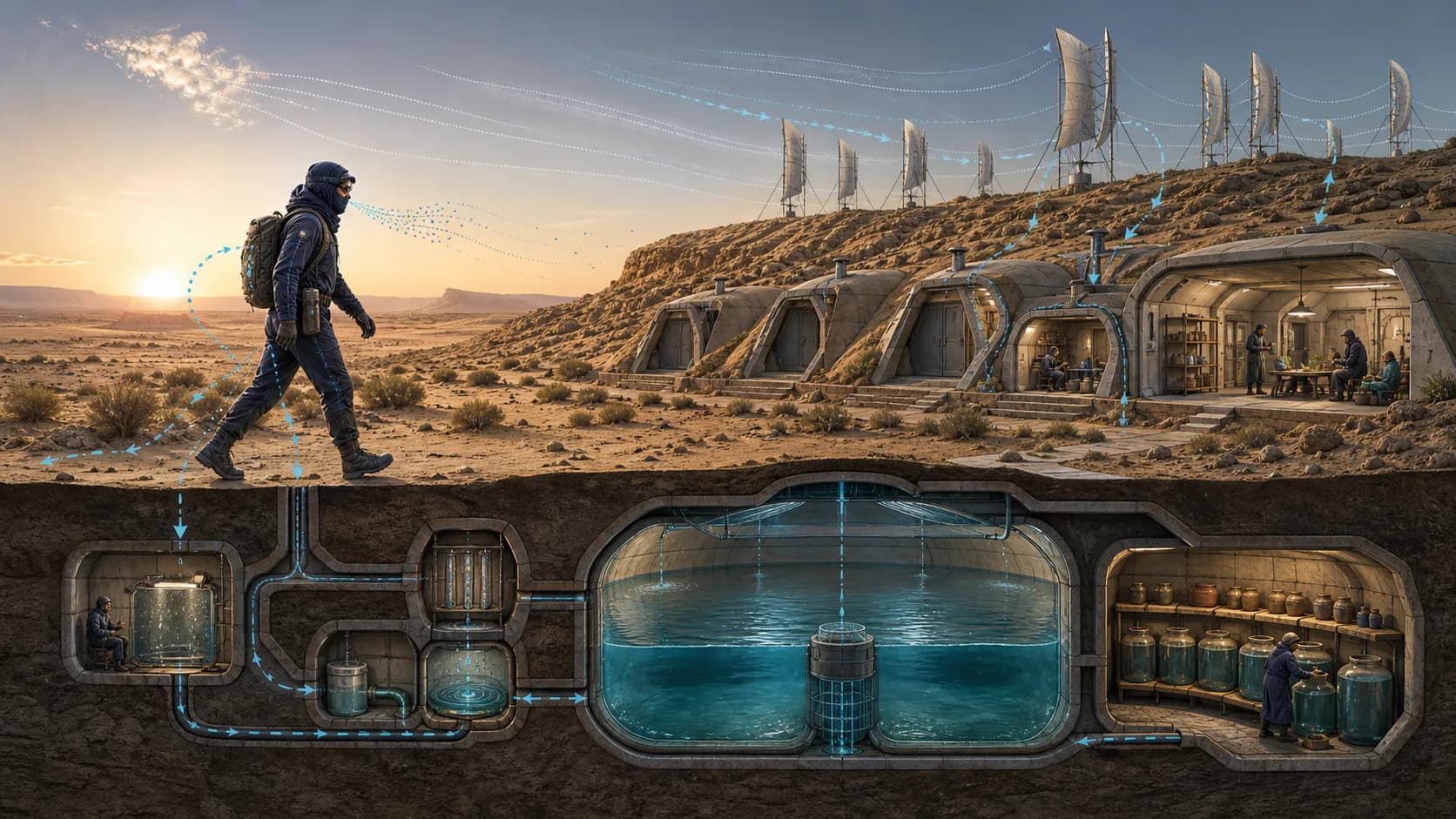
What to notice
- 01
Portable water-recovery system
Stillsuit
The stillsuit makes survival a continuous accounting of bodily moisture rather than a supply carried once and consumed.
In the image: Clothing returns bodily moisture to the survival budget.
- 02
Desert society and organized resistance
The Fremen
The Fremen turn water conservation, mobility, ecological patience, and communal discipline into a durable civilization hidden from imperial accounting.
In the image: Water discipline is social organization, not only equipment.
- 03
Primary concept
Planetary ecosystem engineering
Arrakis makes ecology a political timescale: water discipline, species relationships, and a multigenerational planetary plan decide who can imagine a different world.
In the image: Storage and recovery create the capacity for changes measured across generations.
- 04
Desert world, homeland, and imperial fief
Arrakis
Arrakis joins extreme water scarcity, a hidden human geography, and the only known supply of spice.
In the image: The surrounding desert defines the scarcity every loop must respect.
- What Paul fears
- Failing the people he loves—or fulfilling a future that uses them and him
- What he wants
- Enough understanding and control to survive the trap around House Atreides
- What he needs
- A way to distinguish chosen responsibility from roles imposed by training, ancestry, and myth
- What to track
- Water, spice, hidden knowledge, and every institution that claims to see farther than one lifetime
Series flight path
Dune Chronicles
Dune begins Frank Herbert's six-novel Dune Chronicles. This first book establishes Paul's rise and the systems around Arrakis; later volumes examine the political, religious, and ecological consequences rather than treating victory as an ending.
Volume 1 · You are here
DuneDemanding
02 · Story map
From inherited danger to a movement no individual can contain
Follow how each loss or new alliance changes the choices Paul believes are still available.
The story, in human terms
Book I · Dune
- 1
Arrival
The Atreides try to govern through loyalty rather than terror
Leto needs allies quickly but refuses to treat workers and local people as disposable inputs.
What changes: His ethics attract trust while making the house vulnerable to enemies willing to spend far more lives and money.
- 2
Two kinds of knowledge
Kynes and the Fremen read a different planet
Paul senses that imperial reports underestimate both the population and the discipline hidden beyond the cities.
What changes: Arrakis stops looking empty; it becomes a society and ecological project concealed beneath an extractive map.
Books I–II · mid-book context
Defeat removes Paul's inherited place and gives him a new one
- 1
The fall
The prepared trap overwhelms House Atreides
Paul loses the protection, status, and future he expected while Jessica must use every trained ability to keep them alive.
What changes: They enter the desert as fugitives who can no longer command belonging; they must be judged by Fremen law.
- 2
The desert test
Survival becomes participation rather than possession
Paul must accept that skill can save him without making him innocent, and that taking a place among the Fremen carries obligations to the person displaced.
What changes: He receives a new name and community, but the identity available to him is already charged with religious expectation.
- 3
A future stored underground
Water discipline becomes planetary intention
The Fremen's hidden reserves reveal patience measured in generations rather than the extraction schedules of outside rulers.
What changes: Ecology and resistance become one program: change the planet, preserve the people capable of changing it, and control what outsiders fail to count.
- 4
The movement grows
Paul's training and Fremen hope reinforce each other
He needs the community to survive and wants to protect it, yet his successful predictions make a prepared messianic role feel increasingly real.
What changes: A tactical alliance becomes a movement whose momentum cannot be reduced to Paul's private motives.
Book III · complete trajectory
Paul wins the immediate contest by taking control of the dependency beneath it
- 1
Expanded sight
The Water of Life widens knowledge and responsibility
Paul seeks a view clear enough to escape surprise, but seeing more futures also makes him experience how fear, identity, and repeated choices narrow the available routes.
What changes: He can now target the structure of imperial power rather than only its armies.
- 2
The ecological threat
Knowledge of spice becomes civilization-scale leverage
Paul needs a way to force the Emperor and the Guild to accept his terms without winning an endless conventional war.
What changes: By threatening the spice cycle itself, he turns the empire's hidden dependence into a weapon.
- 3
The throne
Victory gives Paul authority but not release
He defeats the Harkonnen position, protects the Fremen from immediate conquest, and claims imperial legitimacy through marriage.
What changes: The arrangement secures the center while leaving the religious war Paul feared ready to move outward in his name.
03 · Ideas and visuals
Read Arrakis as a water system, a supply chokepoint, and a political story about knowledge
The novel's difficult machinery becomes clearer when each idea is translated into a human consequence.
Ideas explained
Ideas to carry into the story
Carry these three lenses through every faction and desert scene.
Idea 1
Planetary ecosystem engineering
Changing a world means changing linked water, soil, life, climate, and settlement feedbacks over long periods.
In this story: The Fremen survive by conserving water now while investing in a different Arrakis for descendants they will never meet.
Who gets to define a more habitable planet, and what existing life would that target displace?
Read the plain-language concept articleIdea 2
Critical resource dependence
A resource becomes critical when essential systems depend on it, supply is concentrated, substitutes are weak, and disruption travels faster than adaptation.
In this story: Spice turns one planet into the physical foundation beneath transport, wealth, longevity, and imperial bargaining.
Which actor appears powerful only because everyone else has designed away their alternatives?
Read the plain-language concept articleIdea 3
Galactic empire
Distant rule survives through delegated force, trade, transport, and legitimacy because no center can supervise every world directly.
In this story: The Emperor governs through houses and monopolies that are strong enough to rule locally but dangerous if they become too popular or independent.
Does the Imperium control Arrakis, or does dependence on Arrakis control the Imperium?
Read the plain-language concept articleIllustrated explanation
One planet is the empire's supply chokepoint
Spice moves from a unique source through a narrow transfer system into many distant dependencies. The farther consequences are larger than the physical flow.
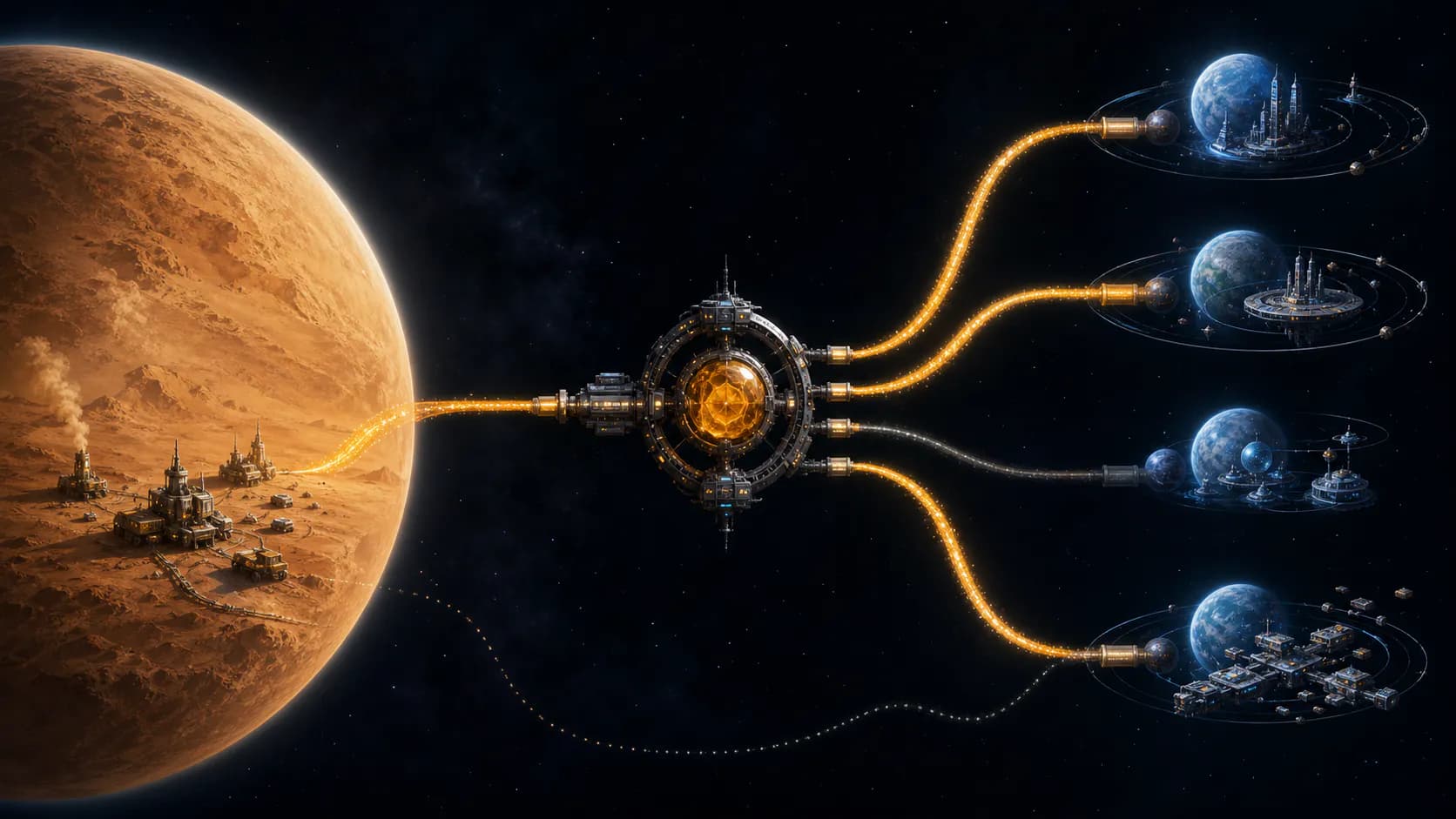
What to notice
- 01
Resource that binds the imperial system
Spice melange
Spice makes one dangerous desert economy essential to interstellar travel, elite life, and political bargaining.
In the image: The only known source begins on Arrakis.
- 02
Primary concept
Critical resource dependence
Spice is physically concentrated on one planet while transport, wealth, longevity, and imperial power are designed around its continued flow.
In the image: A single hub converts concentration into leverage.
- 03
Primary concept
Galactic empire
The Imperium holds distant houses together through feudal legitimacy, commercial monopolies, transport dependence, and the assignment of planetary fiefs.
In the image: Distant political and economic systems rely on continued flow.
- 04
Speculative concept
Information asymmetry
Training, secret plans, ecological knowledge, and prescient glimpses give different actors radically unequal maps of the same apparent contest.
In the image: Weak alternatives matter only if actors know and can activate them in time.
Optional detailWhy the science is ecological rather than merely technologicalThe most consequential machines in Dune often work because they fit inside a larger cycle.
Matter and feedback
Water is never just a quantity
A stillsuit, cistern, windtrap, native organism, and planted reserve each changes where water moves and who can use it later. The Fremen advantage is not a single invention. It is the coordination of bodies, tools, customs, secrecy, and long time horizons around a shared water budget.
Political analysis
A planted myth can become more real than its planner
Bene Gesserit stories create recognizable roles that can shelter an endangered sister. On Arrakis, those patterns meet genuine Fremen oppression, ecological hope, and Paul's unusual abilities. The resulting belief is neither wholly manufactured nor simply spontaneous. Prepared language gives a movement a shape; lived need gives it force.
Illustrated explanation
Seeing the future can narrow the chooser
Uncertain alternatives remain visible, but identity, institutions, fear, and repeated victories feed one dominant pathway until private intention cannot contain collective momentum.

What to notice
- 01
Heir, student, and threatened viewpoint
Paul Atreides
Paul arrives trained to notice danger but unsure whether his abilities and inherited expectations leave room for a self he can choose.
In the image: Paul stands at the point where knowledge becomes responsibility.
- 02
Speculative concept
Information asymmetry
Training, secret plans, ecological knowledge, and prescient glimpses give different actors radically unequal maps of the same apparent contest.
In the image: Possible futures are visible to him but not equally communicable to others.
- 03
Speculative concept
Ideological capture
Prepared prophecy and genuine Fremen need converge around Paul until a survival alliance becomes a political and religious movement larger than his private intentions.
In the image: Repeated choices feed a movement whose meaning exceeds one person's plan.
- 04
Plot trajectory
Paul takes the imperial center
After defeating the Harkonnen position and coercing the Emperor, Paul claims the throne through political marriage while the wider religious war he foresaw remains poised to spread.
In the image: Victory at the center opens the route to wider mobilization.
- 05
Speculative concept
Survival ethics
Paul repeatedly chooses immediate survival through tools that preserve his family and allies while increasing the probability of violence beyond Arrakis.
In the image: Protecting the immediate community transfers risk to people beyond the battlefield.
04 · Reading guide
Use the three named parts as story landmarks
This edition is organized as Book I: Dune, Book II: Muad'Dib, and Book III: The Prophet. The guide refers to those parts rather than individual unnumbered chapters.
People shaping Paul's choices
Paul Atreides
Heir, student, and threatened viewpoint
Paul arrives trained to notice danger but unsure whether his abilities and inherited expectations leave room for a self he can choose.
Lady Jessica
Paul's mother and Bene Gesserit teacher
Jessica protects Paul with skills learned from an order whose long plans do not fully align with her family.
Duke Leto Atreides
Atreides leader entering an imperial trap
Leto accepts Arrakis while trying to convert duty, reputation, and care for people into defenses against a danger he cannot refuse.
Baron Vladimir Harkonnen
Architect of the rival house's return
The Baron treats people, institutions, and scarcity as components of a plan to destroy the Atreides and recover Arrakis.
Liet-Kynes
Planetologist between empire and desert society
Kynes understands that Arrakis's apparent emptiness contains both a connected ecology and a population capable of changing it.
Chani
Fremen fighter, guide, and intimate ally
Chani helps Paul learn the desert as lived knowledge rather than a noble estate or strategic abstraction.
Stilgar
Leader of the Fremen community that receives Paul
Stilgar judges Paul and Jessica by the survival value, danger, and possibility they bring to his people.
The systems of Arrakis
Arrakis
Desert world, homeland, and imperial fief
Arrakis joins extreme water scarcity, a hidden human geography, and the only known supply of spice.
The Fremen
Desert society and organized resistance
The Fremen turn water conservation, mobility, ecological patience, and communal discipline into a durable civilization hidden from imperial accounting.
Bene Gesserit
Long-range political and educational order
The order's training and seeded beliefs shape how Paul and Jessica are recognized before either can control what those expectations will become.
Spice melange
Resource that binds the imperial system
Spice makes one dangerous desert economy essential to interstellar travel, elite life, and political bargaining.
Sandworms
Dominant desert organisms and harvesting hazard
Sandworms make open desert movement and spice extraction inseparable from ecological knowledge and mortal risk.
Stillsuit
Portable water-recovery system
The stillsuit makes survival a continuous accounting of bodily moisture rather than a supply carried once and consumed.
Terms explained
- Stillsuit
- Clothing that recovers bodily moisture so desert travel consumes far less water. · from Part 1 · Dune
- Spice melange
- Arrakis's unique resource, valued for altered awareness, longevity, wealth, and interstellar institutions. · from Part 1 · Dune
- Kwisatz Haderach
- The name attached to the Bene Gesserit's long breeding program and hoped-for expansion of human awareness. · from Part 1 · Dune
- Water of Life
- A poisonous substance central to Fremen ritual and transformed awareness. · from Part 2 · Muad'Dib
Reader lens · after Book I
Ask what the trap required
The fall of House Atreides is not one clever betrayal. It requires imperial fear of Leto's popularity, Harkonnen wealth accumulated through extraction, hidden access to the household, control of transport, and willingness to spend lives at a scale Leto would not. The system defeats him by making his virtues costly.
Reader lens · after Book II
Separate Paul's intention from the movement's feedback
Paul may sincerely want to protect the Fremen and avoid the future he sees. Still, every successful prediction, victory, and inherited symbol changes how others act around him. Notice when fear of becoming a messiah leads him to take steps that make the role more credible.
Progress-safe room
Safe through Part 1 · Dune
Progress-safe room
Safe through Part 2 · Muad'Dib
05 · Ending explained
The ending proves that self-control is not the same as freedom
Paul wins the immediate struggle, but the way he wins gives the future he fears a path into the world.
The ending mechanism
Paul wins by controlling what the empire cannot replace
Paul survives the Water of Life and understands the ecological relationship that produces spice. During the final confrontation, he can therefore threaten something stronger than an army: permanent destruction of the resource required by the Spacing Guild and the imperial order around it. The Guild cannot treat the threat as bluff because its navigators' dependence also lets them see the danger.
Fremen forces defeat the Harkonnen and imperial position. Paul kills Feyd-Rautha, forces Emperor Shaddam IV to yield, and takes Princess Irulan as a political wife while affirming Chani as his true partner. This settlement gives him formal control of the empire and immediate protection for the people who made victory possible.
It does not give him the escape he wanted. The Fremen movement now reads military victory, prophecy, ecological hope, and Paul's prescience as one story. The jihad he foresaw can travel outward with the legitimacy he has just secured.
- The ecological leverage
- Paul's knowledge lets him threaten the spice cycle rather than merely interrupt one harvest.
- The imperial leverage
- The Emperor and Guild cannot accept the loss of the resource that sustains transport and authority.
- The political settlement
- Marriage to Irulan supplies dynastic legitimacy while Paul's bond with Chani remains personal and Fremen.
- The unresolved cost
- A victory meant to preserve a people also releases a movement capable of carrying war across the empire.
Keep exploring
Follow the idea beyond this ending
The Idea Atlas connects this novel’s central question to the science, philosophy, and other stories that approach it differently.
Open the connected ideaContinue through the catalog
Find another world on the same axis
More ways to read Arrakis
The novel links ecology, belief, family, and empire into one system
Paul's rise is easier to understand when it is not treated as a separate hero story laid over political worldbuilding. Every source of his power comes from a system that also limits what he can choose.
These four perspectives show how the same victory can look liberating at one scale and dangerous at another.
Paul and prescience
Does seeing more of the future create freedom?
Paul's visions reveal branching dangers, but attention to those dangers can make the visible paths feel inevitable. He increasingly acts to avoid the worst future while strengthening the identity around which that future organizes itself.
Why this matters: Prescience becomes a trap of interpretation: knowledge expands his view while narrowing the self he believes can act.
Jessica and inheritance
How does a mother's protection become part of a larger design?
Jessica loves Paul and repeatedly saves him, yet her training, ancestry, and Bene Gesserit decisions also place him inside plans older than either of them. Among the Fremen, the truths she tells and the roles she accepts activate prepared beliefs.
Why this matters: Family care and institutional manipulation are intertwined rather than clean opposites.
Fremen agency
Are the Fremen followers, allies, or authors of the revolution?
They possess military skill, ecological knowledge, social discipline, and a long planetary project before Paul arrives. He helps unite and redirect those capacities, but prophecy gives his personal future unusual authority over a collective struggle.
Why this matters: The story can be read as both anticolonial revolt and a warning about a movement being captured by a charismatic figure.
Ecology and empire
Why does control of water become control of space travel?
Arrakis joins local bodily survival to the spice cycle on which imperial transport depends. Ecological knowledge therefore becomes leverage over a political order that treats the planet mainly as a mine.
Why this matters: The final threat works because environmental relationships ignored by empire are actually the foundation of imperial power.
Coordinates on a neighboring axis
Novel guide
The Three-Body Problem
The Three-Body Problem
Cixin Liu
The universe starts counting down inside a scientist’s eyes. To learn why, he must enter a world with three suns—and follow a signal humanity may regret sending.
Novel guide
The Dark Forest
The Dark Forest
Cixin Liu
Humanity can prepare for an invasion everyone can see, but its only secure hiding place may be a single private mind.
Novel guide
Cibola Burn
Cibola Burn
James S. A. Corey
On the first contested colony beyond the Rings, refugees and a corporate expedition fight over one world while its alien systems begin waking beneath them.
Content notes
Violence, assassination, and death · Colonial extraction and forced displacement · Religious manipulation and holy war · Drug use and dependence · Eugenic planning
Editorial record
Research and sources
The story analysis is original. Background sources support the scientific and philosophical explainers connected to this novel.
Last reviewed July 22, 2026