Novel guide
The Martian
Andy Weir

Story and ideas · Standalone
The Martian
by Andy Weir
Ballantine Books paperback · 2014 · Publisher details · Cover via Open Library
Left for dead on Mars, Mark Watney must turn a short-stay habitat into a system that can keep him alive long enough for distant humans to reach him.
Full-story article
This article discusses the complete story, including the ending.
- Reading time
- About 10 hours
- Length
- 416 pages
- Reading complexity
- Accessible
- Direct structure and terminology make the main story comparatively easy to follow.
- Science intensity
- 5/5
- Scientific mechanisms are central to understanding the story.
Affiliate links. As an Amazon Associate, we earn from qualifying purchases.
Before you read
Is this book for you?
Start by tracking: For each problem, track the limiting resource, Mark’s test, the result, and the new constraint that result creates.
Read this if you enjoy
- Practical survival problems solved in sequence
- Engineering explained through consequences
- A hopeful story about distributed rescue
Why readers may get lost
- Calculations and equipment details drive much of the plot
- Failures often invalidate several earlier plans at once
Keep these anchors in mind
- Mark Watney
- turns fear into measurable work
- The Hab
- links air, water, food, heat, and shelter
- NASA
- widens private survival into public coordination
- Hermes
- carries the crew who must choose whether to return
- Time
- is the resource every repair is really creating
Accessible reading complexity. Direct structure and terminology make the main story comparatively easy to follow.
Science intensity 5/5. Scientific mechanisms are central to understanding the story.
The problem Mark wakes up to
One person, one hostile planet, and no quick rescue
Mark Watney has survived the accident that made his crew leave Mars, but survival for one day is not the same as remaining alive until anyone can return. The story proceeds by turning that enormous problem into linked systems he can measure, repair, and extend.
The opening situation
The mission leaves Mark Watney behind
A violent dust storm forces the six-person Ares 3 crew to evacuate Mars. An antenna strikes Mark, his suit stops reporting vital signs, and the others leave believing he is dead. He wakes injured, alone, and unable to contact either his crew or Earth.
Mark is a botanist and mechanical engineer, but expertise does not make him fearless. He wants to live long enough to be found, and his first terror is brutally practical: the next crewed mission is years away, while the Hab was stocked for weeks. Every plan must create time from equipment that was never meant to support one person for so long.
The central question
Can a person survive Mars by treating every fatal problem as the next solvable one?
The Martian is a survival story about competence under pressure, but Mark never begins from nothing: his training, procedures, tools, and habitat preserve years of other people’s work.
- The reading promise
- A propulsive survival novel built from engineering, humor, setbacks, and cooperative problem-solving
- What to track
- What Mark needs, what resource limits him, what he tests, and what the result changes
- What can pass
- You do not need to reproduce the arithmetic; keep the constraint, the attempted fix, and its consequence
- The human question
- How does a person remain part of a community when distance makes every answer slow or impossible?
The story, in human terms
The first two turns
Begin with the person. The engineering becomes legible once you know what Mark is afraid of losing.
- 1
Chapter 1
He survives being left behind
Mark is wounded, presumed dead, and suddenly the only human on a planet where stepping outside requires a pressure suit.
What changes: Reaching the Hab solves the immediate injury but exposes the larger problem: nobody knows he is alive, and his supplies will expire long before another mission arrives.
- 2
Chapters 2–3
He turns panic into an inventory
Mark cannot promise himself rescue, so he looks for something smaller he can control: air, water, food, power, shelter, and the next repair.
What changes: The abandoned base stops being a collection of leftovers and becomes a provisional survival system whose parts must keep one another working.
02 · Mission knowledge
How the Hab manufactures time
The opening science is easiest to follow as one connected system. Mark is not collecting clever tricks; he is keeping several life-support loops inside safe limits at the same time.
Illustrated explanation
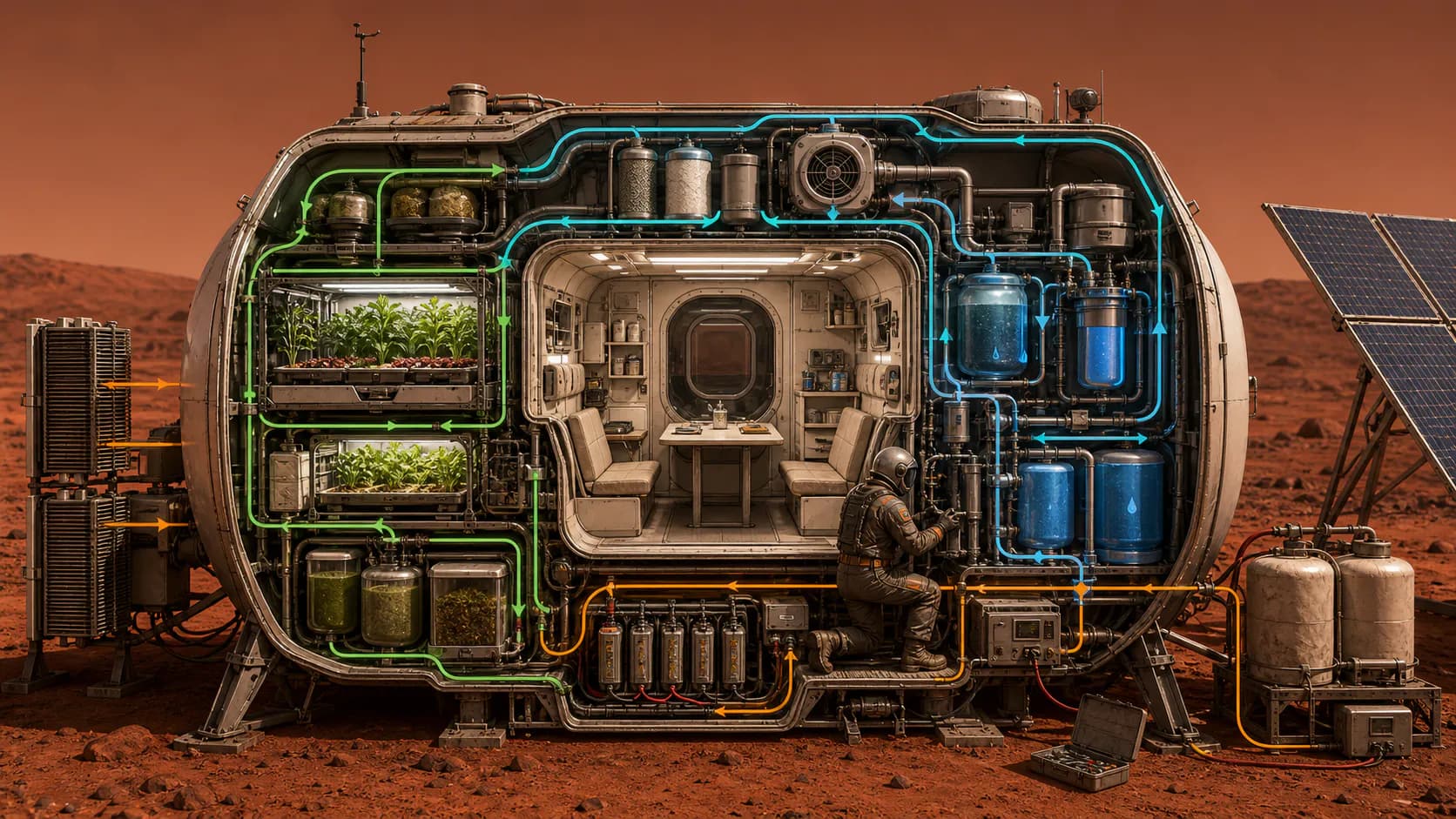
A short-stay habitat becomes a survival system
The Hab keeps Mark alive only while material loops, energy supply, stored reserves, and daily maintenance remain in balance.
What to notice
- 01
Surface shelter and life-support system
The Hab
The Hab links atmosphere, water, food, power, heat, storage, and repair into Mark's temporary environment.
In the image: The pressure shell contains every life-support dependency.
- 02
Primary concept
Closed-loop life support
Mark turns short-mission equipment into a coupled habitat where every breath, drink, calorie, watt, and repair changes the time he has left.
In the image: Air, water, food, waste, and power must be managed as connected flows.
- 03
Stranded botanist, engineer, and viewpoint
Mark Watney
Mark inventories the abandoned mission systems and treats survival as a sequence of measurable problems without pretending the danger is small.
In the image: One person supplies the monitoring and repair work the extended mission requires.
- 04
Plot trajectory
Mission leftovers become a survival loop
Food calculations, water production, crops, and environmental equipment are joined into a plan for extending life far beyond the scheduled stay.
In the image: Stored energy and reserves convert successful recovery into additional time.
A survival rhythm
Need → measure → test → repair → recount
Mark begins each problem with a human need: another breath, drink, meal, warm night, or day of electrical power. He measures what remains, makes a plan that can fail, observes the result, and recalculates the schedule. A successful repair does not end danger. It changes which limit will arrive first.
This is why the story can feel optimistic without making Mars gentle. Hope comes from gaining reliable information and another action—not from assuming that everything will work.
Ideas explained
Two ideas explain the opening
Together they show why Mark can act alone without surviving through individual brilliance alone.
Idea 1
Closed-loop life support
A habitat must continually manage breathable air, drinkable water, food, heat, waste, and electrical energy. Some materials can be recovered and reused; others leave the system or accumulate as danger.
In this story: Mark stretches a short expedition by connecting stored supplies, crops, environmental machinery, and daily maintenance. A change in one loop can create pressure somewhere else.
Which part of the habitat has become a single point of failure?
Read the plain-language concept articleIdea 2
Science as infrastructure
Every procedure and machine contains earlier work: measurements, standards, manufacturing, software, training, and lessons from previous missions.
In this story: Mark performs the visible improvisation, but mission hardware, written procedures, training, earlier missions, and many specialist disciplines make each solution possible.
Whose work is present in a solution even when that person is not?
Read the plain-language concept articleOptional detailWater, soil, and the danger of almost enoughOpen this for a closer look at why making food also creates chemistry and resource problems.
Resource lens
A crop is another life-support loop
Calories are not the only input. Plants need water, light, carbon dioxide, nutrients, workable soil, stable temperature, and time. Mark has stored food and equipment, but extending the food schedule means redirecting finite water and power into a biological system that can fail.
Producing water from available chemicals is especially hazardous because hydrogen and oxygen store substantial energy when separated. The underlying lesson is broader than the particular reaction: a material can solve one shortage while introducing fire, pressure, contamination, or control risks elsewhere.
From private survival to a shared rescue
How the situation changes
The middle of the novel widens the story from Mark's local survival loops to communication, institutional planning, public failure, international help, and a crew deciding what obligations continue across distance.
The middle of the story
Six turns widen the story
Each change converts a private survival problem into a larger question about communication, schedule, authority, and shared risk.
- 1
Chapter 6
Earth discovers Mark is alive
Mark still believes he is solving problems without an audience, while people on Earth must absorb that the astronaut they mourned has been working alone.
What changes: Satellite evidence turns a presumed death into an obligation to observe, communicate, and attempt a rescue.
- 2
Chapter 11
An old lander restores contact
Mark needs more than technical advice: after months of isolation, even a slow exchange confirms that other people know where he is.
What changes: Pathfinder, archival knowledge, and new software create a narrow conversation between Mars and Earth.
- 3
Chapter 14
The Hab rupture erases the food margin
Mark survives another sudden decompression, then discovers that staying alive through the accident is not the same as preserving the future he had grown.
What changes: One structural failure crosses the atmosphere, heat, shelter, and crop loops; the rescue schedule becomes urgent again.
- 4
Chapter 15
A rushed resupply launch fails
Earth’s teams are trying to help someone they can see but cannot physically reach. Urgency compresses the time normally used to find mistakes.
What changes: The lost payload removes the straightforward food solution and forces planners to consider a riskier route.
- 5
Chapter 16
A gravity-assist plan sends Hermes back
Mark’s former crewmates must decide whether saving one person justifies extending their journey and exposing all five of them to another Mars encounter.
What changes: The Rich Purnell maneuver uses an Earth flyby to redirect Hermes; rescue becomes a choice made by the people who will carry its risk.
- 6
Chapter 21
Mark carries his habitat across Mars
To meet the returning crew, Mark must leave the shelter he understands and spend weeks depending on a mobile system he assembled himself.
What changes: The rovers, life-support equipment, solar charging, storage, and navigation become a moving habitat aimed at the distant Ares 4 ascent vehicle.
Illustrated explanation
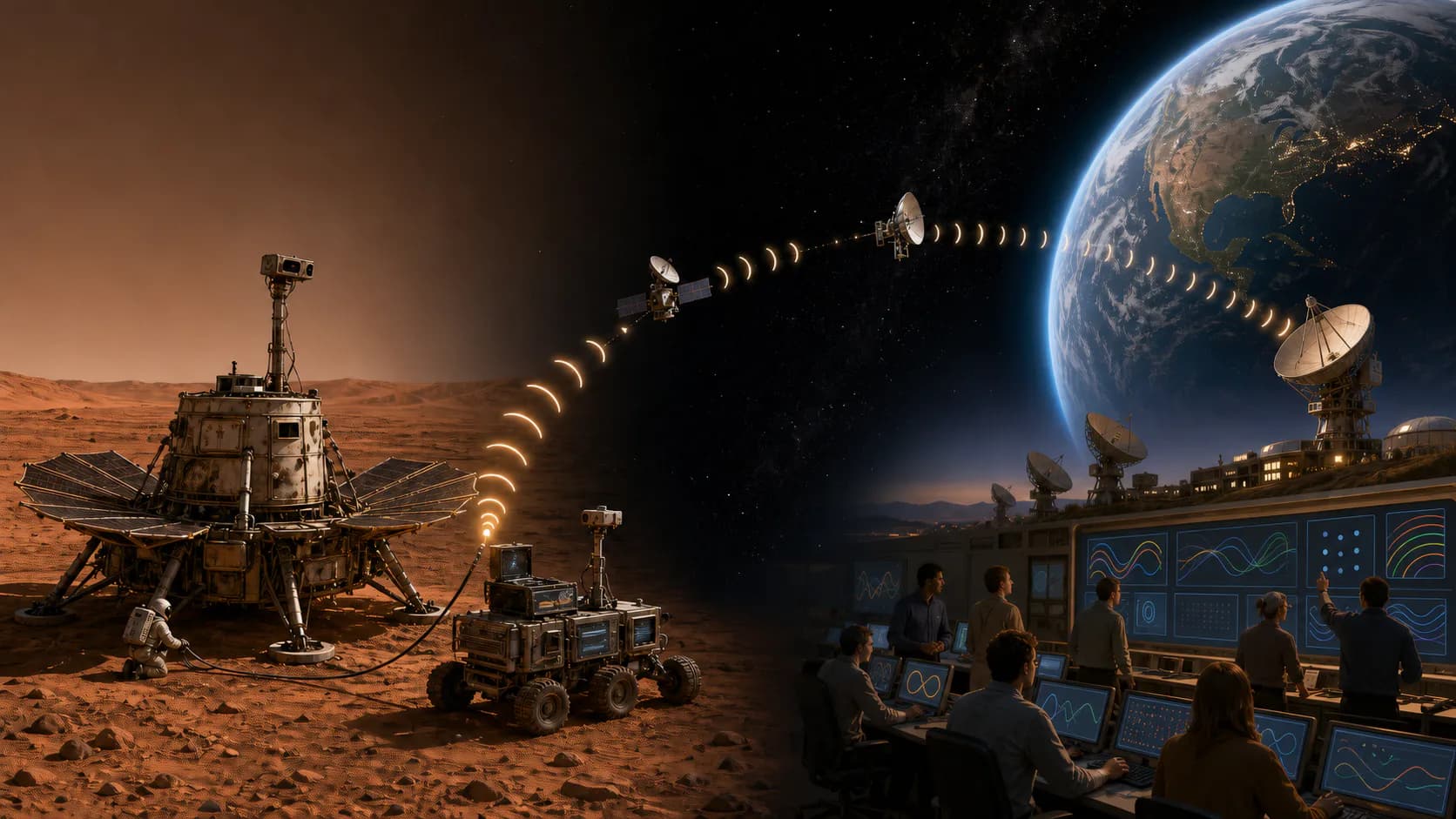
Old infrastructure closes the human distance
Pathfinder turns archived hardware and newly written software into a delayed but dependable chain between Mark and Earth.
What to notice
- 01
Recovered communication bridge
Pathfinder
An earlier lander gives Mark and Earth a slow shared channel after direct mission communications are lost.
In the image: The recovered lander provides a steerable endpoint on Mars.
- 02
Primary concept
Science as infrastructure
Survival depends on accumulated tools, procedures, observations, supply chains, and expert communities even when Mark performs the immediate work alone.
In the image: Hardware, protocols, code, records, and expert teams make the link usable.
- 03
Earthside rescue institution
NASA
NASA converts orbital images, engineering work, public accountability, and mission authority into an evolving attempt to reach Mark.
In the image: Earthside teams turn each delayed exchange into coordinated work.
- 04
Plot trajectory
An old lander carries a new conversation
Mark recovers Pathfinder and collaborates with JPL to build increasingly capable communication across the delay to Earth.
In the image: Communication changes isolation into a shared rescue problem.
Why communication changes the novel
Advice is only one form of rescue
Contact gives Earth access to Mark’s observations and gives Mark access to specialists, computation, and planning. It also introduces disagreement. Once more people can contribute, survival is no longer only an engineering sequence; it becomes a coordination problem shaped by institutional authority, public pressure, and imperfect information.
Optional detailWhy the alternate trajectory is possibleA conceptual guide to the Earth flyby, ion propulsion, and the risk transferred to the Hermes crew.
Ideas explained
The route is geometry, propulsion, and consent
The plan works only because three different questions have compatible answers.
Idea 1
Orbital mechanics
A spacecraft follows a moving path around a massive body. Reaching a destination means arranging position, direction, speed, and arrival time—not steering toward a fixed point on a map.
In this story: Hermes can pass Earth, exchange momentum through gravity, collect supplies, and follow a new solar orbit that crosses Mars at the needed time.
What must be true at the encounter besides being in the same place?
Read the plain-language concept articleIdea 2
Spacecraft propulsion
The Hermes ion drive produces modest thrust continuously. It cannot make an instant turn, but small acceleration sustained for a long time creates a large change in velocity.
In this story: Continuous thrust reshapes the gravity-assist route while the ascent vehicle must trade away mass to produce enough launch performance.
Which cost has moved into time, mass, structure, or safety?
Read the plain-language concept articleIdea 3
Survival ethics
A rescue decision distributes danger. The person who benefits, the people who assume new risk, and the institution authorizing it may not be the same.
In this story: NASA leadership and the Hermes crew disagree over who has the right to choose a longer, more hazardous mission for five people in order to save one.
Who should be allowed to accept risk on another person’s behalf?
Read the plain-language concept articleIllustrated explanation
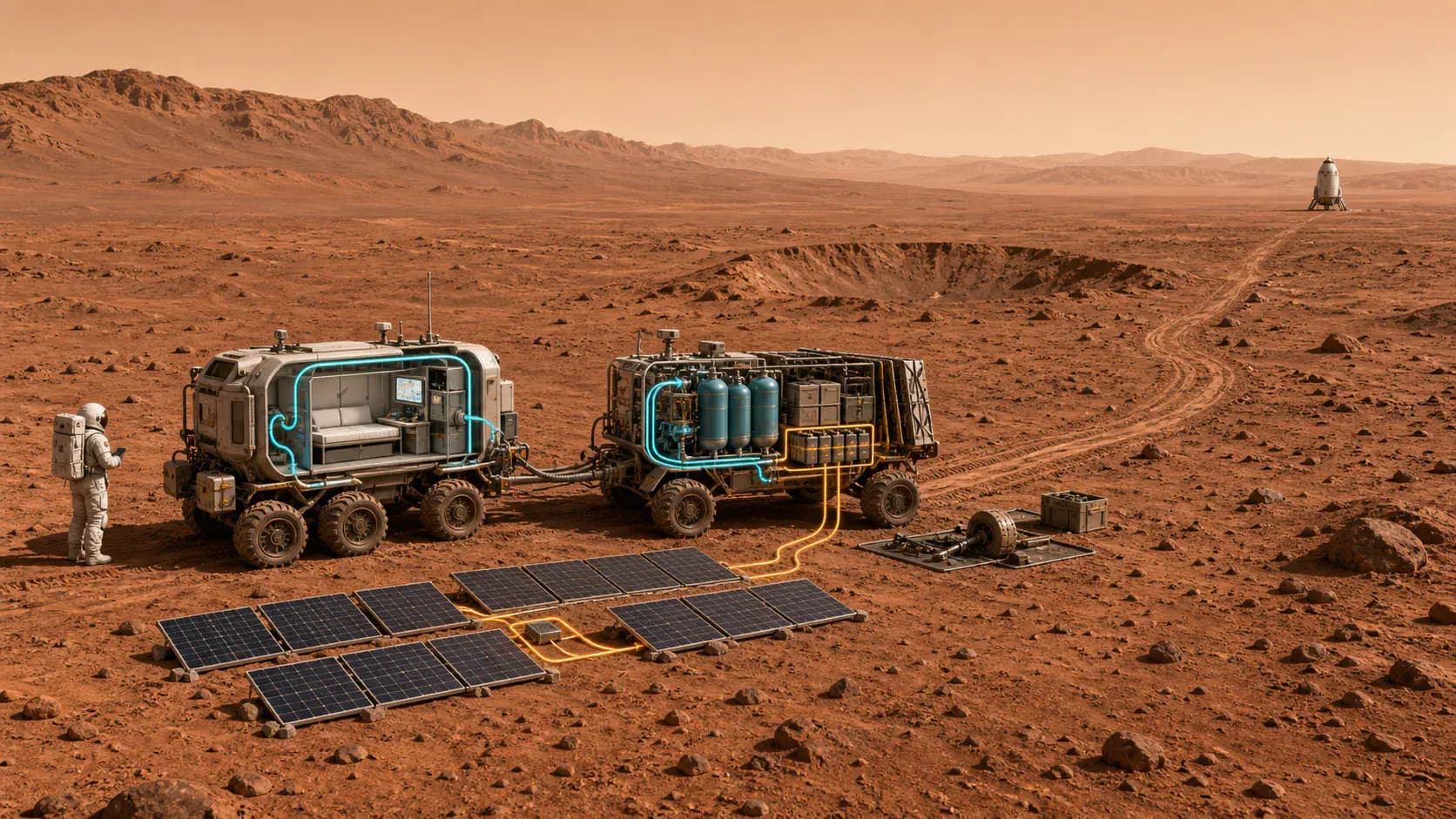
Distance becomes a moving resource budget
The traverse succeeds only if solar charging, life support, storage, navigation, terrain, and repairs stay aligned across the route.
What to notice
- 01
Stranded botanist, engineer, and viewpoint
Mark Watney
Mark inventories the abandoned mission systems and treats survival as a sequence of measurable problems without pretending the danger is small.
In the image: Mark carries the duties of driver, navigator, mechanic, and environmental operator.
- 02
Primary concept
Closed-loop life support
Mark turns short-mission equipment into a coupled habitat where every breath, drink, calorie, watt, and repair changes the time he has left.
In the image: The habitat's essential loops must be compressed into mobile equipment.
- 03
Plot trajectory
Mark carries life support across Mars
Rovers, solar charging, environmental machinery, storage, and navigation become a mobile survival system aimed at the distant ascent vehicle.
In the image: Every kilometer consumes time, stored energy, and repair margin.
- 04
Distant ascent vehicle and surface objective
Ares 4 MAV
The pre-positioned vehicle offers a route from Mars to orbit if Mark can cross the planet and change its mission profile.
In the image: The ascent vehicle is the fixed surface endpoint of the orbital plan.
The surface journey
The Hab becomes a principle rather than a place
Mark cannot bring the building, so he recreates its functions with rover pressure vessels, atmospheric equipment, batteries, solar panels, insulation, storage, and routines. The traverse shows what he has learned: survival does not depend on one safe room. It depends on knowing which flows must continue and which failure can be repaired before it reaches the others.
04 · Reference guide
Keep the people, systems, and decisions connected
These chapter landmarks place people, tools, and decisions beside the story turn where they become important.
People and rescue teams
Mark Watney
Stranded botanist, engineer, and viewpoint
Mark inventories the abandoned mission systems and treats survival as a sequence of measurable problems without pretending the danger is small.
Melissa Lewis
Ares 3 and Hermes commander
Lewis carries responsibility for the evacuation and for decisions that could expose the rest of her crew to further danger.
NASA
Earthside rescue institution
NASA converts orbital images, engineering work, public accountability, and mission authority into an evolving attempt to reach Mark.
Missions, habitats, and routes
Ares 3
Evacuated Mars mission
Its habitat, vehicles, supplies, and procedures become the starting inventory for a survival period the mission never planned.
The Hab
Surface shelter and life-support system
The Hab links atmosphere, water, food, power, heat, storage, and repair into Mark's temporary environment.
Pathfinder
Recovered communication bridge
An earlier lander gives Mark and Earth a slow shared channel after direct mission communications are lost.
Hermes
Interplanetary spacecraft and rescue platform
Hermes carries the Ares 3 crew and has the continuous low-thrust capability needed for an unconventional return toward Mars.
Ares 4 MAV
Distant ascent vehicle and surface objective
The pre-positioned vehicle offers a route from Mars to orbit if Mark can cross the planet and change its mission profile.
Rich Purnell maneuver
Alternate return-to-Mars trajectory
The plan uses an Earth gravity assist and a resupply intercept to send Hermes back past Mars without entering orbit.
People in the story
- Mark Watney
- Ares 3 botanist and mechanical engineer stranded on Mars · from Chapter 1
- Melissa Lewis
- Commander of Ares 3 and the Hermes crew · from Chapter 6
- Rick Martinez
- Ares 3 pilot and the crewmate who remotely flies the modified MAV · from Chapter 6
- Chris Beck
- Flight surgeon and EVA specialist aboard Hermes · from Chapter 6
- Alex Vogel
- Chemist and navigator aboard Hermes · from Chapter 6
- Beth Johanssen
- Systems operator and programmer aboard Hermes · from Chapter 6
- Venkat Kapoor
- NASA director coordinating the Mars response · from Chapter 6
- Mindy Park
- Satellite specialist whose observations reshape the mission · from Chapter 6
- Bruce Ng
- JPL director responsible for building critical hardware · from Chapter 9
- Rich Purnell
- Astrodynamicist who searches for a different route · from Chapter 16
Terms explained
- Hab
- The pressurized surface habitat containing environmental control, work areas, supplies, and the equipment Mark must extend beyond its planned mission. · from Chapter 1
- Water reclaimer
- Equipment that recovers usable water from the habitat’s waste and humidity streams. · from Chapter 2
- Oxygenator
- A life-support unit that processes carbon dioxide to replenish breathable oxygen. · from Chapter 2
- RTG
- A radioisotope thermoelectric generator: a durable source of heat and electrical power that also requires radiation precautions. · from Chapter 8
- Pathfinder
- An earlier robotic Mars lander recovered to help rebuild communication with Earth. · from Chapter 11
- Hermes ion drive
- A low-thrust propulsion system that accumulates a large velocity change by operating continuously over long periods. · from Chapter 16
- MAV
- Mars Ascent Vehicle, designed to lift a crew from the surface to an orbital rendezvous. · from Chapter 21
Safe through chapter 6
Being observed is not yet being heard
Earth can infer Mark’s actions from changed equipment and surface tracks, but Mark cannot receive that recognition. The information relationship is one-way: planners gain responsibility while the person most affected remains outside the conversation.
Safe through chapter 11
Infrastructure can wait quietly for another purpose
Pathfinder matters because hardware, archived designs, communication protocols, and expert memory remain available long after the original mission ended. Recovery becomes collaboration across years as well as planets.
Safe through chapter 14
A coupled system can multiply both success and failure
Linking crops, water, atmosphere, and shelter lets one resource support another. The breach reveals the opposite side of that efficiency: a structural event can become an environmental and food emergency before there is time to isolate it.
Safe through chapter 16
A better route does not erase its moral cost
The alternate maneuver is elegant because it uses celestial motion and sustained thrust. It is difficult because the new probability of saving Mark is purchased with years and danger from the Hermes crew. A technically possible rescue still requires legitimate human choice.
Safe through chapter 21
The traverse is a rehearsal for leaving Mars
Each charging stop, thermal adjustment, navigation check, and equipment repair coordinates Mark’s surface motion with an approaching orbital schedule. The journey is not a pause before the rescue; it is the first half of the rendezvous.
Progress-safe room
Safe through Chapter 11
Progress-safe room
Safe through Chapter 21
05 · Ending explained
What the final orbital problem means
The ending brings the launch constraints, flyby geometry, and human choices into one rescue chain.
Illustrated explanation
A rescue must close distance and relative speed
The ascent vehicle reaches space below the planned state, so both sides spend their remaining options to turn two near paths into one reachable encounter.
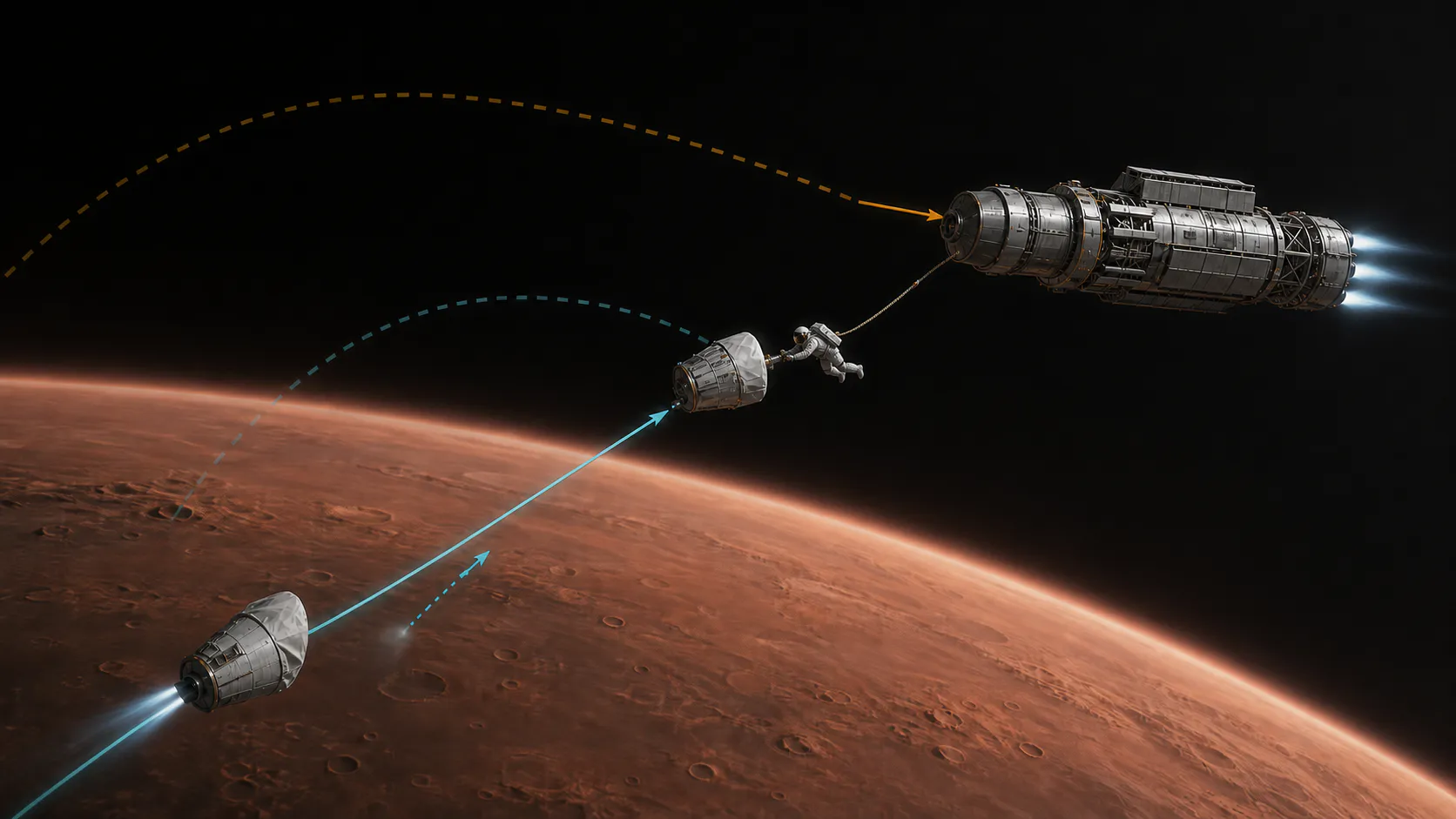
What to notice
- 01
Distant ascent vehicle and surface objective
Ares 4 MAV
The pre-positioned vehicle offers a route from Mars to orbit if Mark can cross the planet and change its mission profile.
In the image: The stripped ascent vehicle converts surface preparation into an imperfect orbital path.
- 02
Interplanetary spacecraft and rescue platform
Hermes
Hermes carries the Ares 3 crew and has the continuous low-thrust capability needed for an unconventional return toward Mars.
In the image: Hermes approaches on a flyby and cannot simply stop above Mars.
- 03
Primary concept
Orbital mechanics
The rescue becomes possible only when surface preparation, launch timing, transfer geometry, and relative velocity converge at one moving point above Mars.
In the image: Meeting requires the same place, the same time, and manageable relative motion.
- 04
Plot trajectory
Two improvised trajectories become one rescue
The modified ascent vehicle and Hermes miss a clean rendezvous, requiring both crews to reduce distance and relative speed with their remaining options.
In the image: Late corrections shrink the remaining separation enough for a tethered retrieval.
Complete story · ending spoilers
Four moving systems must become one rescue
The climax is not a single miracle. It is a chain in which every imperfect result becomes the initial condition for the next decision.
- 1
The ascent
The MAV is stripped to reach the intercept
Mark removes safety equipment, structure, and nearly every comfort because the vehicle must lift far less mass than its original crewed mission planned.
What changes: The improvised launch reaches space, but its actual path and speed do not produce a clean rendezvous with Hermes.
- 2
The flyby
Hermes cannot stop and wait
The crew has crossed interplanetary space to recover Mark, yet the gravity-assist route carries them past Mars rather than into orbit.
What changes: Rescue depends on matching the MAV during one fast encounter, so distance and relative velocity become a shared countdown.
- 3
The improvised closure
Both sides spend their remaining options
The crew refuses to treat a near miss as the end. With the planned margins gone, they seal key compartments, improvise a deliberate airlock breach, and prepare Beck for an exposed retrieval.
What changes: Attitude thrusters and escaping air slow Hermes enough for Beck to cross the remaining gap with a maneuvering unit and tether.
- 4
The reunion
Mark is no longer alone
The first people Mark sees after his long isolation are the crewmates who chose to return for him.
What changes: Beck secures Mark and returns with him to Hermes. The survival problem finally becomes a journey home together.
What orbital mechanics contributes
Meeting requires a shared state, not a shared location
Hermes and the MAV can be near Mars at the same time and still be unable to connect. A rendezvous requires manageable separation and relative velocity before the paths diverge. Every mass reduction, launch time, burn, vent, and tether decision changes one part of that state.
The rescue succeeds when the teams stop asking whether the original plan worked perfectly and start asking what the measured result still permits.
- Why strip the MAV
- Reducing payload mass lets the ascent vehicle reach the speed and altitude demanded by the improvised intercept.
- Why Hermes cannot enter orbit
- The Rich Purnell route is a fast Mars flyby; stopping would require a velocity change and propellant the ship does not have.
- Why a near pass is not enough
- The spacecraft must reduce both physical separation and relative motion before the brief encounter ends.
- Why the tether matters
- It is the final physical bridge after trajectories, propulsion, and improvised impulses narrow the gap.
- What completes Mark’s arc
- The person who survived by acting alone is saved by becoming reachable to a community that refuses to abandon him.
The final log
Home is a network of people, not only a planet
The novel ends aboard Hermes, with Mark injured but safe among the crew. He thinks about the extraordinary labor, money, material, and personal danger that people across Earth accepted to bring one stranger home. That reflection completes the story’s movement from apparent isolation to visible interdependence.
His ordeal does not prove that one exceptional person can master every danger. It shows how disciplined improvisation can keep a person reachable until collective systems arrive—and how readily people may choose to build those systems when another life is in danger.
Keep exploring
Follow the idea beyond this ending
The Idea Atlas connects this novel’s central question to the science, philosophy, and other stories that approach it differently.
Open the connected ideaContinue through the catalog
Find another world on the same axis
What survival reveals
Mark is alone on Mars, but almost nothing keeping him alive is solitary
The logs foreground individual ingenuity. The larger story steadily reveals the accumulated labor, standards, relationships, and willingness to accept risk that make each improvisation possible.
These readings add emotional and institutional depth without taking anything away from the engineering suspense.
Mark's voice
Why is humor part of the survival system?
Jokes let Mark name fear without allowing it to occupy every decision. The log format turns panic into a problem that can be described, divided, and approached again after failure.
Why this matters: His voice is not denial of danger; it is a technique for preserving attention and a sense of self.
Inherited infrastructure
How much of self-reliance was built by other people?
The Hab, rovers, manuals, stored food, software, orbital assets, scientific education, and mission procedures all embody work completed before Mark was stranded. His creativity depends on knowing what those systems can safely become.
Why this matters: The novel celebrates individual skill while showing that competence grows inside maintained public knowledge.
Failure and honesty
Why do mistakes make the science more convincing?
Plans fail because models omit a material detail, equipment exceeds its limits, or a living system changes. Mark and the Earth teams recover by recording what happened and changing the next plan rather than protecting their pride.
Why this matters: Scientific courage appears as the willingness to expose error quickly enough for others to help.
The rescue network
Why risk many people for one person?
NASA, international partners, the Hermes crew, and people following from Earth repeatedly decide that Mark remains part of their community. The cost is debated rather than hidden, and responsibility is distributed across many voluntary acts.
Why this matters: The ending makes rescue a statement about belonging: distance and expense do not automatically make a life disposable.
Coordinates on a neighboring axis
Novel guide
Project Hail Mary
Project Hail Mary
Andy Weir
A scientist wakes alone on a starship with two dead crewmates, no memory, and one impossible assignment: learn why a distant star is surviving the same disaster killing the Sun.
Novel guide
The Eternal Flame
The Eternal Flame
Greg Egan
Three generations into the Peerless voyage, Tamara, Carlo, Carla, and Patrizia must solve fuel and population crises without letting survival make anyone's body expendable.
Novel guide
Foundation
Foundation
Isaac Asimov
A mathematician predicts imperial collapse, exiles a knowledge project to the galaxy's edge, and leaves later leaders to discover how science can become political leverage.
Content notes
Serious injury · Prolonged isolation · Life-threatening accidents · Strong language
Editorial record
Research and sources
The story analysis is original. Background sources support the scientific and philosophical explainers connected to this novel.
Last reviewed July 22, 2026