
The idea in plain English
Plain idea
What changes
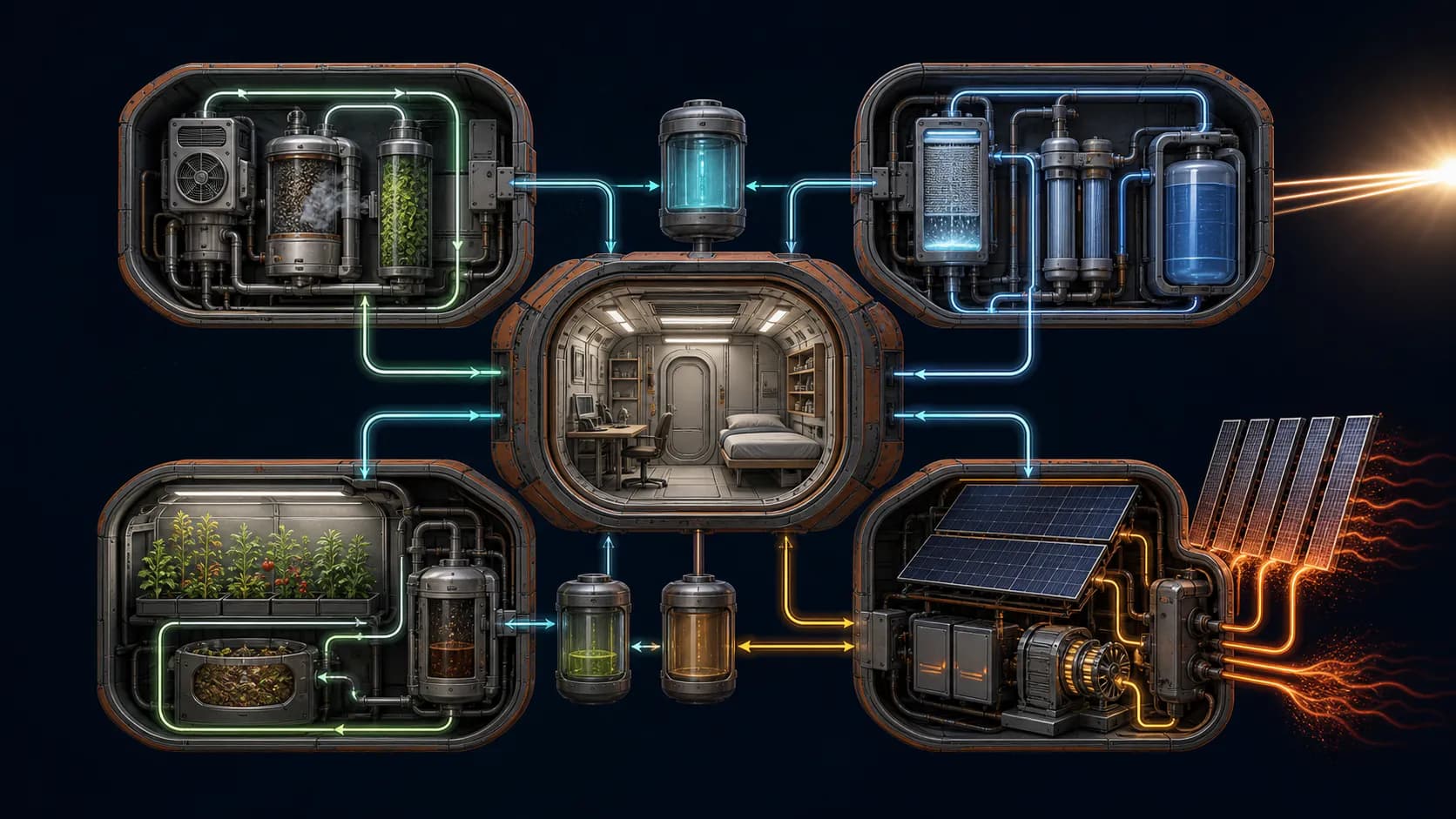
Closed-loop life support keeps a sealed or remote habitat livable by repeatedly cleaning and reusing scarce air, water, nutrients, and waste instead of consuming each supply once.
Mechanism
How it operates
Every person changes the habitat by breathing, drinking, eating, producing waste, and releasing heat. Equipment removes carbon dioxide, renews oxygen, recovers water, processes waste, and may support crops. Sensors, stored reserves, and replacement parts keep those linked flows within safe ranges, while electrical power drives the machinery and radiators or other sinks remove its waste heat.
Human stakes
Why it matters
Inside a remote habitat, tomorrow's breath and drink depend on today's maintenance. Recycling reduces the mass that must arrive from elsewhere, but it also joins daily life to pumps, filters, microbes, software, power, and human attention. A small unnoticed drift can become a medical emergency before help can arrive.
Used in: 4 catalog novels
Related: Science as infrastructure · Climate survival · Survival ethics
A few terms make the rest of the explanation easier to follow.
- Closure
- The fraction of a material flow recovered and reused rather than lost or replaced from outside the habitat.
- Buffer
- Stored air, water, food, power, or processing capacity that gives the crew time to detect and repair a failing loop.
- Trace contaminant
- A harmful chemical present in small amounts that can accumulate when air or water is repeatedly recycled.
- Mass balance
- Accounting for where every important material enters, moves, accumulates, leaks, and leaves a system.
Use the idea while reading
Turn the definition into three observations
Do not begin by asking whether a novel is “about” closed-loop life support. Begin with what changes in the lives of its characters, then use the concept to explain the mechanism underneath that change.
- 01
Notice which material flows are recovered and which supplies are steadily depleted.
- 02
Notice what buffers, alarms, and manual repairs exist when one loop drifts.
- 03
Notice how power loss or waste heat connects several otherwise separate survival systems.
Keep one question open: Where does the habitat still depend on outside mass, energy, or expertise?
Avoid the shortcut: Closed loop does not mean perfectly sealed, permanently balanced, or maintenance-free. Real systems leak material, accumulate contaminants, consume spare parts, and need energy, monitoring, buffers, and occasional outside supplies.
How it works, step by step
- 1
Measure human and habitat outputs
Breathing, humidity, urine, solid waste, food preparation, equipment, and materials continuously change air, water, chemistry, and heat.
- 2
Separate and transform waste streams
Filters, adsorbents, distillation, electrolysis, chemical reactors, and biological processes recover useful water, oxygen, and nutrients while concentrating residues.
- 3
Return safe resources to use
Sensors and treatment standards determine whether recovered material is clean enough to reenter drinking, breathing, agriculture, or industrial loops.
- 4
Reject heat and replace losses
Every processor needs energy and creates waste heat, while leaks, worn parts, contaminants, and incomplete reactions require buffers, maintenance, and occasional resupply.
A concrete example
Full oxygen tanks, dangerous air
A remote habitat stores a month of oxygen, but its carbon-dioxide removal system slowly loses capacity.
01
Crew metabolism continues adding carbon dioxide even though oxygen remains available, so the atmospheric composition drifts toward danger.
02
A sensor trend and spare scrubber can reveal and buffer the failure; oxygen inventory alone gives false reassurance.
03
Repair may require power, replacement sorbent, pumps, and trained labor, linking one air loop to logistics and maintenance.
The point
Life support is regulation, not possession of supplies. Survival depends on maintaining safe flows, detecting drift, and preserving time and capability to repair the loop.
What is real, and what remains uncertain
First separate what we can observe or build today from what remains a prediction or a fictional extension.
What evidence supports it
Operating systems and incomplete closure
Spacecraft already remove carbon dioxide and recover much of their water, while controlled agriculture and ecological experiments recycle other materials. No human habitat can yet remain fully closed and self-sustaining indefinitely without maintenance, energy, or replacement inputs.
A common misunderstanding
Closed loop does not mean perfectly sealed, permanently balanced, or maintenance-free. Real systems leak material, accumulate contaminants, consume spare parts, and need energy, monitoring, buffers, and occasional outside supplies.
Try this example in your head
A habitat stores thirty days of oxygen, so its crew feels safe. Then its carbon-dioxide scrubber begins losing capacity. The oxygen tanks remain full, but the air becomes dangerous within hours. Which reserve or warning would have protected the crew?
No habitat is perfectly closed
Current systems recover substantial water and oxygen, but still lose material, vent byproducts, consume filters and parts, and depend on external energy.
Higher closure can increase coupling
Reusing more streams reduces resupply mass while allowing contaminants or one process failure to propagate into several essential resources.
How science fiction tests the idea
Stories usually test both the promise of an idea and the trouble it creates.
Its promise
Recovery loops can make remote habitats resilient with far fewer imported resources.
Its problem
Tightly coupled recycling can let one hidden failure propagate through every condition needed for life.
What to notice in a story
- 01
Which material flows are recovered and which supplies are steadily depleted
- 02
What buffers, alarms, and manual repairs exist when one loop drifts
- 03
How power loss or waste heat connects several otherwise separate survival systems
Novels that use this idea
Cosmic scale
Cautious · Layered
Pushing Ice
A mining crew chases Saturn's departing moon Janus for a brief look at an alien machine. The chase becomes a one-way journey that turns a shipboard disagreement into a civilization's history.
Civilization scale
Hopeful · Demanding
The Clockwork Rocket
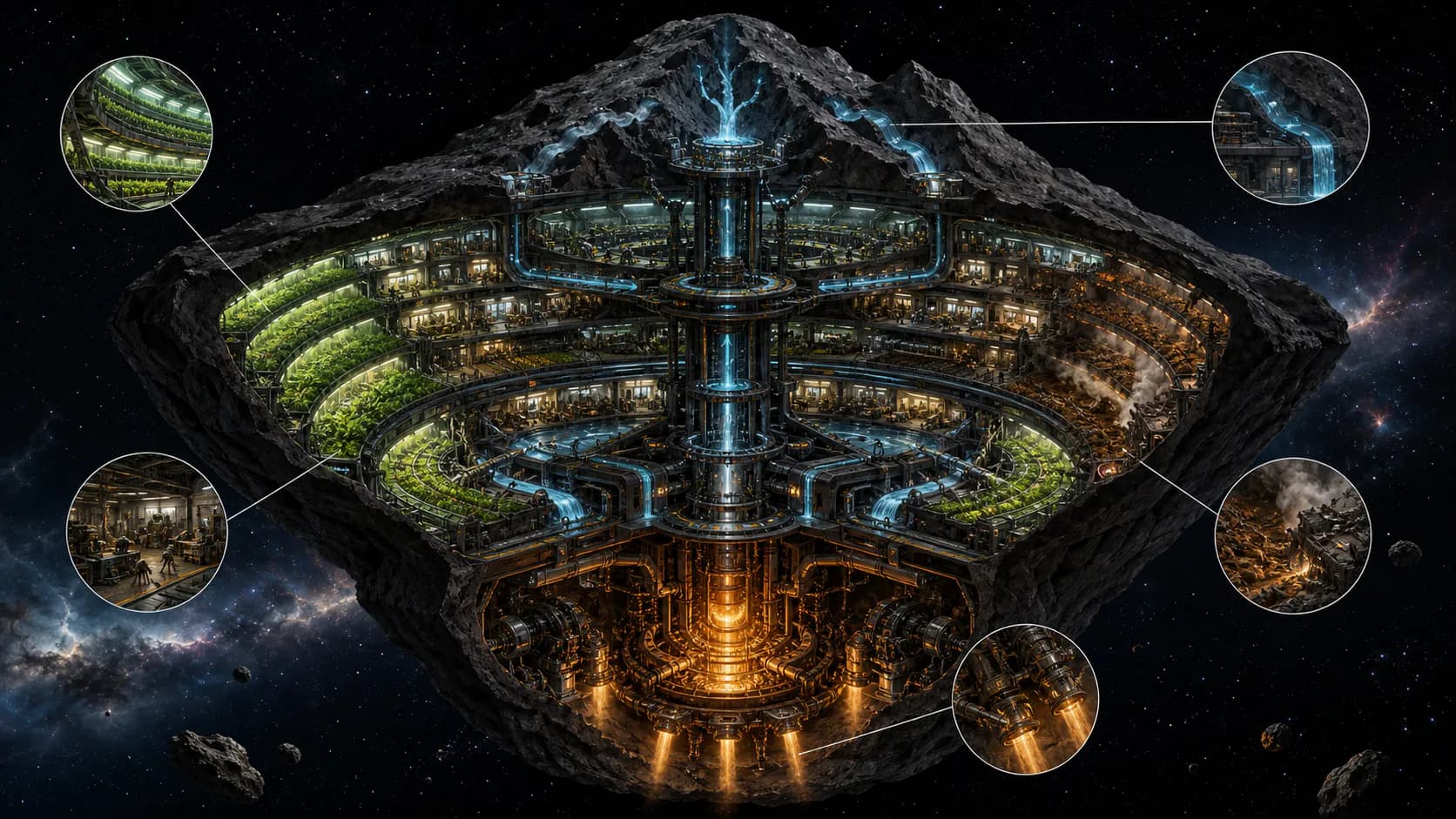
When weightlessness stunts crops, Peerless reveals that food, gravity, heat, and maintenance form one coupled survival system.
Visual example · A mountain becomes a coupled living system
Societal scale
Balanced · Demanding
The Eternal Flame
Peerless cannot treat population, food, forest, fuel, or heat as separate ledgers because every extra life and experiment changes the same finite habitat.
Human scale
Hopeful · Accessible
The Martian
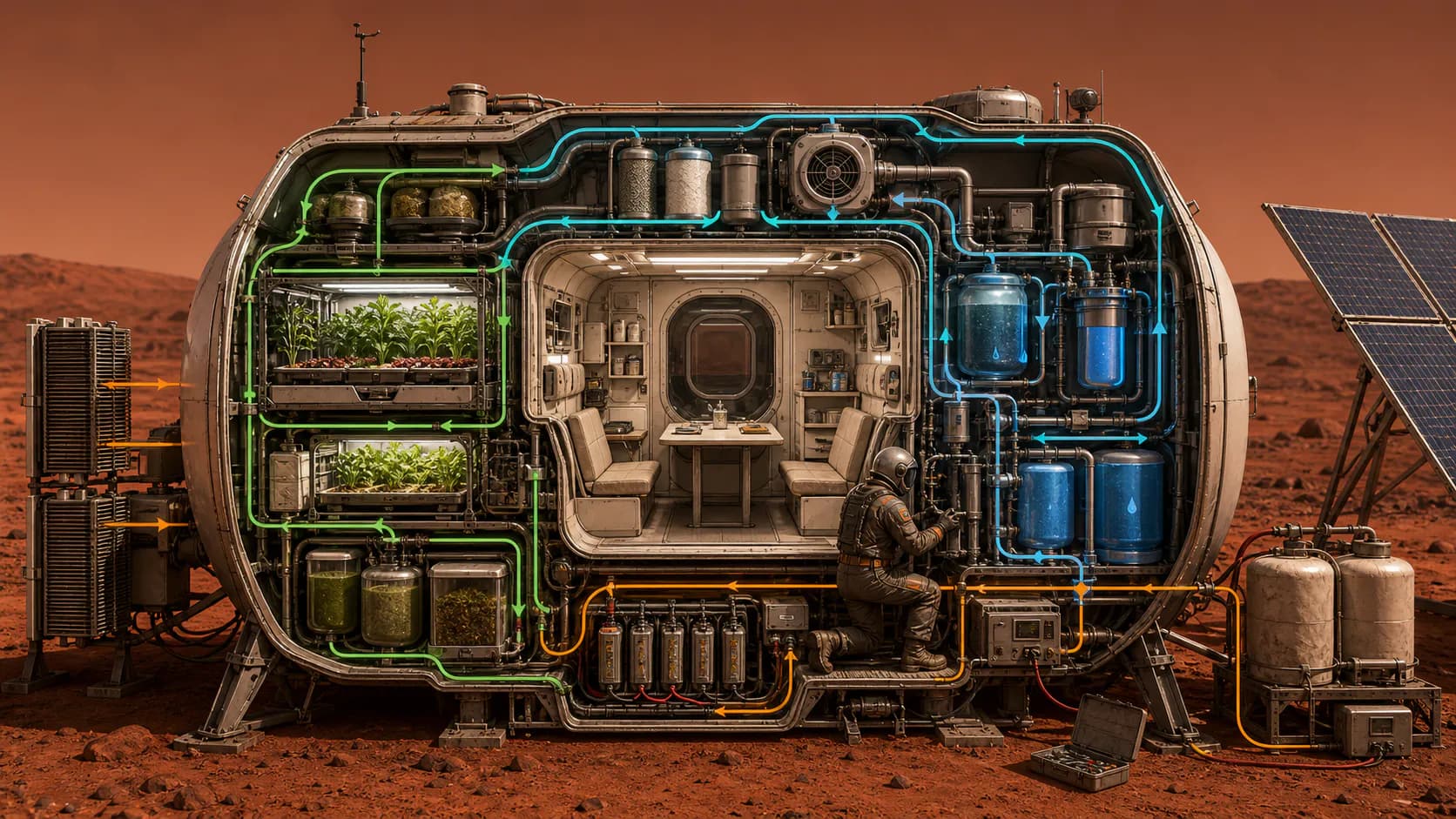
Mark turns short-mission equipment into a coupled habitat where every breath, drink, calorie, watt, and repair changes the time he has left.
Visual example · A short-stay habitat becomes a survival system
Questions to keep thinking about
Where does the habitat still depend on outside mass, energy, or expertise?
Which failure can spread furthest before the crew notices it?
Who performs the continuous maintenance that makes apparent self-sufficiency possible?
Sources and further reading
These references ground the portable lesson; story interpretations remain editorial analysis.