
The idea in plain English
Plain idea
What changes
Orbital mechanics explains how spacecraft move while continually falling around a planet, moon, or star, and how timed velocity changes reshape where that fall will carry them.
Mechanism
How it operates
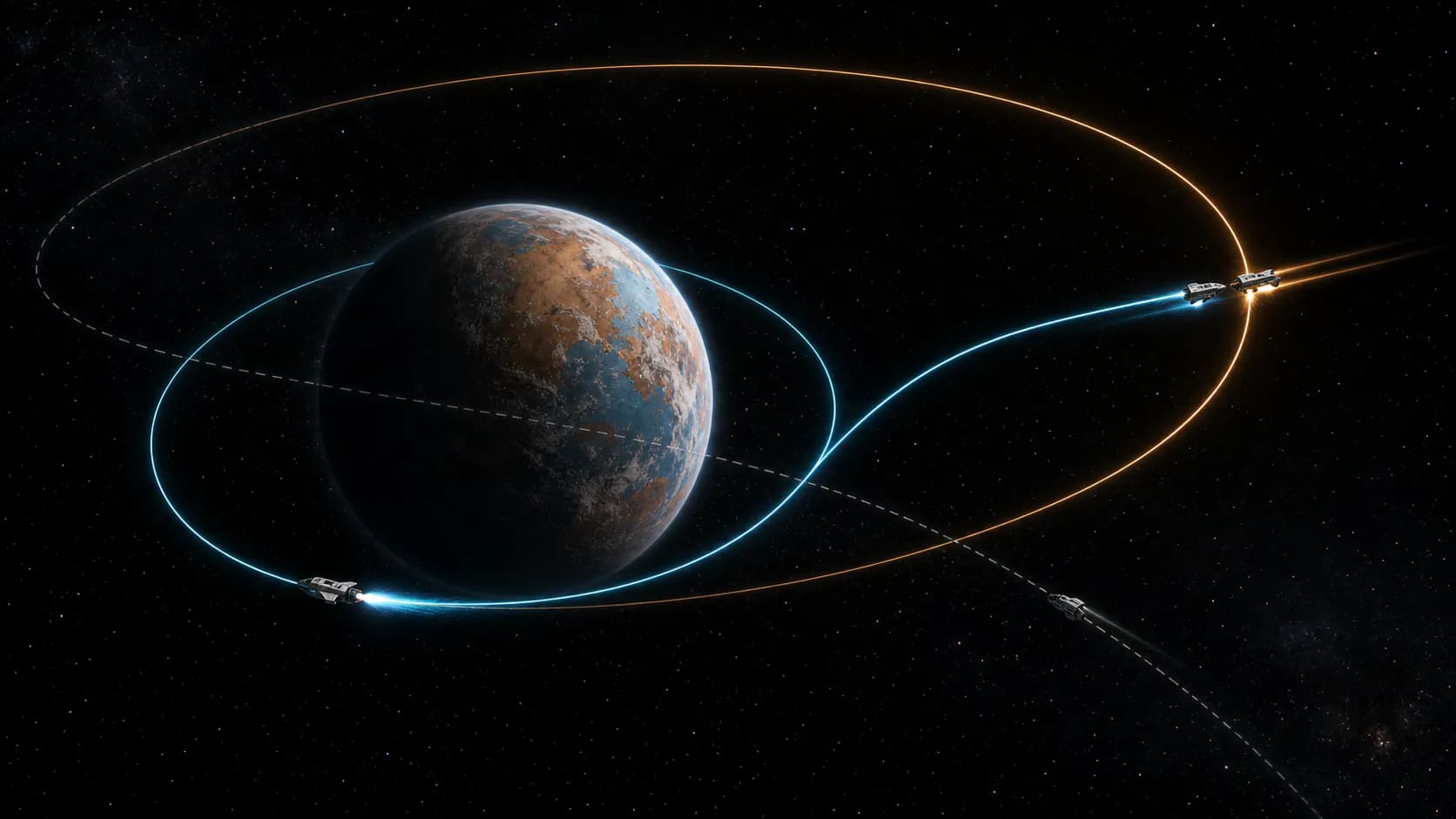
A spacecraft's position and velocity define a curved path through gravity. A burn adds or removes velocity at one point, changing the energy, shape, and timing of the later orbit. For rendezvous, two craft must reach the same place at the same time and also reduce their relative velocity; paths that merely cross do not create a safe meeting.
Human stakes
Why it matters
Mission geometry turns time into a physical constraint. Launching too early, correcting too late, or arriving with the wrong velocity can consume scarce propellant, miss a rescue window, or make contact destructive. Navigation is therefore a chain of predictions and commitments rather than ordinary steering.
Used in: 2 catalog novels
Related: Spacecraft propulsion · Interstellar travel · Relativistic time dilation
A few terms make the rest of the explanation easier to follow.
- State vector
- The position and velocity that together specify a spacecraft's motion at one time in a chosen reference frame.
- Transfer orbit
- A trajectory designed to move a spacecraft from one orbit or encounter condition to another.
- Rendezvous
- An encounter in which two spacecraft reach nearly the same position and velocity at the same time.
- Launch window
- A limited interval when the geometry of departure, destination, and available propulsion permits the intended route.
Use the idea while reading
Turn the definition into three observations
Do not begin by asking whether a novel is “about” orbital mechanics. Begin with what changes in the lives of its characters, then use the concept to explain the mechanism underneath that change.
- 01
Notice when and where each burn occurs rather than only how powerful it is.
- 02
Notice whether the craft must match velocity, dock, fly by, land, or escape.
- 03
Notice how launch windows and late corrections change time and propellant margins.
Keep one question open: Which position and velocity must coincide for the mission to succeed?
Avoid the shortcut: A spacecraft usually cannot point directly at a moving target and accelerate until it arrives. Direct pursuit changes the orbit continuously, may waste propellant, and can reach the target with a dangerous closing speed.
How it works, step by step
- 1
Determine the current orbit
Tracking data and a gravitational model estimate position and velocity, including uncertainty that grows between observations.
- 2
Design the future encounter
Mission planners choose a path whose arrival time, direction, speed, lighting, communication, and fuel use satisfy the objective.
- 3
Apply a timed velocity change
A burn at one location changes orbital energy and geometry, affecting where the spacecraft will be much later rather than steering directly toward a target.
- 4
Correct and match conditions
Later measurements guide smaller corrections, while rendezvous or orbit insertion requires reducing relative velocity instead of merely crossing the same point.
A concrete example
Two paths cross without a meeting
Two spacecraft trajectories pass through the same point above a planet, one at noon moving east and one six minutes later moving north.
01
A map of the curves suggests an intersection, but the vehicles occupy the location at different times and cannot interact.
02
Changing the first craft's burn time can move its arrival to noon, yet the north-east relative velocity could still make contact destructive.
03
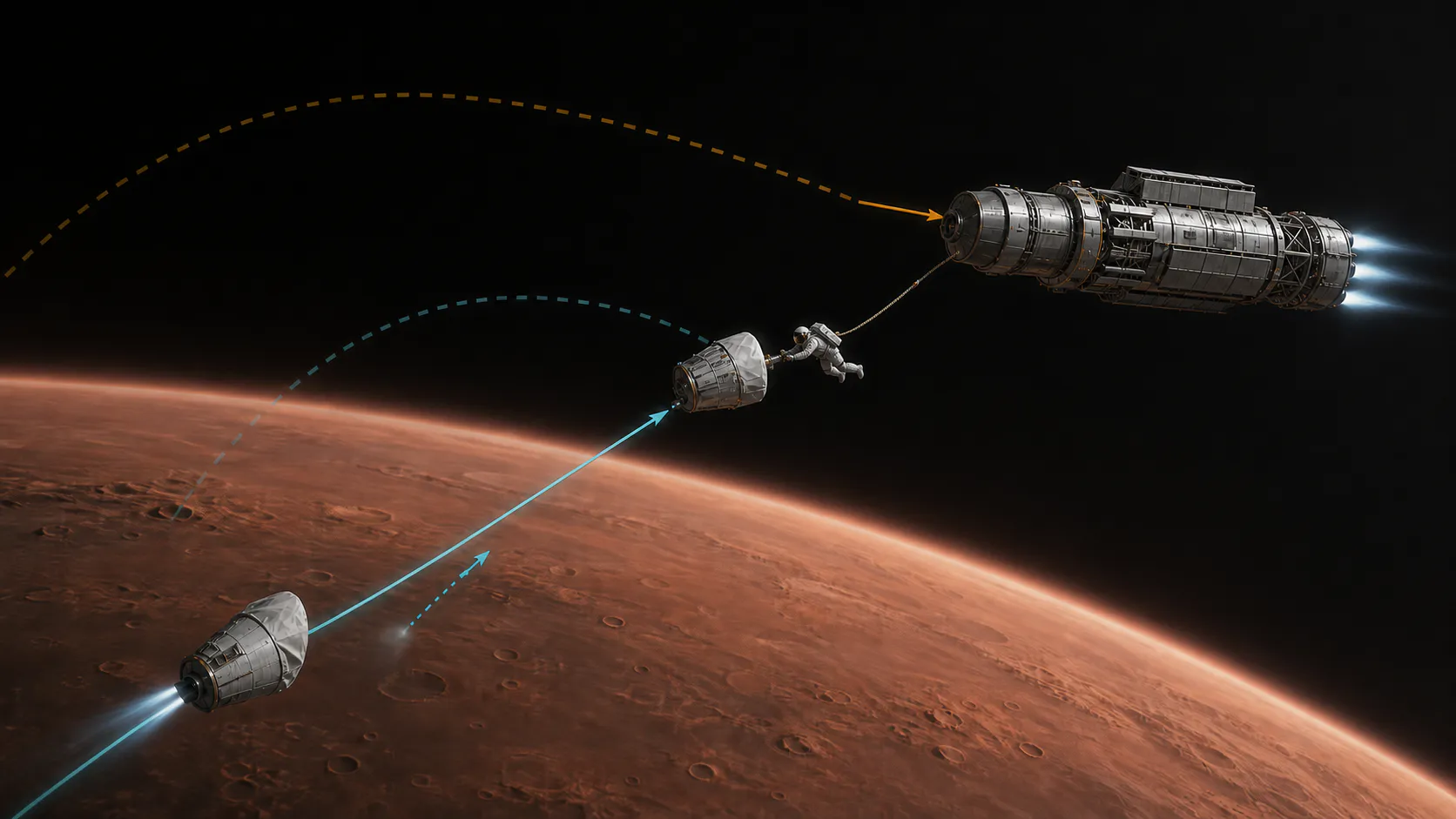
A true rendezvous needs additional maneuvers that align timing and remove most of the closing speed before approach.
The point
Orbital success requires matching place, time, and velocity. A route that looks direct on a map can miss or collide because motion is part of the destination.
What is real, and what remains uncertain
First separate what we can observe or build today from what remains a prediction or a fictional extension.
What evidence supports it
Established physics and active mission practice
Newtonian gravity, orbital transfers, gravity assists, rendezvous, and station keeping guide real satellites and crewed spacecraft. Fictional missions may use speculative engines, but their paths still expose the same position, velocity, timing, and propellant constraints.
A common misunderstanding
A spacecraft usually cannot point directly at a moving target and accelerate until it arrives. Direct pursuit changes the orbit continuously, may waste propellant, and can reach the target with a dangerous closing speed.
Try this example in your head
Two craft pass through the same point above a planet. One arrives at noon moving east; the other arrives six minutes later moving north. Their paths cross on a map, but they never meet. What changes would create a true rendezvous?
Simple models are approximations
Two-body calculations are powerful, but real navigation includes nonspherical gravity, other bodies, atmosphere, radiation pressure, thrust error, and measurement uncertainty.
Later correction usually costs more
Waiting can reduce the time over which a small velocity change accumulates into a useful position change, demanding more propellant or eliminating the window.
How science fiction tests the idea
Stories usually test both the promise of an idea and the trouble it creates.
Its promise
Predictable orbital paths let carefully timed missions reach places that direct flight could not afford.
Its problem
Narrow timing and velocity margins can turn a small error into a missed encounter with no cheap correction.
What to notice in a story
- 01
When and where each burn occurs rather than only how powerful it is
- 02
Whether the craft must match velocity, dock, fly by, land, or escape
- 03
How launch windows and late corrections change time and propellant margins
Novels that use this idea
Civilization scale
Cautious · Accessible
Leviathan Wakes
An ice-hauler officer and a Belt detective follow one missing woman into a conspiracy capable of turning political tension into system-wide war.
Human scale
Hopeful · Accessible
The Martian
The rescue becomes possible only when surface preparation, launch timing, transfer geometry, and relative velocity converge at one moving point above Mars.
Visual example · A rescue must close distance and relative speed
Questions to keep thinking about
Which position and velocity must coincide for the mission to succeed?
What cost grows when a correction is delayed?
Does the plan require a stable orbit, a transfer, a flyby, or a full rendezvous?
Sources and further reading
These references ground the portable lesson; story interpretations remain editorial analysis.