
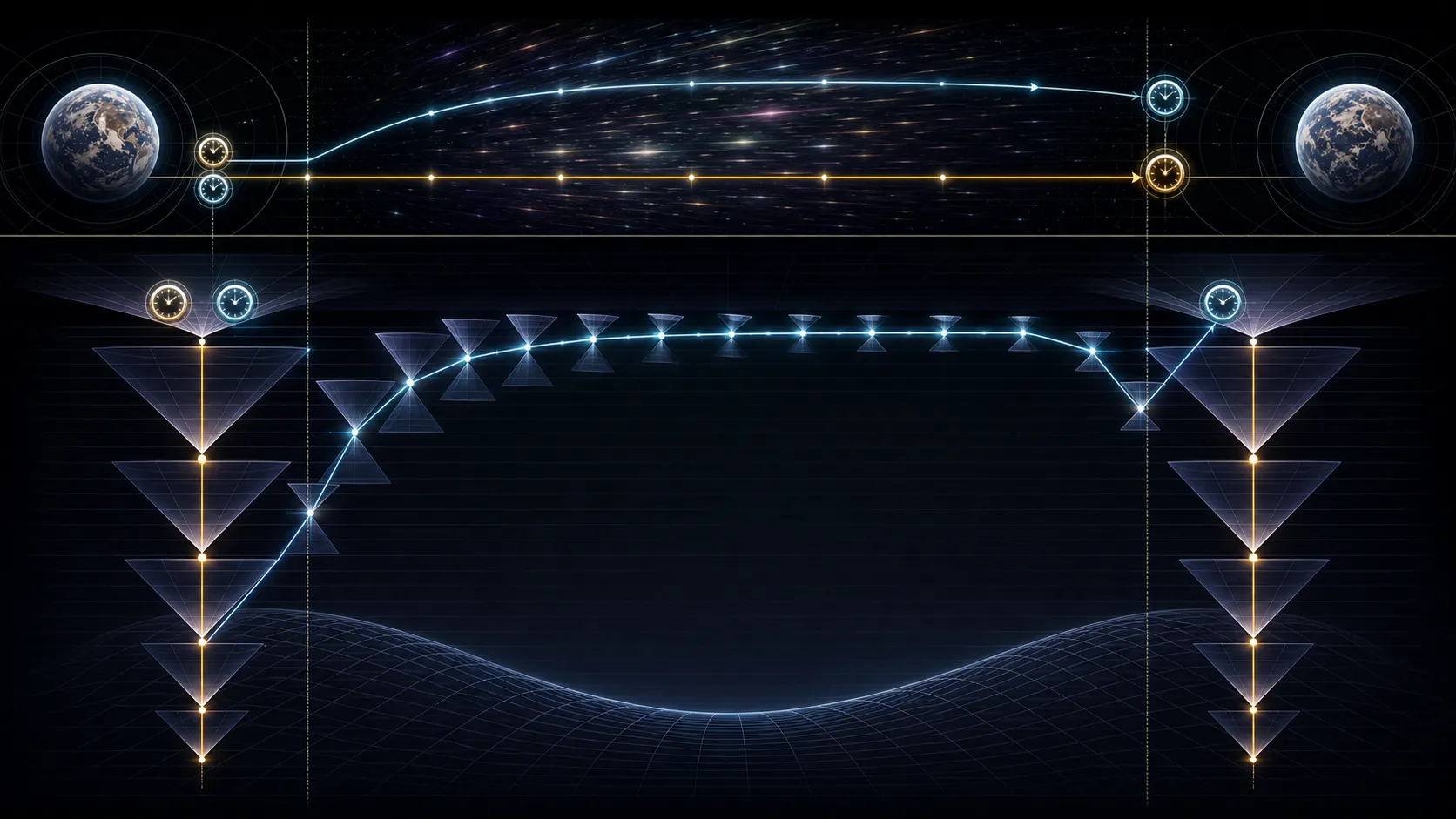
The idea in plain English
Plain idea
What changes
Relativistic time dilation means two observers can follow different paths through motion or gravity and accumulate different amounts of elapsed time between meetings.
Mechanism
How it operates
At speeds close to light, a traveler's proper time can be shorter than the time measured in the departure frame. Stronger gravity can also slow elapsed time relative to a more distant observer; each local clock still feels normal to its owner.
Human stakes
Why it matters
Relativity can put distant travel inside one lifetime while making home age far faster. It turns speed into social separation: return may mean entering the future rather than rejoining the people who launched the mission.
Used in: 3 catalog novels
Related: Time travel and temporal displacement · Interstellar travel · Spacecraft propulsion
A few terms make the rest of the explanation easier to follow.
- Reference frame
- A coordinated way of assigning positions and times to events relative to an observer or system of observers.
- Proper time
- The elapsed duration recorded by a clock that travels along the path being measured.
- Lorentz factor
- A quantity that grows as relative speed approaches light speed and relates time, distance, energy, and momentum between inertial frames.
- Worldline
- The complete path of an object through spacetime, including where and when each event along its history occurs.
Use the idea while reading
Turn the definition into three observations
Do not begin by asking whether a novel is “about” relativistic time dilation. Begin with what changes in the lives of its characters, then use the concept to explain the mechanism underneath that change.
- 01
Notice which observers and clocks the story is comparing.
- 02
Notice whether acceleration and braking make a reunion possible.
- 03
Notice how unequal elapsed time changes relationships, ownership, and authority.
Keep one question open: Whose frame defines words such as now, late, or future?
Avoid the shortcut: The traveler does not feel time slow and no universal master clock is being cheated. Different paths through spacetime contain different elapsed durations when clocks are compared again.
How it works, step by step
- 1
Synchronize clocks at one event
Two observers begin together so their clocks and departure event can be compared without ambiguity.
- 2
Follow different spacetime paths
One observer travels at high relative speed or occupies a different gravitational potential while each local clock continues ticking normally.
- 3
Reunite or exchange measurements
When the observers compare records again, their paths can contain different amounts of proper time even though neither experienced a malfunctioning clock.
- 4
Translate the difference into history
Unequal elapsed time changes ages, institutions, ownership, relationships, and the meaning of return, not merely the display on an instrument.
A concrete example
A five-year voyage and a fifty-year homecoming
A pilot completes a high-speed round trip and experiences five years while fifty years pass for the departure society.
01
During every local moment, the pilot's heartbeat and clock feel ordinary; there is no sensation of time being slowed.
02
The complete outbound and return path differs from the path of the home clock, especially because the pilot changes direction to reunite.
03
At reunion, both clocks occupy the same event and can directly reveal the unequal durations accumulated along their worldlines.
The point
Time dilation is not an optical illusion or a universal clock running badly. Different paths through spacetime can contain different elapsed time, with irreversible social consequences.
What is real, and what remains uncertain
First separate what we can observe or build today from what remains a prediction or a fictional extension.
What evidence supports it
Established physics
Velocity- and gravity-based time dilation are repeatedly measured and included in technologies such as satellite navigation. Extreme story-scale journeys remain engineering challenges.
A common misunderstanding
The traveler does not feel time slow and no universal master clock is being cheated. Different paths through spacetime contain different elapsed durations when clocks are compared again.
Try this example in your head
A pilot experiences five years on a near-light-speed round trip while fifty years pass at home. The mission succeeds physically, but every institution that authorized it has changed.
Extreme effects demand extreme conditions
Measured time dilation is routine in precision clocks and satellite systems, but large human-scale differences require speeds or gravitational fields far beyond ordinary travel.
A quoted speed is not a full journey
Acceleration, turnaround, braking, energy, radiation, and collision hazards determine whether separated observers can actually reunite.
How science fiction tests the idea
Stories usually test both the promise of an idea and the trouble it creates.
Its promise
Relativity can make a distant journey fit within one traveler's lifetime.
Its problem
The same journey can make return a permanent separation from everyone who remained behind.
What to notice in a story
- 01
Which observers and clocks the story is comparing
- 02
Whether acceleration and braking make a reunion possible
- 03
How unequal elapsed time changes relationships, ownership, and authority
Novels that use this idea
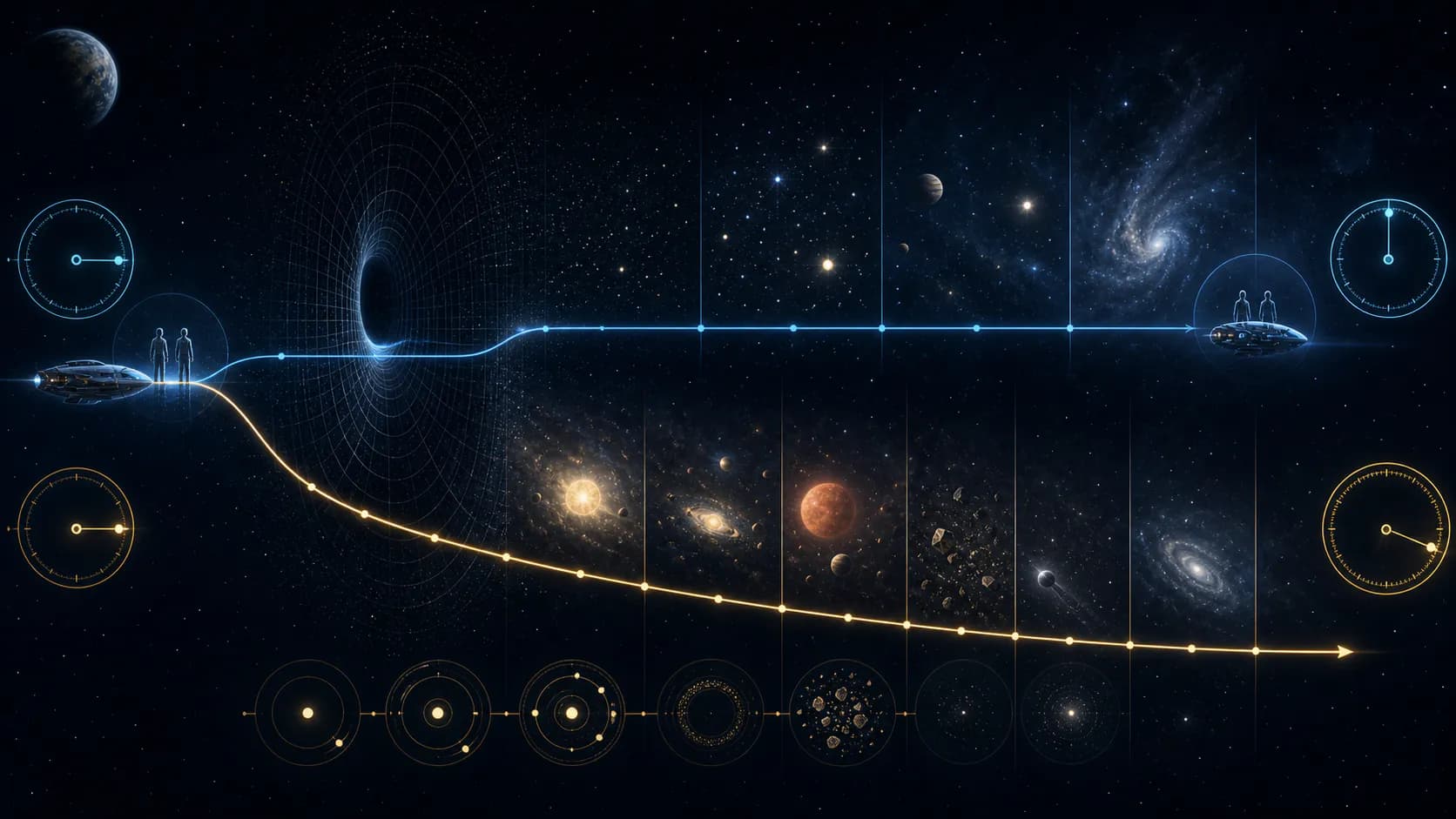
Cosmic scale
Dark · Demanding
Death’s End
A short local interval near altered spacetime becomes millions of external years, making an intended reunion physically impossible.
Visual example · When one short delay consumes the future
Cosmic scale
Dark · Demanding
Hyperion
Seven pilgrims travel toward a time-reversing valley and the Shrike, telling the stories that made each of them part of the same approaching catastrophe.
Cosmic scale
Cautious · Layered
Pushing Ice
A mining crew chases Saturn's departing moon Janus for a brief look at an alien machine. The chase becomes a one-way journey that turns a shipboard disagreement into a civilization's history.
Questions to keep thinking about
Whose frame defines words such as now, late, or future?
What human promise becomes impossible when the clocks separate?
Is relativistic travel used as access to distance, escape from history, or both?
Sources and further reading
These references ground the portable lesson; story interpretations remain editorial analysis.