
The idea in plain English
Plain idea
What changes
Temporal displacement is any separation between a character's experienced time and the chronology shared by the people, places, or history around them.
Mechanism
How it operates
Stories produce that separation in different ways. Suspension reduces experienced biological time, relativity produces real differences in elapsed time, and backward travel or causal loops require speculative changes to ordinary cause and effect.
Human stakes
Why it matters
Leaving shared time turns travel into loss. A displaced person may outlive relationships, arrive after institutions have changed, or gain knowledge that complicates responsibility for events others still experience normally.
Used in: 7 catalog novels
Related: Memory technology · Suspended animation · Relativistic time dilation
A few terms make the rest of the explanation easier to follow.
- Proper time
- The duration measured by a clock traveling along one particular path through spacetime.
- Temporal displacement
- A separation between the time a traveler experiences and the chronology experienced by their surroundings.
- Causal loop
- A speculative path in which information or action returns to an earlier event and becomes part of its own history.
Use the idea while reading
Turn the definition into three observations
Do not begin by asking whether a novel is “about” time travel and temporal displacement. Begin with what changes in the lives of its characters, then use the concept to explain the mechanism underneath that change.
- 01
Notice which clock measures the traveler's experience.
- 02
Notice what changes in society while the traveler is absent.
- 03
Notice whether information or action can move backward into an established past.
Keep one question open: What exactly is being displaced: body, awareness, information, or cause and effect?
Avoid the shortcut: Traveling into the future through sleep or relativity does not reverse causality. It changes how much time the traveler experiences, not whether earlier events can be altered.
How it works, step by step
- 1
Choose the moving thing
A story must specify whether a body, consciousness, information pattern, or causal influence is moving away from ordinary shared chronology.
- 2
Name the physical or speculative mechanism
Suspension changes biology, relativity changes elapsed duration along paths, and backward travel requires a spacetime or causal structure beyond ordinary experience.
- 3
Compare clocks and records
The traveler, home society, instruments, and historical archives may accumulate different durations or disagree about which events are already fixed.
- 4
Apply the causality rule consistently
Fixed, branching, revisable, and self-consistent histories produce different consequences; a story becomes confusing when it changes rules only to rescue a plot event.
A concrete example
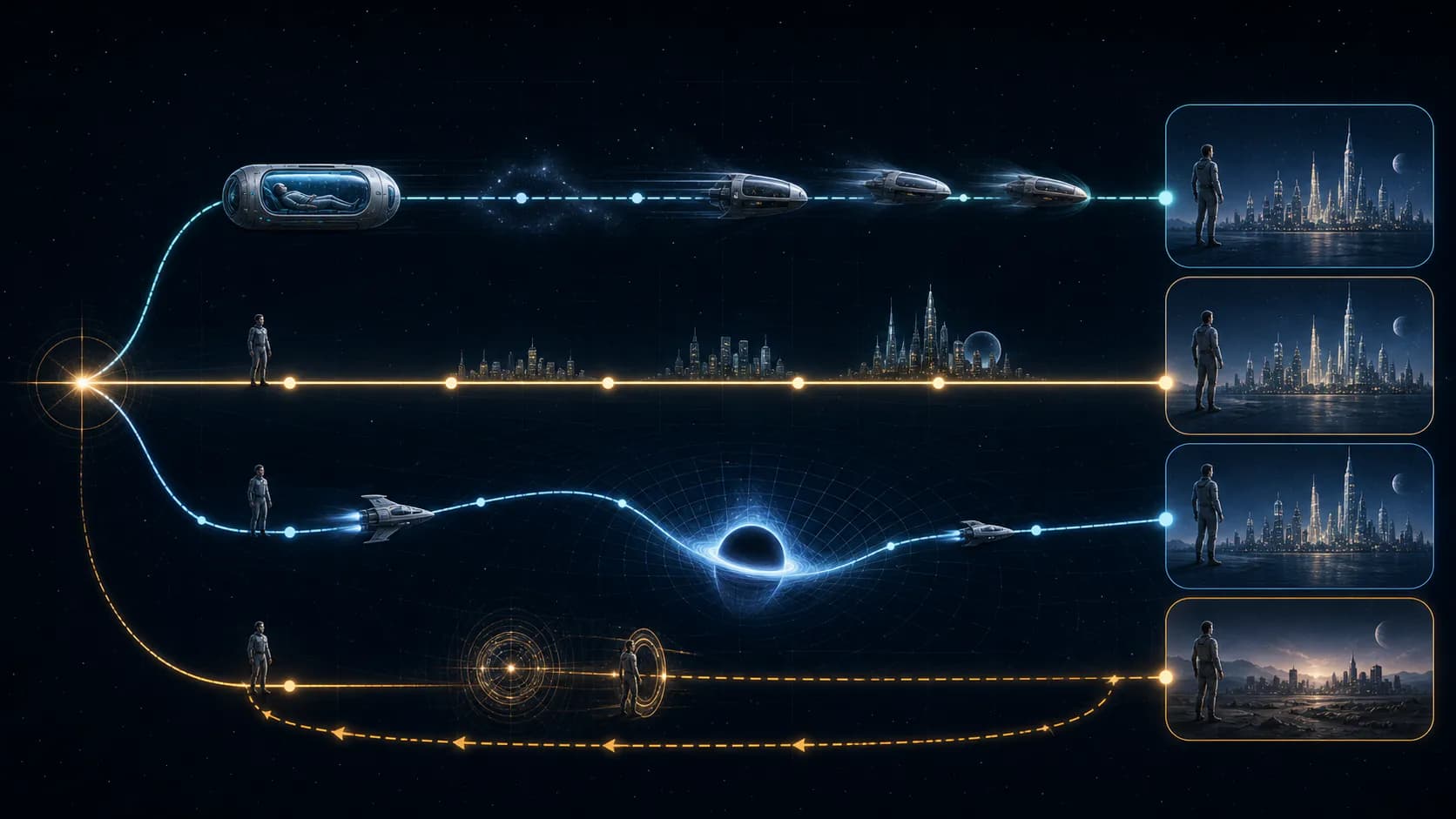
Three travelers called time travelers
One person sleeps for a century, one completes a relativistic round trip, and one carries a message back to yesterday.
01
The sleeper experiences little biological time, but every external clock advances normally and no earlier event is changed.
02
The relativistic traveler follows ordinary forward causality while accumulating less proper time than people who remain at home.
03
Only the backward message reaches an established past, so it must obey a rule about paradox, branching, or self-consistency.
The point
The phrase time travel hides different mechanisms. Identifying the displaced object, clocks, and causality rule prevents biological skipping and relativistic aging from being confused with changing the past.
What is real, and what remains uncertain
First separate what we can observe or build today from what remains a prediction or a fictional extension.
What evidence supports it
Established effects plus speculation
Relativistic time differences are measured and biological suspension has limited analogues. Backward time travel and controllable causal loops remain speculative.
A common misunderstanding
Traveling into the future through sleep or relativity does not reverse causality. It changes how much time the traveler experiences, not whether earlier events can be altered.
Try this example in your head
One traveler sleeps for a century, another experiences only five years because of relativistic flight, and a third returns to yesterday. All are called time travelers, but only one creates a causal paradox.
Future travel is not one phenomenon
Suspension and relativity can both separate experienced time from history, but they use different biology and physics and create different engineering constraints.
Backward travel is unverified
Relativity permits unusual spacetime solutions in theory, yet no experiment has demonstrated controllable travel or communication into an established past.
How science fiction tests the idea
Stories usually test both the promise of an idea and the trouble it creates.
Its promise
Crossing time can free a person from the limits of one lifetime.
Its problem
Skipping time transfers history's lived cost to people who cannot skip it.
What to notice in a story
- 01
Which clock measures the traveler's experience
- 02
What changes in society while the traveler is absent
- 03
Whether information or action can move backward into an established past
Novels that use this idea

Cosmic scale
Hopeful · Layered
Contact
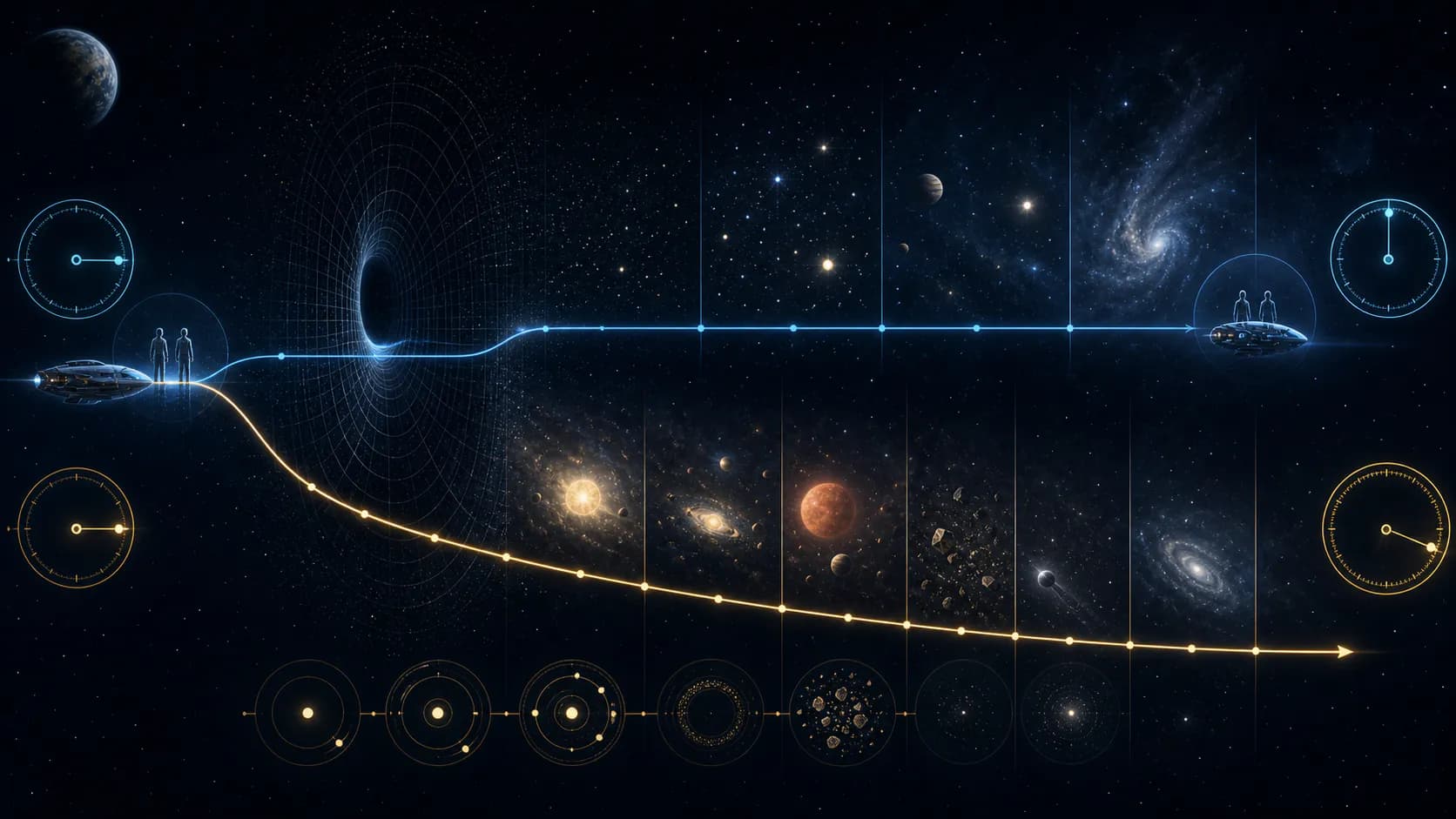
The travelers' day and Earth's twenty minutes expose how unusual paths through spacetime can make witnesses and instruments disagree without either clock feeling broken.
Visual example · One event produces two incompatible records
Cosmic scale
Dark · Demanding
Death’s End
Hibernation, light-speed flight, and altered spacetime turn chronology into infrastructure that separates intention from consequence.
Visual example · When one short delay consumes the future
Civilization scale
Cautious · Layered
Endymion
Centuries after the WorldWeb falls, Raul Endymion rescues a girl from the Time Tombs and flees a resurrection empire through the dead paths of its former portals.
Cosmic scale
Dark · Demanding
Hyperion
Seven pilgrims travel toward a time-reversing valley and the Shrike, telling the stories that made each of them part of the same approaching catastrophe.

Civilization scale
Hopeful · Demanding
The Arrows of Time
Messages sent around a closed path through opposing time arrows can return as apparently prior knowledge, but the loop changes who gets to choose and who merely complies.
Visual example · A shortcut to future answers can close the present
Cosmic scale
Cautious · Demanding
The Fall of Hyperion
As war reaches Hyperion, a new Keats cybrid dreams the pilgrims' fates and helps expose that humanity's instant-travel network is also the TechnoCore's hidden body.
Cosmic scale
Hopeful · Demanding
The Rise of Endymion
Aenea begins teaching a direct, embodied alternative to Pax resurrection while Raul crosses years of time debt to rejoin her before the Core closes its trap.
Questions to keep thinking about
What exactly is being displaced: body, awareness, information, or cause and effect?
Who bears the years the traveler avoids?
Does the story treat history as fixed, branching, revisable, or self-consistent?
Sources and further reading
These references ground the portable lesson; story interpretations remain editorial analysis.