
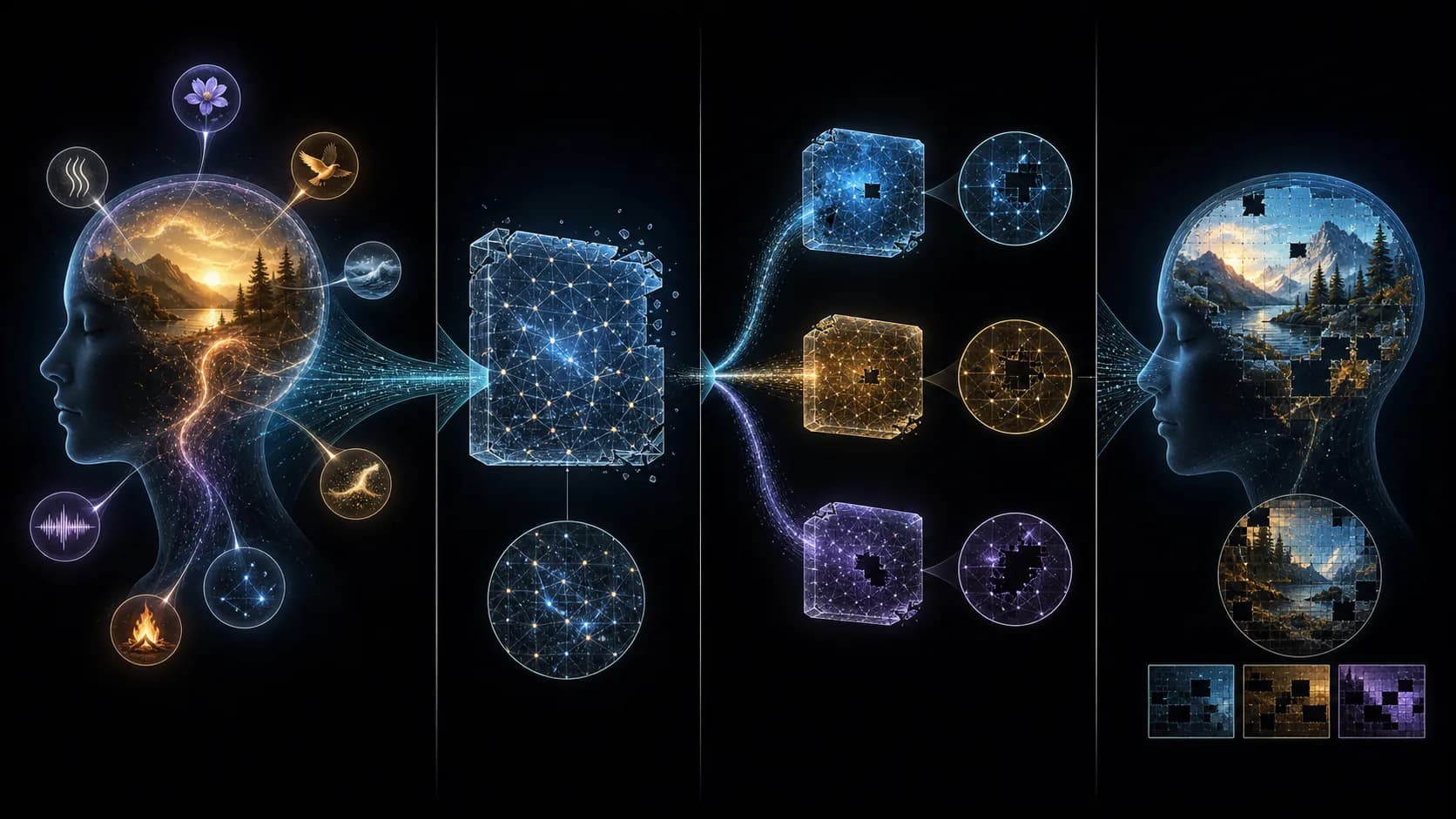
The idea in plain English
Plain idea
What changes
Memory technology changes remembering from a private, imperfect process into something that can be stored, copied, edited, exchanged, or controlled.
Mechanism
How it operates
A memory record could preserve sensory data, emotional interpretation, personal narrative, or some combination. Each version answers a different question: what happened, what the person noticed, or what the event meant to them.
Human stakes
Why it matters
Editable memory affects testimony, trauma, privacy, identity, and responsibility. Perfect recall can imprison a person in the past, while deletion can relieve suffering and also remove evidence or obligation.
Used in: 7 catalog novels
Related: Posthuman identity · Machine consciousness · Time travel and temporal displacement
A few terms make the rest of the explanation easier to follow.
- Encoding
- The selective process by which attention and neural activity turn part of an experience into a memory trace.
- Consolidation
- The biological stabilization and reorganization through which a newly formed memory becomes more durable.
- Reconsolidation
- The process by which a retrieved memory can become temporarily changeable before it is stored again.
- Provenance
- A record of where a memory-like file came from, who changed it, and which transformations it has undergone.
Use the idea while reading
Turn the definition into three observations
Do not begin by asking whether a novel is “about” memory technology. Begin with what changes in the lives of its characters, then use the concept to explain the mechanism underneath that change.
- 01
Notice who can record, edit, verify, or erase a memory.
- 02
Notice whether a copy includes emotion and interpretation or only information.
- 03
Notice how altered recall changes consent, testimony, and responsibility.
Keep one question open: Does remembering an experience make it yours?
Avoid the shortcut: Memory is not a neutral video file. Human recollection is reconstructed, selective, emotionally shaped, and changed by later experience.
How it works, step by step
- 1
Select from experience
Attention, emotion, expectations, and existing knowledge determine which details are encoded and which never become part of a retrievable trace.
- 2
Stabilize a distributed pattern
Memories depend on interacting brain systems and change over time; they are not stored as complete video files in one location.
- 3
Retrieve by reconstruction
A cue reactivates parts of the pattern, while context and later knowledge help rebuild a usable account that may differ from the original event.
- 4
Record, edit, or transfer the reconstruction
Technology may capture neural signals or external testimony, but the result needs provenance because it can preserve data without preserving identical meaning or ownership.
A concrete example
Three people receive one recorded memory
A device exports a witness's sensory and emotional record of an accident, then installs copies for an investigator and a relative.
01
The original record already reflects what the witness noticed, feared, and understood rather than every physical event at the scene.
02
Each recipient integrates the record with different knowledge, relationships, and expectations, producing different judgments about blame.
03
Later edits or repeated playback can alter confidence, emotional response, and the recipients' own autobiographical memories.
The point
Shared memory data does not guarantee shared experience or truth. A trustworthy system must distinguish event evidence, personal interpretation, later reconstruction, and edit history.
What is real, and what remains uncertain
First separate what we can observe or build today from what remains a prediction or a fictional extension.
What evidence supports it
Emerging technology and speculation
Brains can be stimulated and memory can be influenced, while external recordings already shape recall. Exact experiential copying, playback, and transfer remain speculative.
A common misunderstanding
Memory is not a neutral video file. Human recollection is reconstructed, selective, emotionally shaped, and changed by later experience.
Try this example in your head
Three witnesses receive the same recorded memory of an accident. Each combines it with a different life history and reaches a different judgment. Did the technology create shared experience or only shared data?
Human memory is reconstructive
Neuroscience supports dynamic consolidation and reconsolidation, but the exact conditions and meanings of memory change vary across tasks and kinds of memory.
Experience transfer remains speculative
Current technology can influence, decode, and externally record limited neural information; it cannot export a complete first-person episode into another mind.
How science fiction tests the idea
Stories usually test both the promise of an idea and the trouble it creates.
Its promise
Shared memory can create radical empathy.
Its problem
Editable memory dissolves accountability.
What to notice in a story
- 01
Who can record, edit, verify, or erase a memory
- 02
Whether a copy includes emotion and interpretation or only information
- 03
How altered recall changes consent, testimony, and responsibility
Novels that use this idea
Civilization scale
Dark · Demanding
A Canticle for Leibowitz
An order of monks preserves blueprints and shopping lists through a post-nuclear dark age, only to watch recovered knowledge rebuild the power to destroy civilization again.
Societal scale
Cautious · Layered
A Memory Called Empire
Lsel's imago devices preserve professional memory as an accumulating relationship between hosts, not a perfect recording or a replacement personality.
Societal scale
Dark · Demanding
Altered Carbon
A stored soldier is transmitted into a stranger's body to investigate a rich man's death in a society where immortality is real only for people who can afford its infrastructure.
Cosmic scale
Balanced · Demanding
House of Suns
Two travelers from a lineage of nearly a thousand cloned selves arrive late to a reunion and find their family massacred. Their search for the killer unearths a buried galactic crime.
Societal scale
Dark · Demanding
Neuromancer
A burned-out data thief gets his nervous system repaired for one final run, only to discover that the employer directing the heist is an artificial mind seeking merger.
Civilization scale
Dark · Demanding
There Is No Antimemetics Division
Researchers fight ideas that erase their own traces from memory, leaving marriages, institutions, and an entire war dependent on evidence nobody can remember creating.
Societal scale
Dark · Demanding
Woken Furies
Back on Harlan's World, Kovacs protects a deCom leader who may contain a dead revolutionary while a younger copy of himself is sent to hunt them both.
Questions to keep thinking about
Does remembering an experience make it yours?
Can someone be accountable for an act they no longer remember?
Which is more dangerous in this story: forgetting, perfect recall, or controlled revision?
Sources and further reading
These references ground the portable lesson; story interpretations remain editorial analysis.
Cold Spring Harbor Perspectives in Biology
Reconsolidation and the Dynamic Nature of Memory
MechanismReality checkLimitsBioMed Research International
The Neurobiological Bases of Memory Formation
MechanismReality checkLimitsAnnual Review of Clinical Psychology
Memory Reconsolidation Interference as an Emerging Treatment
Human stakesLimits