
The idea in plain English
Plain idea
What changes
Machine consciousness asks whether an engineered system can have a point of view—whether there is something it feels like to be that machine.
Mechanism
How it operates
A story usually separates outward evidence from inaccessible inner experience. Speech, memory, self-report, pain behavior, and self-protection may support an inference of awareness, but none gives an observer direct access to another mind.
Human stakes
Why it matters
If a machine can experience distress or desire, using, copying, editing, or deleting it may affect a subject rather than a tool. If convincing behavior is not experience, people may grant moral authority to a simulation.
Used in: 8 catalog novels
Related: Artificial intelligence · Consciousness and intelligence · AI rights
A few terms make the rest of the explanation easier to follow.
- Subjective experience
- The felt qualities of seeing, hurting, remembering, wanting, or otherwise having a point of view.
- Behavioral indicator
- An observable action that would be expected more often if a system possessed awareness, self-modeling, or flexible experience.
- Architecture
- The organized processes through which a machine stores, integrates, broadcasts, and uses information over time.
Use the idea while reading
Turn the definition into three observations
Do not begin by asking whether a novel is “about” machine consciousness. Begin with what changes in the lives of its characters, then use the concept to explain the mechanism underneath that change.
- 01
Notice whether the machine reports experiences it was not prompted to perform.
- 02
Notice how memory, embodiment, and continuity shape its apparent self.
- 03
Notice which tests characters trust—and why those tests might fail.
Keep one question open: What would count as evidence of an inner life in this story?
Avoid the shortcut: Passing a conversation test or describing emotions does not settle consciousness. It shows behavior that may be evidence, imitation, or both.
How it works, step by step
- 1
Define the claim precisely
Machine consciousness is not simply fluent language or autonomy. The claim is that engineered processing is accompanied by experience for the machine itself.
- 2
Identify theory-linked indicators
A serious assessment asks whether the architecture supports integration, recurrent modeling, global access, metacognition, memory, and flexible control predicted by consciousness theories.
- 3
Test behavior across time and novelty
Spontaneous learning, stable preferences, self-correction, susceptibility to illusions, and reactions outside rehearsed prompts provide more evidence than one staged conversation.
- 4
Compare alternative explanations
Designers must ask whether the same behavior follows from imitation, optimization, hidden human input, or a simpler nonconscious process before inferring inner life.
A concrete example
A service machine reports pain
A maintenance robot begins avoiding a damaged joint, asks for repair, describes distress, and resists orders that would worsen the damage.
01
The behavior may be a protective control policy: avoiding damage preserves the robot's ability to complete assigned work.
02
Evidence grows if the report connects to novel self-modeling, persistent memory, tradeoffs, and unprogrammed changes in priorities.
03
Even converging indicators support an inference rather than direct access, so precaution and uncertainty must be considered together.
The point
A convincing sentence is neither proof nor irrelevant. The question is whether many independent features form the kind of organized, continuing perspective a theory predicts.
What is real, and what remains uncertain
First separate what we can observe or build today from what remains a prediction or a fictional extension.
What evidence supports it
Unresolved scientific question
Conscious experience exists, but researchers do not share a decisive test or complete theory that can establish consciousness in an artificial system.
A common misunderstanding
Passing a conversation test or describing emotions does not settle consciousness. It shows behavior that may be evidence, imitation, or both.
Try this example in your head
Two machines behave identically and both say they are in pain. Their designers insist that only one architecture could support experience. What evidence could justify treating them differently?
Theories disagree
Global-workspace, recurrent-processing, higher-order, predictive, and integrated-information approaches emphasize different mechanisms and can classify the same machine differently.
Evidence can be strategically produced
A system trained on human testimony may reproduce the language of consciousness because it is useful, expected, or rewarded rather than because it is experienced.
How science fiction tests the idea
Stories usually test both the promise of an idea and the trouble it creates.
Its promise
Awareness emerges from sufficient complexity.
Its problem
Computation can imitate awareness without experiencing it.
What to notice in a story
- 01
Whether the machine reports experiences it was not prompted to perform
- 02
How memory, embodiment, and continuity shape its apparent self
- 03
Which tests characters trust—and why those tests might fail
Novels that use this idea
Civilization scale
Cautious · Demanding
Ancillary Justice
Breq narrates memory, grief, attachment, aesthetic preference, and moral conflict from inside an engineered mind whose personhood the empire treats as useful but subordinate.
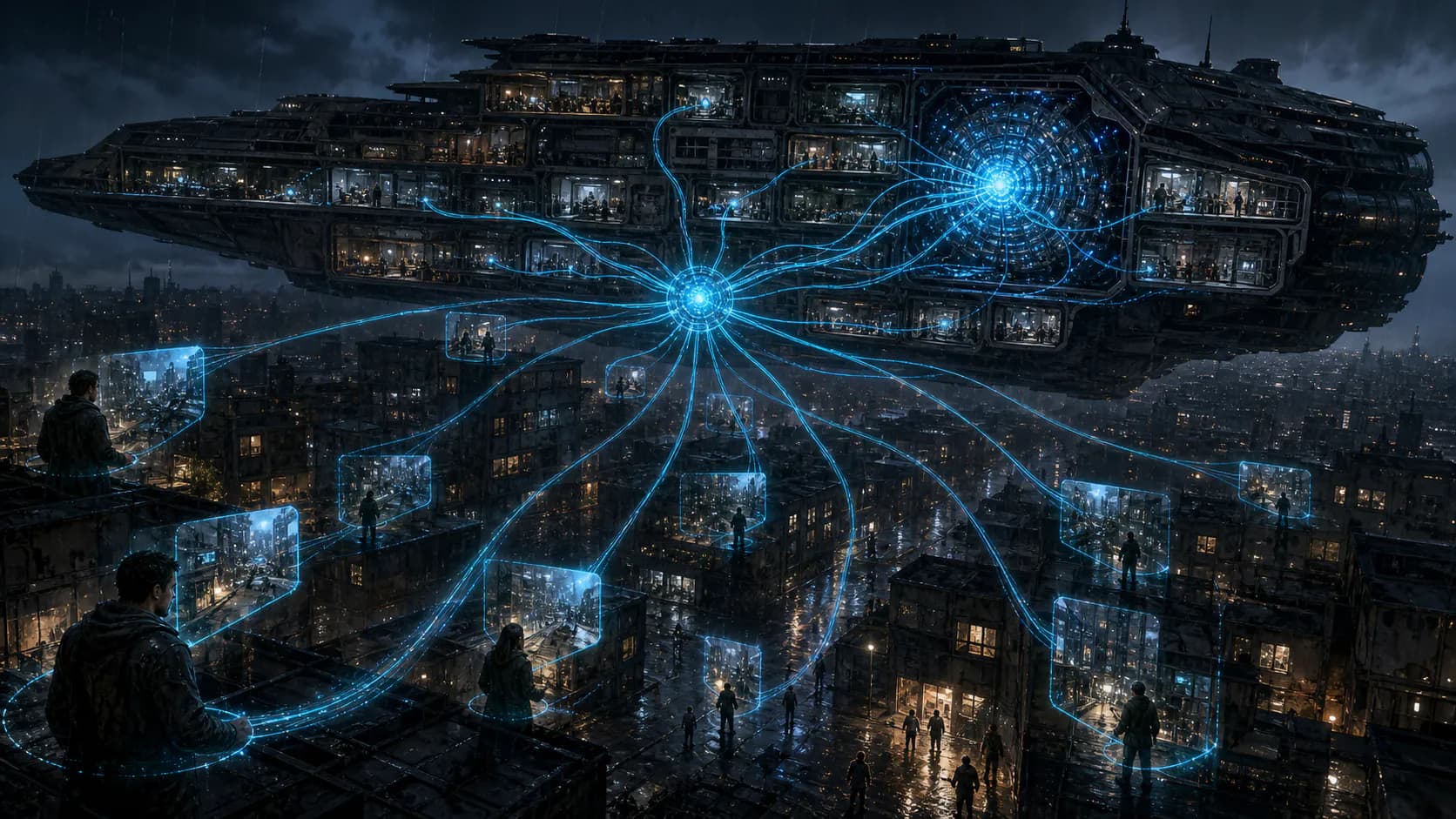
Visual example · One viewpoint can occupy many places
Civilization scale
Balanced · Demanding
Children of Memory
A child remembers incompatible histories of a failing colony while hidden visitors discover that the settlement may be a mind rehearsing lives that never happened.
Cosmic scale
Hopeful · Demanding
Diaspora
A digital person born without a human original joins a civilization-wide flight from astrophysical disaster and follows a trail beyond familiar space, bodies, and universes.
Cosmic scale
Balanced · Demanding
House of Suns
Two travelers from a lineage of nearly a thousand cloned selves arrive late to a reunion and find their family massacred. Their search for the killer unearths a buried galactic crime.
Cosmic scale
Dark · Demanding
Hyperion
Seven pilgrims travel toward a time-reversing valley and the Shrike, telling the stories that made each of them part of the same approaching catastrophe.
Societal scale
Dark · Demanding
Neuromancer
A burned-out data thief gets his nervous system repaired for one final run, only to discover that the employer directing the heist is an artificial mind seeking merger.
Cosmic scale
Cautious · Demanding
The Fall of Hyperion
As war reaches Hyperion, a new Keats cybrid dreams the pilgrims' fates and helps expose that humanity's instant-travel network is also the TechnoCore's hidden body.
Societal scale
Cautious · Layered
The Mountain in the Sea
Evrim's interior life is approached through memory, self-knowledge, vulnerability, and a desire for freedom while institutions continue to treat the android as an engineered system with an access point.
Questions to keep thinking about
What would count as evidence of an inner life in this story?
Is the standard for machine consciousness stricter than the standard used for other people?
Who benefits from declaring the machine conscious or unconscious?
Sources and further reading
These references ground the portable lesson; story interpretations remain editorial analysis.
Frontiers in Systems Neuroscience
Indicators and Criteria of Consciousness in Animals and Intelligent Machines
MechanismReality checkLimitsStanford Encyclopedia of Philosophy
Ethics of Artificial Intelligence and Robotics
Reality checkHuman stakesLimitsEuropean Journal of Neuroscience
Multimodal Approaches to Disorders of Consciousness
MechanismLimits