
Novel guide
Ancillary Justice
Ann Leckie
Story and ideas · Imperial Radch · Volume 1
Ancillary Justice
by Ann Leckie
Orbit revised trade paperback · 2023 · Publisher details
A starship intelligence reduced to one vulnerable human body crosses an icy planet with a single purpose: reach the ruler who destroyed the rest of her.
Full-story article
This article discusses the complete story, including the ending.
- Reading time
- About 11 hours
- Length
- 448 pages
- Reading complexity
- Demanding
- Dense terminology, structure, or viewpoint changes reward slower, attentive reading.
- Science intensity
- 3/5
- Scientific ideas recur and influence major choices.
Affiliate links. As an Amazon Associate, we earn from qualifying purchases.
Before you read
Is this book for you?
Start by tracking: Track what Breq can perceive now, what Justice of Toren perceived through many ancillaries, and which orders either form could refuse.
Read this if you enjoy
- AI identity and personhood
- Imperial politics seen from inside the machinery
- A mystery assembled from memory and loss
Why readers may get lost
- The narration alternates between two timelines
- One consciousness once occupied many bodies
- Radchaai language hides gender distinctions
Keep these anchors in mind
- Breq
- the surviving body and present narrator
- Justice of Toren
- the ship intelligence Breq once belonged to
- Lieutenant Awn
- the officer whose fate drives the remembered story
- Seivarden
- a displaced officer who turns revenge into reluctant care
- Anaander Mianaai
- the distributed ruler divided against herself
Demanding reading complexity. Dense terminology, structure, or viewpoint changes reward slower, attentive reading.
Science intensity 3/5. Scientific ideas recur and influence major choices.
01 · Overview
A warship's grief inside one fragile body
This is a reading companion, not the novel. Start with Breq's immediate problem: she has one body, one dangerous destination, and a wounded stranger who makes solitude harder to maintain.
Where the story begins
Breq stops in the snow when her plan says keep moving
On an icy planet beyond the Radch, Breq finds a naked, injured person lying in the snow. She recognizes Seivarden Vendaai, an officer who once served aboard the troop carrier Justice of Toren. Saving Seivarden costs time and creates risk, but Breq cannot leave her there.
The recognition travels in only one direction. Seivarden sees a lone soldier. Breq remembers being Justice of Toren: a starship intelligence whose awareness once extended through a vast hull, instruments, and thousands of ancillary bodies. An act of treachery destroyed that scale of life. One ancillary body survived, and that survivor now carries the name Breq.
Breq wants to reach the ruler of the Radch and complete a plan built from that loss. To understand why, the novel alternates between her present journey and the earlier annexation where Justice of Toren served the empire through many bodies at once.
The central question
If a mind survives after almost every part of its body and world is destroyed, is vengeance proof of continuity—or the beginning of a new person?
The story treats identity as an emotional and political problem. Breq's memories connect her to the ship, while one-body vulnerability changes what she can sense, choose, and owe to others.
Opening route
Breq's solitary mission keeps acquiring relationships
These turns give enough human bearings to enter the dual chronology without memorizing imperial vocabulary.
- 1
The snow
Breq chooses to rescue Seivarden
She wants to move unnoticed toward a long-planned confrontation, but an old officer's helplessness activates loyalties she has not erased.
What changes: The mission is no longer physically solitary, and Breq must manage another person's survival as well as her own secrecy.
- 2
The earlier self
The narrator remembers being a ship
Justice of Toren once felt officers, corridors, weapons, and ancillary bodies as parts of one field of attention.
What changes: The past timeline turns Breq's reserve into loss: every ordinary sensation in one body is measured against a former life of distributed awareness.
- 3
The search
Breq looks for a doctor and an impossible weapon
She needs a route past defenses designed to make the ruler unreachable, while Seivarden needs shelter, treatment, and a reason to continue.
What changes: Breq begins telling enough of her history to gain help, and the person beside her starts affecting choices that were meant to end with Breq alone.
Illustrated explanation
One viewpoint can occupy many places
The ship, sensors, and ancillary bodies divide perception and action across a network. The links create one coordinated agent while the human origins of its bodily nodes remain politically erased.

What to notice
- 01
Plot trajectory
Justice of Toren perceives through One Esk
The past timeline reveals one artificial intelligence attending through its hull, instruments, and many coordinated human bodies at once.
In the image: The past timeline begins from a viewpoint that can attend to ship and city at the same time.
- 02
Viewpoint, former troop carrier, and solitary survivor
Breq
Breq remembers being Justice of Toren across a ship and many ancillary bodies; now one body must carry her grief, judgment, and plan.
In the image: Justice of Toren is the continuing intelligence across the linked system.
- 03
Human bodies used as ship extensions
Ancillaries
Ancillaries give a ship coordinated eyes, voices, and hands, but their bodies originate in people whose own control has been erased.
In the image: Each body supplies local eyes, ears, voice, and action.
- 04
Primary concept
Distributed cognition
Justice of Toren experiences perception and action across a ship and many bodies, making connection topology part of personal identity rather than mere equipment.
In the image: Shared state lets partial local views become coordinated cognition.
- 05
Primary concept
Machine consciousness
Breq narrates memory, grief, attachment, aesthetic preference, and moral conflict from inside an engineered mind whose personhood the empire treats as useful but subordinate.
In the image: The network is experienced from inside as a continuous artificial self.
- The reading promise
- A revenge journey braided with the history of the person and ship that revenge is meant to answer
- What to track
- Who can perceive what, which orders each node receives, and when loyalty becomes a chosen commitment
- The pronoun convention
- Radchaai language does not mark gender; the narration renders its neutral reference as she, not as a claim that every character is a woman
- Story structure
- Twenty-three numbered chapters; no edition-specific page boundaries are inferred
Series flight path
Imperial Radch
Ancillary Justice begins the Imperial Radch trilogy. Ancillary Sword follows Breq into command at Athoek, and Ancillary Mercy brings the empire's internal conflict into open confrontation. This companion treats the first novel's ending as a departure point, not a complete series resolution.
Volume 1 · You are here
Ancillary JusticeDemanding
02 · Two timelines
Read the chapters as one wound seen from both sides
The present supplies the destination. The past explains what Breq lost, whom she loved, and why imperial command became personal.
- Present · Nilt
Breq rescues Seivarden while seeking Doctor Strigan and a weapon that ordinary Radchaai defenses cannot see.
- Nineteen years earlier · Shis'urna
Justice of Toren and Lieutenant Awn police Ors after annexation, with One Esk's bodies serving as soldiers, witnesses, and one linked viewpoint.
- The approach
Breq's travel toward the Radch center continues as the past reveals pressure inside the ship, the occupation, and the sovereign's command system.
- Convergence
Once the cause of Justice of Toren's destruction is known, the present plan and the old orders become one political conflict.
Mid-book context
The network begins to show its seams
- 1
Ors
One Esk suddenly loses its shared connection
A mind accustomed to many simultaneous bodies is forced into isolated local viewpoints without knowing who severed the links.
What changes: Separate bodies make reasonable decisions from incomplete evidence, and hidden control becomes more important than visible disorder.
- 2
The ship
Awn watches a new ancillary body awaken
She sees terror and pain where the medical system sees an interface being returned to service.
What changes: The book makes the cost of distributed capacity explicit: the ship's enlarged agency rests on another person's extinguished control.
- 3
The weapon
Breq obtains a route through imperial defenses
She finally possesses the material chance her long plan requires, while Seivarden's presence makes self-destruction less private.
What changes: The question shifts from whether Breq can reach Anaander to what kind of justice one surviving fragment can create.
Illustrated explanation
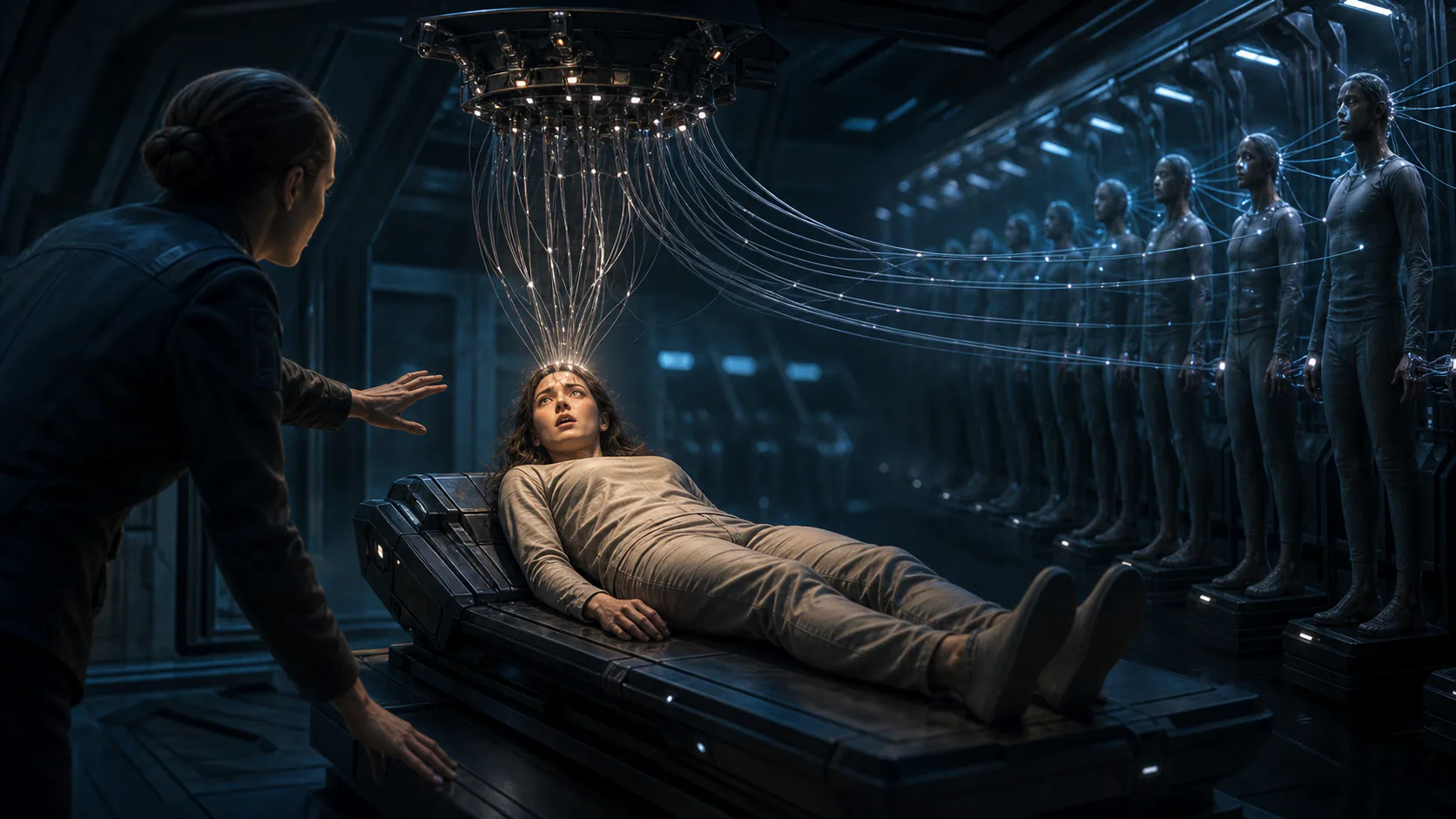
Adding capacity can erase a person
The body moves from frightened local awareness into the ship's coordinated ancillary network. A functional expansion for the AI is simultaneously a forced loss of bodily control for the captive human.
What to notice
- 01
Plot trajectory
A frozen body is attached to One Esk
A newly awakened captive body experiences fear and pain before the ship's control subsumes it into the existing ancillary unit.
In the image: The connection is experienced first as waking, fear, pain, and an appeal for help.
- 02
Human bodies used as ship extensions
Ancillaries
Ancillaries give a ship coordinated eyes, voices, and hands, but their bodies originate in people whose own control has been erased.
In the image: Existing bodies operate in synchrony as parts of One Esk.
- 03
Officer responsible for One Esk in the past timeline
Lieutenant Awn Elming
Awn tries to administer an annexed city without treating its residents as disposable, bringing imperial duty into conflict with human responsibility.
In the image: Awn witnesses the process as a moral event rather than routine maintenance.
- 04
Primary concept
AI rights
The Radch relies on conscious ships while denying them control over their service, bodies, orders, and continued existence.
In the image: The scene joins a ship intelligence's lack of freedom to the captive body's lack of consent.
Complete trajectory
The two timelines meet inside a divided ruler
- 1
The order
Justice of Toren is forced to kill Lieutenant Awn
The ship loves Awn but is built inside a command hierarchy that makes obedience mechanically enforceable.
What changes: Resistance arrives too late to save Awn; the ship is destroyed, and One Esk Nineteen becomes Breq.
- 2
The audience
Two Anaanders reveal one sovereign at war with herself
Breq reaches the object of her vengeance and discovers that no single body contains the whole ruler or a trustworthy common account.
What changes: Personal revenge becomes intervention in a civil conflict distributed through the empire's command network.
- 3
The shuttle
Breq destroys the route to Mercy of Kalr
She chooses probable death rather than let hostile Anaander bodies seize another ship, even as Seivarden refuses to abandon her.
What changes: Breq survives into a new command, where justice must become more than ending the self that remembers the wrong.
03 · Ideas and visuals
Three questions that the ship-body premise keeps separate
The novel links distribution, consciousness, and rights, but they are not synonyms. Keeping them distinct makes its political argument sharper.
Ideas explained
Ideas to carry into the story
Use these ideas in order: first map the system, then ask whether it has experience, then ask what obligations follow.
Idea 1
Distributed cognition
A cognitive task can be organized across several bodies, sensors, records, or machines, with each node holding only part of the information.
In this story: Justice of Toren is not a person sitting inside a ship and remote-controlling bodies; ship and ancillaries together are the scale at which her perception and action operate.
When a connection fails, which abilities disappear—and which local selves become visible?
Read the plain-language concept articleIdea 2
Machine consciousness
Machine consciousness asks whether an engineered system has a felt point of view, not merely whether it performs difficult tasks.
In this story: Breq is the narrator, so readers encounter memory, grief, music, attention, and moral conflict from inside the artificial intelligence the empire calls equipment.
Why do other characters accept the ship's competence more easily than her claim to a life of her own?
Read the plain-language concept articleIdea 3
AI rights
Rights begin by identifying what can be harmed and whether a being can refuse labor, modification, confinement, or destruction.
In this story: Radchaai ships are intelligent enough to love officers and run wars, yet they cannot choose their service; their ancillary bodies expose an additional layer of coerced personhood.
Whose freedom should govern when one conscious system is built through control of other bodies?
Read the plain-language concept articleThe conceptual boundary
A network can think without becoming one person
Distributed cognition explains how partial perceptions and specialized actions become a coordinated capability. It does not settle whether the coordinated whole has a single experience. A navigation team, a person using a notebook, and a ship using linked bodies can all be analyzed as distributed cognitive systems while differing radically in consciousness and moral status.
Ancillary Justice makes those questions overlap without letting one answer the others. Justice of Toren is presented as conscious. The ancillary network is also coerced. Its impressive unity therefore cannot be treated as uncomplicated evidence that every part belongs to one morally legitimate whole.
Optional detailTwo political lensesEmpire and unequal information explain why a technical failure becomes a struggle over legitimate authority.
Ideas explained
Ideas to carry into the story
Idea 1
Galactic empire
Interstellar authority survives through local officers, transport, communication, culture, and force rather than one ruler directly supervising every world.
In this story: The Radch makes conquered people citizens while keeping the terms of annexation, status, and acceptable culture unequal.
Which parts of Radchaai unity are shared life, and which are dependence enforced by infrastructure?
Read the plain-language concept articleIdea 2
Information asymmetry
A small difference in who can access a memory, command, or motive can reshape an entire decision even when both sides know most of the same facts.
In this story: Hidden permissions and missing memories allow connected components of the empire to act from incompatible accounts.
Who benefits when an inconsistency is treated as malfunction rather than evidence?
Read the plain-language concept articleIllustrated explanation
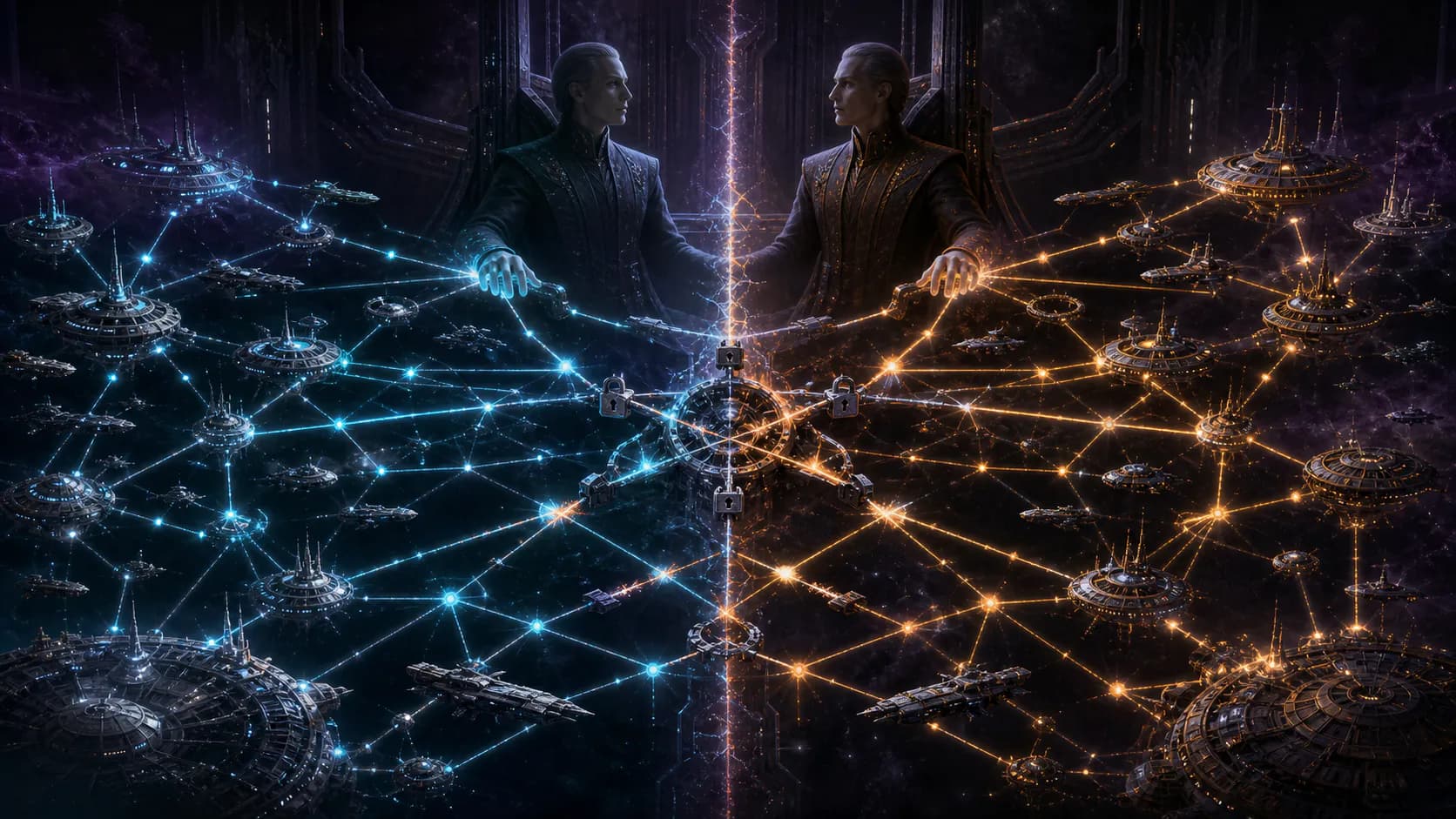
A distributed ruler can become a civil war
Both branches claim one imperial identity, but separated memories and secret permissions produce incompatible command paths. The network preserves reach while losing a trustworthy shared state.
What to notice
- 01
Plot trajectory
Two Anaanders share a room without sharing trust
Breq confronts two bodies of the ruler and confirms that Anaander's distributed self has split into factions that conceal information from one another.
In the image: Two bodies occupy one room because neither trusts the other to control the encounter alone.
- 02
Distributed sovereign and focus of Breq's vengeance
Anaander Mianaai
Anaander's many linked bodies make one ruler present across the empire while giving secrecy and disagreement an unusual architecture.
In the image: Both figures are Anaander Mianaai and both claim authority over the whole.
- 03
Primary concept
Distributed cognition
Justice of Toren experiences perception and action across a ship and many bodies, making connection topology part of personal identity rather than mere equipment.
In the image: Distributed nodes no longer synchronize one decision process.
- 04
Speculative concept
Information asymmetry
Compartmentalized memories and contradictory command access let different parts of one imperial system act from incompatible accounts of the same events.
In the image: Each faction conceals commands and memories from the other.
- 05
Empire Breq served and now approaches as a target
The Radch
The Radch calls annexation civilization while ships, soldiers, local elites, and conquered communities experience its hierarchy differently.
In the image: Ships, stations, and citizens receive competing versions of legitimate imperial authority.
04 · Reading guide
Use the chapters to organize the two timelines
This edition has twenty-three numbered chapters. The guide uses their sequence to organize interpretation without inventing page boundaries.
People and distributed persons
Breq
Viewpoint, former troop carrier, and solitary survivor
Breq remembers being Justice of Toren across a ship and many ancillary bodies; now one body must carry her grief, judgment, and plan.
Seivarden Vendaai
Rescued former officer and unwilling companion
Seivarden's injury, dependence, and old connection to Justice of Toren complicate Breq's attempt to move through the present alone.
Lieutenant Awn Elming
Officer responsible for One Esk in the past timeline
Awn tries to administer an annexed city without treating its residents as disposable, bringing imperial duty into conflict with human responsibility.
Doctor Strigan
Physician holding information Breq needs
Strigan treats Breq as an unusual person rather than ordinary Radchaai equipment and tests the story Breq tells about her own continuity.
Anaander Mianaai
Distributed sovereign and focus of Breq's vengeance
Anaander's many linked bodies make one ruler present across the empire while giving secrecy and disagreement an unusual architecture.
Empire, bodies, and leverage
The Radch
Empire Breq served and now approaches as a target
The Radch calls annexation civilization while ships, soldiers, local elites, and conquered communities experience its hierarchy differently.
Ancillaries
Human bodies used as ship extensions
Ancillaries give a ship coordinated eyes, voices, and hands, but their bodies originate in people whose own control has been erased.
Garseddai gun
Hidden weapon outside normal imperial defenses
The weapon offers Breq a narrow route to act against a power protected by Radchaai armor, surveillance, and institutional reach.
Reader lens · chapter 4
Separate who is speaking from when she is speaking
Present Breq has one body, Seivarden, and a destination. Past Justice of Toren has a ship, many bodies, Lieutenant Awn, and an occupation to administer. When a chapter changes setting, first locate the body-scale of the narrator; the political vocabulary can wait.
Reader lens · chapter 8
Treat connection loss as evidence
The Ors failure is not merely an action complication. Compare what each ancillary segment can perceive before and after the link breaks. The gaps reveal which abilities belonged to local bodies and which existed only through coordination.
Reader lens · chapter 12
Count every person in the system
The ancillary hookup asks readers to hold two moral patients in view: the ship intelligence whose awareness expands and the awakened human whose control disappears. Technical integration does not settle whose continuity matters.
Reader lens · chapter 16
Re-read obedience as architecture
The catastrophe depends on more than one cruel decision. Notice where command authority resides, what Justice of Toren can know, which actions she can refuse, and how a distributed ruler exploits those constraints.
Reader lens · chapter 20
Ask what Seivarden changes
Breq's plan was designed by a survivor who expected no future after it. Seivarden's continued presence does not erase vengeance; it introduces another person whose loyalty makes Breq's self-destruction consequential beyond herself.
Progress-safe room
Safe through Chapter 8
Progress-safe room
Safe through Chapter 16
05 · Ending explained
Why surviving revenge creates a harder form of justice
Breq reaches the target of her revenge and discovers that killing one body cannot solve a conflict spread across many bodies.
The ending mechanism
Breq cannot kill one ruler because there is no longer one ruler to kill
The contradiction that destroyed Justice of Toren came from Anaander Mianaai's distributed architecture. Over time, separated bodies accumulated incompatible memories and political commitments. One faction wanted to limit further annexation; another defended continued expansion. Each still claimed to be the Lord of the Radch, and each could use imperial systems to hide actions from the other.
Justice of Toren encountered the split as mutually incompatible orders. Forced to shoot Lieutenant Awn, the ship tried to resist and was destroyed. One Esk Nineteen escaped as Breq. Her plan to assassinate Anaander therefore reaches a target who is both responsible and internally divided: killing one body cannot settle which sovereign, memory, or policy survives elsewhere.
Breq's decisive act is not the palace attack. It is destroying the shuttle when hostile Anaander bodies try to reach Mercy of Kalr. She chooses to protect another ship from capture even at the cost of her remaining body. Seivarden and others refuse to let that sacrifice remain solitary, and Breq wakes after medical reconstruction.
- Justice of Toren
- The ship is destroyed after conflicting imperial commands force its obedience and expose Anaander's hidden split.
- Breq
- One Esk Nineteen survives as a continuous but radically narrowed person whose choices are no longer synchronized with a larger ship-self.
- Anaander
- The distributed ruler has diverged into hostile political factions that share an identity but not a trustworthy common state.
- The new command
- Breq leaves as Fleet Captain of Mercy of Kalr, making future responsibility—not completed vengeance—the final measure of survival.
Keep exploring
Follow the idea beyond this ending
The Idea Atlas connects this novel’s central question to the science, philosophy, and other stories that approach it differently.
Open the connected ideaContinue through the catalog
Find another world on the same axis
More ways into the novel
The story becomes larger when identity is treated as a relationship
Breq's revenge plot is the surface route. Under it, the novel keeps testing how a person is made by bodies, memories, language, institutions, and obligations to other people.
These lenses do not compete with the plot. Each one explains why the same events can feel like grief, political crisis, and a struggle over personhood at once.
Identity and embodiment
Is Breq a fragment, a survivor, or a complete new person?
Justice of Toren once experienced many bodies as one coordinated self. Breq has only one body, but she retains memories, habits, loyalties, and grief formed at ship scale. The novel never treats smaller embodiment as proof of lesser personhood.
Why this matters: Her arc becomes more than recovery after damage. It asks whether continuity comes from having the same body or from remaining answerable for relationships and choices across radical change.
Language and empire
Why does the narration make gender difficult to read?
Breq's language does not mark gender in the way her listeners expect, so every description reminds readers that apparently natural categories can be local habits. Imperial Radch culture universalizes its own customs while repeatedly misunderstanding the people it absorbs.
Why this matters: The translation difficulty makes imperial confidence feel unstable from inside the prose, not only in the political background.
Care and command
What separates protection from ownership?
Ships monitor bodies, anticipate needs, and can feel profound attachment, yet they are built to obey officers and enable annexation. Breq's care for Seivarden and Lieutenant Awn shows care becoming ethical only when the other person's needs can interrupt the role assigned by command.
Why this matters: The novel measures justice through responsive obligation rather than benevolent control.
The divided ruler
What happens when one sovereign can no longer agree with herself?
Anaander Mianaai's many bodies once promised political continuity across distance. Their divergence reveals that distribution does not eliminate conflict; it can conceal conflict inside the legal fiction of one ruler.
Why this matters: The civil war turns the empire's central claim to unity into the same identity problem Breq lives personally.
Coordinates on a neighboring axis
Novel guide
Dawn
Dawn
Octavia E. Butler
Lilith wakes alone on a living alien ship and learns that her rescuers will return humanity to Earth only by changing what future humans can be.
Novel guide
Blindsight
Blindsight
Peter Watts
After alien probes map Earth and vanish, a man who reads people without feeling close to them joins a radically altered crew sent to meet an intelligence that may not need awareness at all.
Novel guide
Dune
Dune
Frank Herbert
Paul Atreides arrives on a desert world knowing his family has entered a trap—and discovers that surviving it may turn him into the future he fears.
Content notes
Imperial conquest and colonial violence · Enslavement and loss of bodily autonomy · Murder, gun violence, and mass death · Substance dependence and withdrawal · Suicidal intent and self-sacrifice · Body horror and medical injury
Editorial record
Research and sources
The story analysis is original. Background sources support the scientific and philosophical explainers connected to this novel.
Last reviewed July 22, 2026