

The idea in plain English
Plain idea
What changes
A galactic empire is a political system trying to rule many worlds despite enormous travel times, communication delays, and cultural divergence.
Mechanism
How it operates
Authority can travel only as fast as messages, administrators, money, and force. When a capital learns of a crisis years later, local governors must act independently, so formal central control may hide practical federation or coercive delegation.
Human stakes
Why it matters
Interstellar scale makes ordinary questions of representation and accountability physical. People may be taxed or punished by rulers they can never meet, while frontier societies change faster than orders can reach them.
Used in: 10 catalog novels
Related: First contact · Time travel and temporal displacement · Interstellar travel
A few terms make the rest of the explanation easier to follow.
- Communication latency
- The delay between an event, the arrival of news at the center, and the return of an instruction or response.
- Delegation
- Authority granted to local officials who must act without receiving current directions from distant rulers.
- Imperial extraction
- An unequal flow of labor, resources, taxes, or strategic advantage from subordinated regions toward a political center.
Use the idea while reading
Turn the definition into three observations
Do not begin by asking whether a novel is “about” galactic empire. Begin with what changes in the lives of its characters, then use the concept to explain the mechanism underneath that change.
- 01
Notice how long orders, taxes, and news take to travel.
- 02
Notice which powers belong to local worlds and which remain centralized.
- 03
Notice whether culture and citizenship are shared, imposed, or merely claimed.
Keep one question open: What material system keeps distant worlds politically connected?
Avoid the shortcut: A large territory is not automatically an empire. Empire involves unequal rule, extraction, or constrained sovereignty; a multi-world federation may distribute authority differently.
How it works, step by step
- 1
Distance separates information from authority
Even light-speed messages take years between sufficiently distant systems, so a central government learns about events after local conditions have changed.
- 2
Local agents acquire practical power
Governors, military commanders, companies, or councils interpret old rules and control the resources needed for immediate decisions.
- 3
The center maintains dependence
Trade routes, technology, legitimacy, finance, force, or access to shared infrastructure can bind worlds whose daily administration is effectively autonomous.
- 4
Culture and interests diverge
Generations raised under different environments and delays develop identities that make the center's claim of one political community harder to sustain.
A concrete example
A law arrives fifty years late
A capital sends a resource quota to a frontier world. The message arrives after the original government has fallen and the frontier's environment has changed.
01
Local officials can obey the text, reinterpret its purpose, reject it, or claim compliance while following their own policy.
02
The capital cannot quickly distinguish necessary adaptation from rebellion because a question and answer require another century.
03
Control therefore depends less on live supervision than on local incentives, inherited institutions, and control of transport or technology.
The point
Interstellar empire is not ordinary government made larger. Communication delay converts centralized rule into a changing mixture of delegation, dependence, ritual loyalty, and coercion.
What is real, and what remains uncertain
First separate what we can observe or build today from what remains a prediction or a fictional extension.
What evidence supports it
Speculative political model
No interstellar state exists. The concept extrapolates from historical empires, federations, colonial systems, and the real speed limit on communication.
A common misunderstanding
A large territory is not automatically an empire. Empire involves unequal rule, extraction, or constrained sovereignty; a multi-world federation may distribute authority differently.
Try this example in your head
A frontier world receives an imperial law fifty years after it was issued. The original crisis is over and the government that wrote it is gone. Is obedience continuity, absurdity, or domination?
No observed interstellar state
The concept combines real communication limits with historical political analogies; there is no empirical case of sovereignty operating between star systems.
Empire is a political relation
Large scale alone does not establish empire. The analysis must identify unequal sovereignty, extraction, imposed rule, or constrained exit rather than merely many connected worlds.
How science fiction tests the idea
Stories usually test both the promise of an idea and the trouble it creates.
Its promise
Scale makes representative government impossible.
Its problem
Federated autonomy can outlast centralized rule.
What to notice in a story
- 01
How long orders, taxes, and news take to travel
- 02
Which powers belong to local worlds and which remain centralized
- 03
Whether culture and citizenship are shared, imposed, or merely claimed
Novels that use this idea
Societal scale
Cautious · Layered
A Memory Called Empire
Teixcalaan expands through fleets and annexation, but also through language, poetry, infrastructure, prestige, bureaucracy, and the promise that outsiders might become legible to the center.
Civilization scale
Cautious · Demanding
Ancillary Justice
Radchaai unity depends on annexation, cultural standardization, gates, local officers, and a ruler whose distributed bodies are meant to make distant sovereignty present.
Civilization scale
Dark · Demanding
Dune
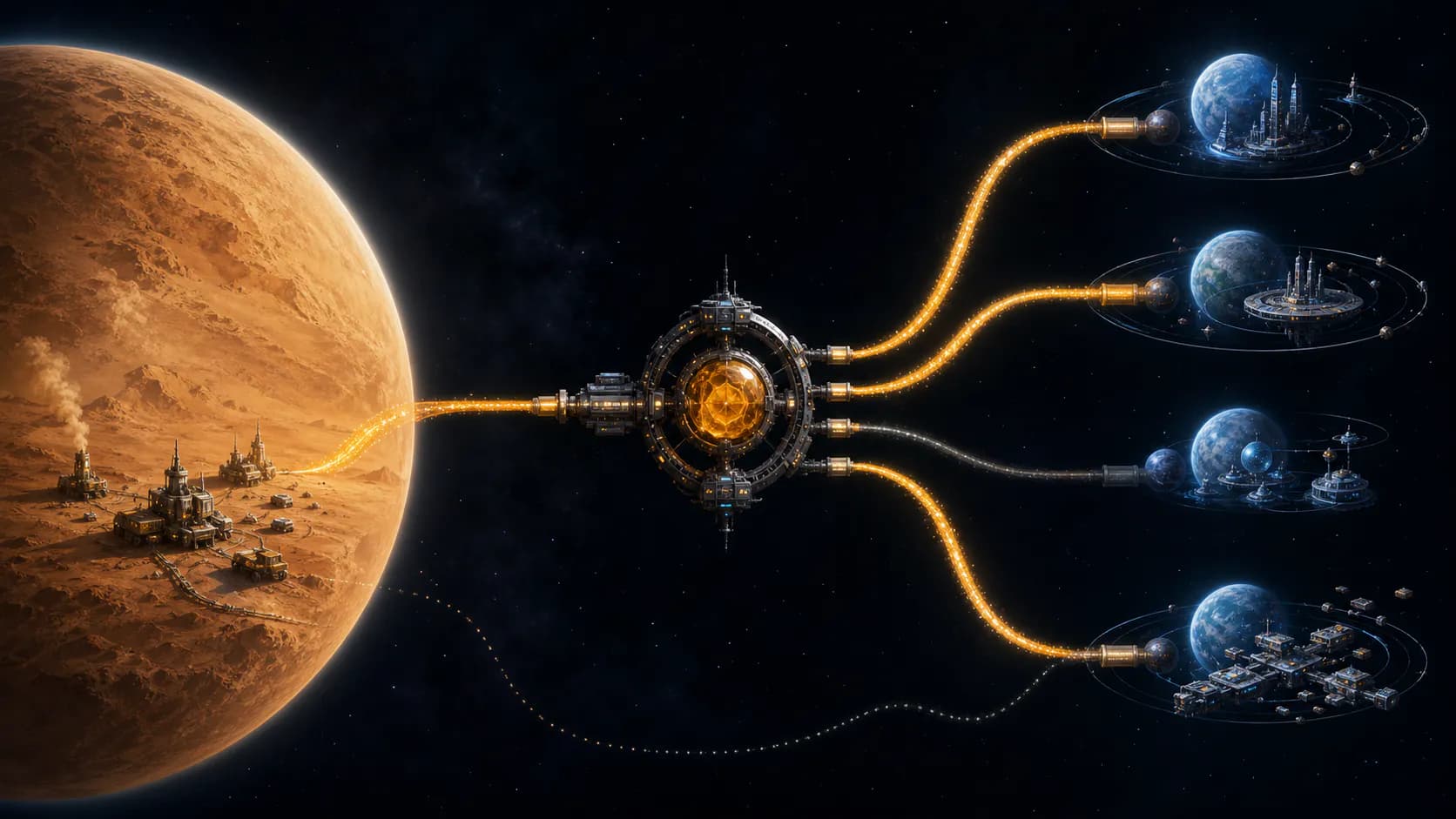
The Imperium holds distant houses together through feudal legitimacy, commercial monopolies, transport dependence, and the assignment of planetary fiefs.
Visual example · One planet is the empire's supply chokepoint
Civilization scale
Balanced · Layered
Foundation
A mathematician predicts imperial collapse, exiles a knowledge project to the galaxy's edge, and leaves later leaders to discover how science can become political leverage.
Civilization scale
Dark · Layered
Foundation and Empire
The Seldon Plan survives the Empire's greatest general, then fails in front of a conqueror who can change the emotions that mass prediction assumes will average out.
Cosmic scale
Dark · Demanding
Hyperion
Seven pilgrims travel toward a time-reversing valley and the Shrike, telling the stories that made each of them part of the same approaching catastrophe.
Civilization scale
Dark · Layered
Persepolis Rising
Decades after the Free Navy war, an empire returns from isolation with alien-enhanced warships and a plan to place every human world under one command.
Civilization scale
Cautious · Demanding
Second Foundation
Two searches hunt the hidden guardians of the Seldon Plan, only to discover that every apparent victory may be the belief those guardians needed their pursuers to hold.
Cosmic scale
Cautious · Demanding
The Fall of Hyperion
As war reaches Hyperion, a new Keats cybrid dreams the pilgrims' fates and helps expose that humanity's instant-travel network is also the TechnoCore's hidden body.
Cosmic scale
Cautious · Demanding
Tiamat's Wrath
With Holden imprisoned and the Rocinante crew dispersed, a hidden resistance confronts Laconia while experiments awaken the force that destroyed the gate builders.
Questions to keep thinking about
What material system keeps distant worlds politically connected?
Who can refuse the center without losing access to trade or protection?
Does distance weaken domination—or make local abuse harder to challenge?
Sources and further reading
These references ground the portable lesson; story interpretations remain editorial analysis.