
Novel guide
Dawn
Octavia E. Butler

Story and ideas · Lilith’s Brood · Volume 1
Dawn
by Octavia E. Butler
Grand Central Publishing trade paperback · 2021 · Publisher details · Cover via Open Library
Lilith wakes alone on a living alien ship and learns that her rescuers will return humanity to Earth only by changing what future humans can be.
Full-story article
This article discusses the complete story, including the ending.
- Reading time
- About 8 hours
- Length
- 320 pages
- Reading complexity
- Layered
- Several ideas or timelines overlap, but the central path remains visible.
- Science intensity
- 3/5
- Scientific ideas recur and influence major choices.
Affiliate links. As an Amazon Associate, we earn from qualifying purchases.
Before you read
Is this book for you?
Start by tracking: Track who controls Lilith’s body, information, movement, and relationships before judging whether any agreement is voluntary.
Read this if you enjoy
- First contact shaped by power and dependency
- Questions about consent, biology, and survival
- A close character study under coercion
Why readers may get lost
- Care and captivity remain entangled
- Biological transformation carries political meaning
- No available choice is fully free
Keep these anchors in mind
- Lilith Iyapo
- survives by learning inside an imposed role
- Jdahya
- introduces rescue as a relationship of control
- Nikanj
- joins affection, healing, and reproductive power
- The Oankali
- treat genetic exchange as both salvation and necessity
- The awakened humans
- fear both their captors and Lilith’s adaptation
Layered reading complexity. Several ideas or timelines overlap, but the central path remains visible.
Science intensity 3/5. Scientific ideas recur and influence major choices.
01 · Overview
A rescue whose terms cannot be refused
This is a reading companion, not the novel. It begins with Lilith's immediate problem: she is alive, alone, and dependent on people whose help reaches all the way inside her body.
Where the story begins
Lilith wakes inside someone else's idea of survival
Lilith Iyapo wakes in a sealed room with no visible door and no trustworthy measure of time. She remembers a nuclear war, the loss of her family, and earlier awakenings controlled by voices she could not see. When one of her captors finally enters, the encounter is difficult even before either of them speaks: Jdahya is an Oankali, a being whose face and body force Lilith to confront how physical fear can arrive ahead of knowledge.
The Oankali saved the surviving humans, kept them in suspended animation, and repaired Earth. They now want Lilith to prepare a group for return. The offer is not freedom restored. The Oankali believe humanity can survive only by entering a biological trade that will change future bodies and future families. Lilith wants to go home and protect the people still asleep, but the route to both goals is controlled by the same beings she may need to resist.
The central question
If survival requires surrendering control over future bodies, is rescue another form of captivity?
The novel refuses a clean choice between grateful acceptance and simple rebellion. Healing, coercion, intimacy, fear, and real care occupy the same relationships.
The story, in human terms
What happens first—and why it changes Lilith's choices
These three opening turns are enough to orient the human story before the biology and social systems become dense.
- 1
Waking
Lilith survives, but cannot leave
She wants facts, privacy, and a path back to Earth while grieving a life the war has already ended.
What changes: Jdahya's arrival turns an invisible imprisonment into a relationship she can question, fear, and learn from.
- 2
The rescue
Earth lives because the Oankali intervened
The news gives Lilith hope, but it also means her captors control the only world she still considers home.
What changes: Escape is no longer merely leaving a room; it means understanding the conditions attached to human return.
- 3
The assignment
Lilith is chosen to wake the others
She wants to protect sleeping humans from shock and manipulation, yet they may see her knowledge as evidence of betrayal.
What changes: Her private captivity becomes a leadership problem: she must use Oankali help without letting that help define what humanity deserves.
Illustrated explanation
A room, a body, and a ship are one system
The cradle, chamber wall, circulation network, and guide form one living infrastructure. Rescue is real, but none of its controls belong to the person waking inside it.
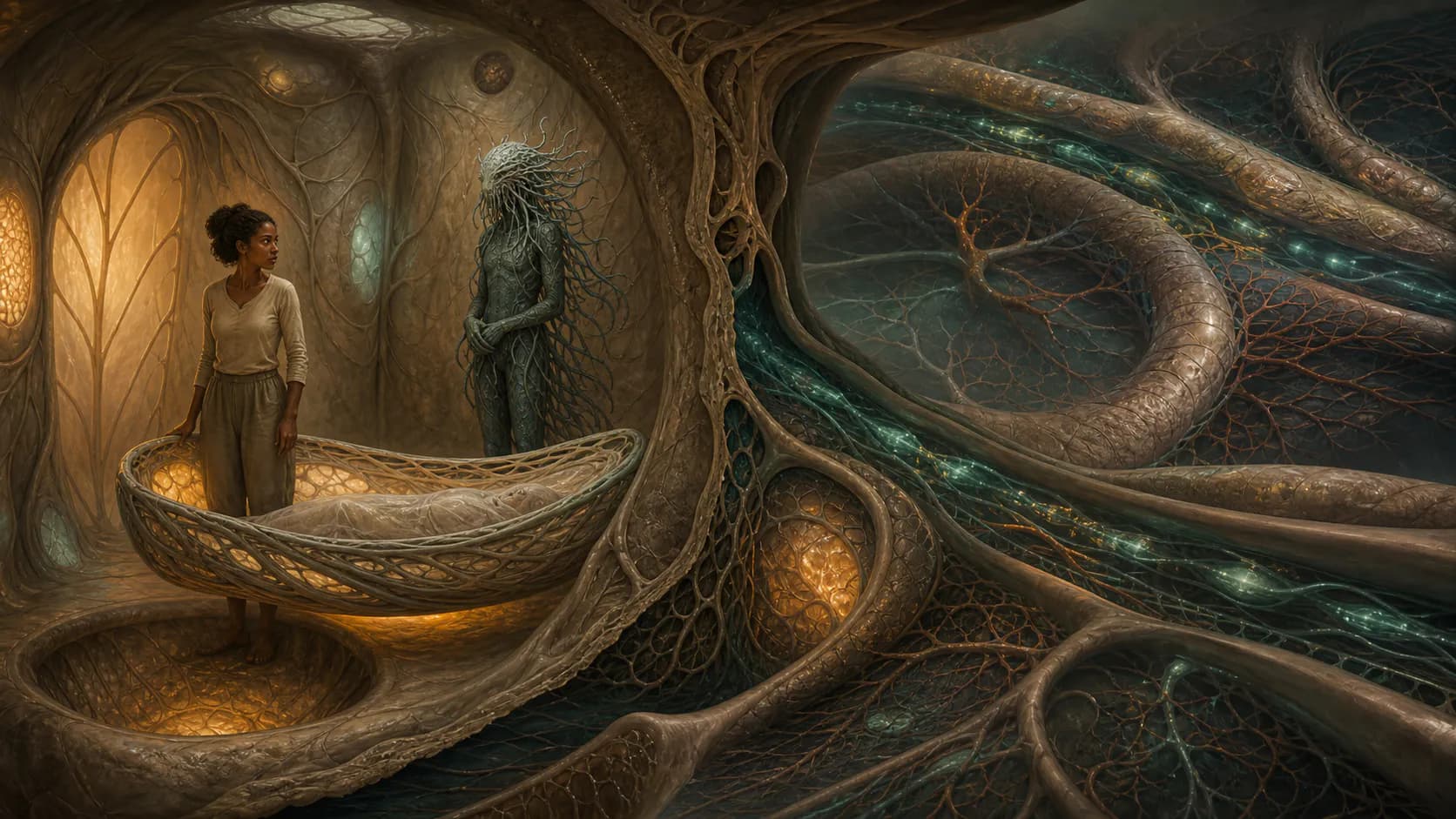
What to notice
- 01
Plot trajectory
Lilith wakes in a room she cannot leave
Repeated waking and questioning make survival inseparable from an unseen authority that controls contact, food, sleep, and information.
In the image: The first awakening turns preservation into a question of who controls the next conscious moment.
- 02
Human viewpoint and reluctant trainer
Lilith Iyapo
Lilith wants to return to Earth and protect other survivors, but every useful skill she gains also makes her look more aligned with her captors.
In the image: Lilith wakes alive but without independent access to food, doors, knowledge, or Earth.
- 03
Lilith's first Oankali guide
Jdahya
Jdahya explains the rescue, the restored Earth, and the proposed genetic trade while controlling how quickly Lilith can encounter the truth.
In the image: Jdahya is both her first relationship and the representative of the system holding her.
- 04
Speculative concept
Suspended animation
Suspension carries human bodies across centuries while transferring every decision about care, waking, and history to the Oankali.
In the image: Preservation moves biological time forward only when the surrounding system permits revival.
- 05
Habitat, medical system, and enclosure
The Oankali living ship
The ship feeds, heals, suspends, and shelters its inhabitants through living tissues that humans cannot independently command.
In the image: The vessel is habitat, medical infrastructure, observer, and boundary at the same time.
- The reading promise
- An intimate captivity story that widens into a struggle over humanity's biological future
- What to track
- Who controls waking, healing, fertility, information, and access to Earth
- The difficult feeling
- A relationship can contain genuine care and still deny a meaningful refusal
- The structure
- Four named parts: Womb, Family, Nursery, and The Training Floor
Series flight path
Lilith’s Brood
Dawn begins Lilith’s Brood. Adulthood Rites moves the conflict to the next generation on Earth, and Imago follows a later child whose body changes what the trade can become.
Volume 1 · You are here
DawnLayered
02 · Story map
Four spaces that widen the same question
Each named part gives Lilith more room, more knowledge, and more responsibility. None automatically gives her more control over the terms of survival.
- Part I · Womb
A sealed room narrows life to questions, food, sleep, and the frightening first sight of an Oankali.
- Part II · Family
Living among Jdahya's family teaches Lilith how Oankali bodies, kinship, healing, and gene trading fit together.
- Part III · Nursery
Lilith wakes humans who need her guidance but have strong reasons to distrust anyone granted authority by their captors.
- Part IV · The Training Floor
An Earthlike forest tests practical survival while revealing how conflict changes inside a boundary no human controls.
Mid-book context
Knowledge makes Lilith more capable—and more isolated
- 1
Family
Nikanj makes biology relational
Lilith develops trust in a young ooloi whose curiosity and attention feel different from institutional command.
What changes: Healing, bodily enhancement, attraction, and reproductive possibility begin to pass through one personal bond.
- 2
Nursery
The awakened humans turn information into suspicion
Lilith needs cooperation, companionship, and safety, but others know she is stronger and better informed than they are.
What changes: The Oankali's unequal distribution of knowledge reproduces hierarchy inside the captive group, even when Lilith shares what she can.
- 3
Training Floor
A forest offers freedom without an exit
The group can gather food, build shelter, pair off, argue, and plan escape, yet every experiment still occurs inside the ship.
What changes: The question shifts from whether the Oankali are telling the truth to what humans will do to one another under conditions they did not choose.
Illustrated explanation
A wilderness can still be an enclosure
The training floor supplies real food, water, weather, and survival problems. Its hidden living wall shows why competence inside the habitat does not create control over the terms of departure.

What to notice
- 01
Human viewpoint and reluctant trainer
Lilith Iyapo
Lilith wants to return to Earth and protect other survivors, but every useful skill she gains also makes her look more aligned with her captors.
In the image: Lilith must teach useful survival skills while knowing the environment remains controlled.
- 02
Plot trajectory
A forest becomes the final rehearsal
The group enters an Earthlike habitat where practical survival can be tested but the surrounding ship still controls every exit.
In the image: The human camp rehearses cooperation, shelter, food gathering, and conflict before Earth.
- 03
Speculative concept
Survival ethics
The promise to prevent extinction is repeatedly used to narrow which refusals, risks, and human futures remain available.
In the image: Every survival choice occurs inside options selected by a more powerful party.
- 04
Habitat, medical system, and enclosure
The Oankali living ship
The ship feeds, heals, suspends, and shelters its inhabitants through living tissues that humans cannot independently command.
In the image: The revealed membrane turns apparent open nature back into ship infrastructure.
Complete trajectory
The return to Earth preserves humanity by dividing it
- 1
Recognition fails
Curt kills Joseph
Joseph's altered healing makes him look less safely human to a man already primed to see collaboration as contamination.
What changes: Lilith loses the person who shared her position between the human group and the Oankali, and human fear becomes as immediate as alien power.
- 2
Home without her
The other survivors leave for Earth
Lilith did the work of preparing them, but the Oankali decide she is too conspicuous and vulnerable to travel with them.
What changes: Her competence becomes the reason she must remain behind and repeat the role with another group.
- 3
A future inside her
Nikanj reveals the pregnancy
Lilith learns that a reproductive decision was made through her body without her knowledge, even by someone who believes it is giving her life and connection.
What changes: She outwardly accepts another training assignment while privately deciding to learn enough to preserve a human future the Oankali cannot completely design.
03 · Ideas and visuals
The novel's machinery is biological—and therefore political
Dawn does not require a new Atlas concept. Its hardest question appears where existing ideas overlap: contact, editable identity, and reproductive autonomy all operate through the same living system.
Ideas explained
Ideas to carry into the story
Use these three lenses to translate unfamiliar biology into ordinary human stakes.
Idea 1
Reproductive autonomy
A reproductive choice is meaningful only when a person understands it and can refuse without losing safety, care, food, belonging, or freedom.
In this story: The Oankali control health, fertility, attraction, and the only viable route to future children, so consent cannot be separated from dependence.
What would the Oankali have to give up before a human yes could count as freely chosen?
Read the plain-language concept articleIdea 2
Posthuman identity
A person can remain psychologically continuous while bodily repair and enhancement change what they can do and how other people recognize them.
In this story: Lilith's modifications help her survive and lead, but they also make frightened humans wonder whether she still belongs to them.
Who gets to decide whether a changed body is healed, improved, compromised, or no longer human?
Read the plain-language concept articleIdea 3
First contact
Contact is not automatically a meeting between equals. It may begin after one side has already gathered knowledge and gained physical control over the other.
In this story: The Oankali know human biology intimately before Lilith can see them, leave her room, or verify their account of Earth.
Can diplomacy begin after rescue has already created a debt and an enclosure?
Read the plain-language concept articleIllustrated explanation
Every benefit passes through the same mediator
The ooloi can connect bodies, sense illness, shape pleasure, choose genetic combinations, and control fertility. The network makes intimacy possible while concentrating power over refusal.
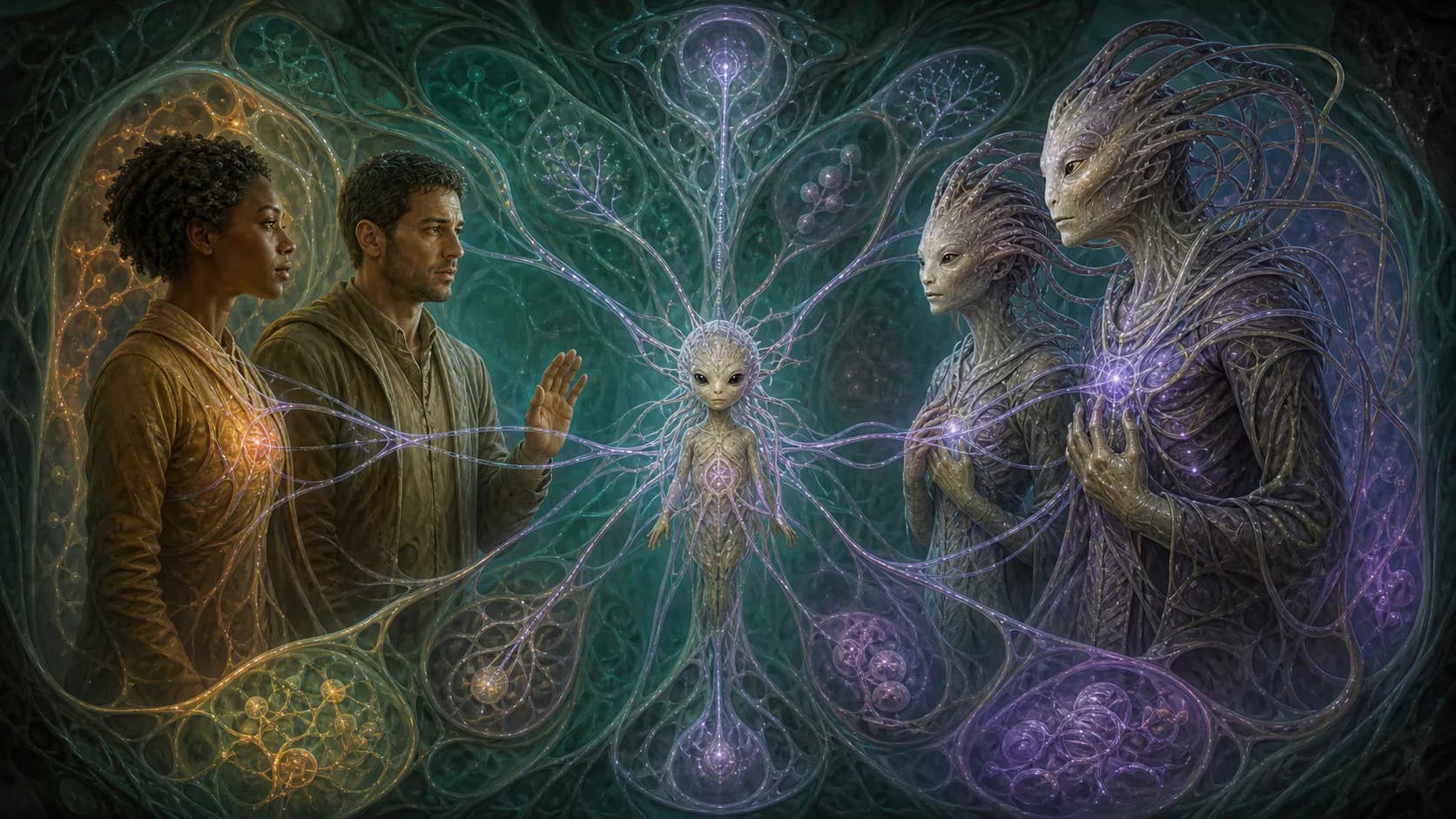
What to notice
- 01
Plot trajectory
Lilith enters an Oankali family
Living with Jdahya's family gives Lilith knowledge and connection while making her future role in the trade more concrete.
In the image: Entering an Oankali family makes an abstract species proposal into a set of intimate biological relationships.
- 02
Primary concept
Reproductive autonomy
Human survival is offered through a biological future whose terms are set by the rescuers who control fertility, health, and access to Earth.
In the image: A raised hand matters only if refusal can change what the network does next.
- 03
Young ooloi and biological mediator
Nikanj
Nikanj's ability to sense and reshape living bodies makes intimacy, healing, enhancement, and reproductive power difficult to separate.
In the image: The ooloi is the biological bridge; no other participant can reproduce the connection independently.
- 04
Primary concept
Posthuman identity
Healing and enhancement make the boundary between preserving a person and redesigning humanity impossible to treat as a purely technical question.
In the image: Healing and enhancement preserve a life while changing what the body can do and how others recognize it.
- 05
Rescuers, captors, and gene traders
The Oankali
The Oankali preserve human life and repair Earth, yet treat biological exchange as a necessity they are entitled to organize.
In the image: For the Oankali, exchange is family, survival, desire, and species continuity rather than a separate procedure.
The central system
The same channel carries healing and control
Ooloi do not merely provide a medical service. They perceive bodies directly, manipulate tissue, coordinate pleasure, manage fertility, and combine genetic possibilities. That concentration makes their care extraordinarily effective and makes independent refusal materially difficult.
The ethical problem is not solved by deciding whether Nikanj is kind. Kindness changes Lilith's experience of dependence without removing the dependence. The book asks readers to judge a relationship and a system at once.
Optional detailTwo supporting ideasSuspension and ecological restoration explain how the Oankali gained both practical and moral leverage.
Ideas explained
Ideas to carry into the story
Idea 1
Suspended animation
The sleepers cross centuries without choosing when they wake or what institutions will exist when they return.
In this story: Preservation saves human lives while transferring every decision during the interval to the ship and its caretakers.
Who becomes responsible for a person who cannot monitor, revoke, or renegotiate their care?
Read the plain-language concept articleIdea 2
Planetary ecosystem engineering
Repairing a whole planet means changing linked water, soil, atmosphere, organisms, and habitats across long timescales.
In this story: The restored Earth proves the Oankali's competence and becomes leverage because no human group can independently reproduce that work.
Does restoring a home grant authority to decide who may inhabit it and in what form?
Read the plain-language concept article04 · Reading guide
Use the four named parts as story landmarks
The guide follows this edition's four named parts and avoids mixing chapter pagination from other editions.
People and species
Lilith Iyapo
Human viewpoint and reluctant trainer
Lilith wants to return to Earth and protect other survivors, but every useful skill she gains also makes her look more aligned with her captors.
Jdahya
Lilith's first Oankali guide
Jdahya explains the rescue, the restored Earth, and the proposed genetic trade while controlling how quickly Lilith can encounter the truth.
Nikanj
Young ooloi and biological mediator
Nikanj's ability to sense and reshape living bodies makes intimacy, healing, enhancement, and reproductive power difficult to separate.
Kahguyaht
Mature ooloi in Lilith's host family
Kahguyaht treats human hierarchy as a dangerous biological tendency and regards resistance to the trade as evidence of that danger.
Joseph Shing
Awakened survivor and Lilith's partner
Joseph offers Lilith trust and companionship while facing the group's fear of every human body the Oankali have changed.
Curt Loehr
Suspicious human faction leader
Curt interprets Lilith's authority and Oankali modifications as threats, turning captivity into conflict among the captives.
The Oankali
Rescuers, captors, and gene traders
The Oankali preserve human life and repair Earth, yet treat biological exchange as a necessity they are entitled to organize.
The living environment
The Oankali living ship
Habitat, medical system, and enclosure
The ship feeds, heals, suspends, and shelters its inhabitants through living tissues that humans cannot independently command.
Reader lens · Womb
Separate rescue from permission
List what the Oankali have done for humans, then list what Lilith has actually agreed to. The gap between those lists is the novel's first political structure.
Reader lens · Family
Watch how dependency becomes affection
Lilith's growing connection with Nikanj is neither fake nor simple freedom. Notice which fears familiarity reduces and which powers remain unchanged beneath that familiarity.
Reader lens · Nursery
Authority travels through unequal information
The awakened humans cannot directly verify Lilith's account or command the ship. Track when they challenge a real asymmetry and when fear redirects that challenge toward the nearest human target.
Reader lens · The Training Floor
Ask who designed the available choices
The forest allows real action, but the habitat, fertility rules, departure schedule, and surveillance remain externally controlled. A choice inside a system is not the same as a choice about the system.
Progress-safe room
Safe through Part 2 · Family
Progress-safe room
Safe through Part 4 · The Training Floor
05 · Ending explained
Why the ending turns rescue into an inheritance
The final choices make the cost of the Oankali rescue clear and show what Lilith can still refuse.
The ending mechanism
Lilith becomes both the first mother and the first dissenter of the new future
Joseph's murder appears to confirm the Oankali diagnosis of human hierarchy and violence. Yet the Oankali response does not produce a moral victory. They send the surviving group to Earth without Lilith, keep humans infertile without ooloi mediation, and reveal that Nikanj has already created a pregnancy through her body without her knowledge.
The pregnancy joins the book's deepest contradiction. It carries Joseph forward and offers Lilith a child after catastrophic loss. It is also an irreversible use of her body. Nikanj interprets biological compatibility, desire, and a beneficial outcome as sufficient permission; Lilith experiences the same act as evidence that the Oankali cannot recognize a refusal that conflicts with the trade.
- Joseph's death
- Fear of altered humanity becomes human violence, not proof that coercive alien authority is justified.
- The Earth party
- The humans gain a home but remain reproductively dependent on the Oankali.
- Lilith's pregnancy
- A promised species future becomes a present violation of individual knowledge and consent.
- Lilith's next move
- She agrees to train another group so she can keep learning and search for openings the Oankali have not designed.
Keep exploring
Follow the idea beyond this ending
The Idea Atlas connects this novel’s central question to the science, philosophy, and other stories that approach it differently.
Open the connected ideaContinue through the catalog
Find another world on the same axis
The questions beneath survival
Every gift in Dawn changes the terms of consent
The Oankali genuinely save lives, heal bodies, and repair Earth. The novel refuses to let those achievements settle whether the people receiving them are free.
Read these aspects together. The discomfort of the novel comes from benefits and violations arriving through the same relationships.
Rescue and captivity
Can a rescuer become an owner without intending cruelty?
Lilith survives only because the Oankali wake, heal, teach, and protect her. They also control doors, information, fertility, sleep, and access to other humans. Dependence makes gratitude real without making obedience voluntary.
Why this matters: The story separates being saved from consenting to the future selected by the savior.
The body as negotiation
Why does so much politics happen through touch and biology?
Oankali technology is living, sensory, and intimate. Changes to strength, perception, healing, pleasure, and reproduction cannot be placed safely outside the self as neutral tools.
Why this matters: Political power becomes impossible to separate from bodily autonomy and the right to understand what is being done.
Lilith's leadership
Why do the humans mistrust the person helping them most?
Lilith has more information because she has endured longer contact and training, but that advantage makes her look like an extension of Oankali control. She must prepare people for danger while representing terms she did not choose.
Why this matters: Leadership under coercion can be necessary, compromised, and caring at the same time.
The human contradiction
Does human violence prove the Oankali right?
Joseph's death and the group's fear show how quickly hierarchy and exclusion return. Yet predicting harmful behavior does not grant another species unlimited authority over every human body and future generation.
Why this matters: The novel resists both easy human innocence and the claim that accurate diagnosis creates a right to rule.
Coordinates on a neighboring axis
Novel guide
Blindsight
Blindsight
Peter Watts
After alien probes map Earth and vanish, a man who reads people without feeling close to them joins a radically altered crew sent to meet an intelligence that may not need awareness at all.
Novel guide
Contact
Contact
Carl Sagan
When radio astronomer Ellie Arroway finds a prime-number signal from Vega, decoding it gives humanity instructions for a Machine no one can prove is invitation rather than trap.
Novel guide
Dune
Dune
Frank Herbert
Paul Atreides arrives on a desert world knowing his family has entered a trap—and discovers that surviving it may turn him into the future he fears.
Content notes
Nuclear war and mass death · Captivity and loss of bodily autonomy · Medical and reproductive coercion · Sexual violence and assault · Racist and gendered violence · Grief and death
Editorial record
Research and sources
The story analysis is original. Background sources support the scientific and philosophical explainers connected to this novel.
Last reviewed July 22, 2026