The idea in plain English
Plain idea
What changes
Suspended animation slows or pauses a person's metabolism and awareness so the outside world advances while they experience little aging or duration.
Mechanism
How it operates
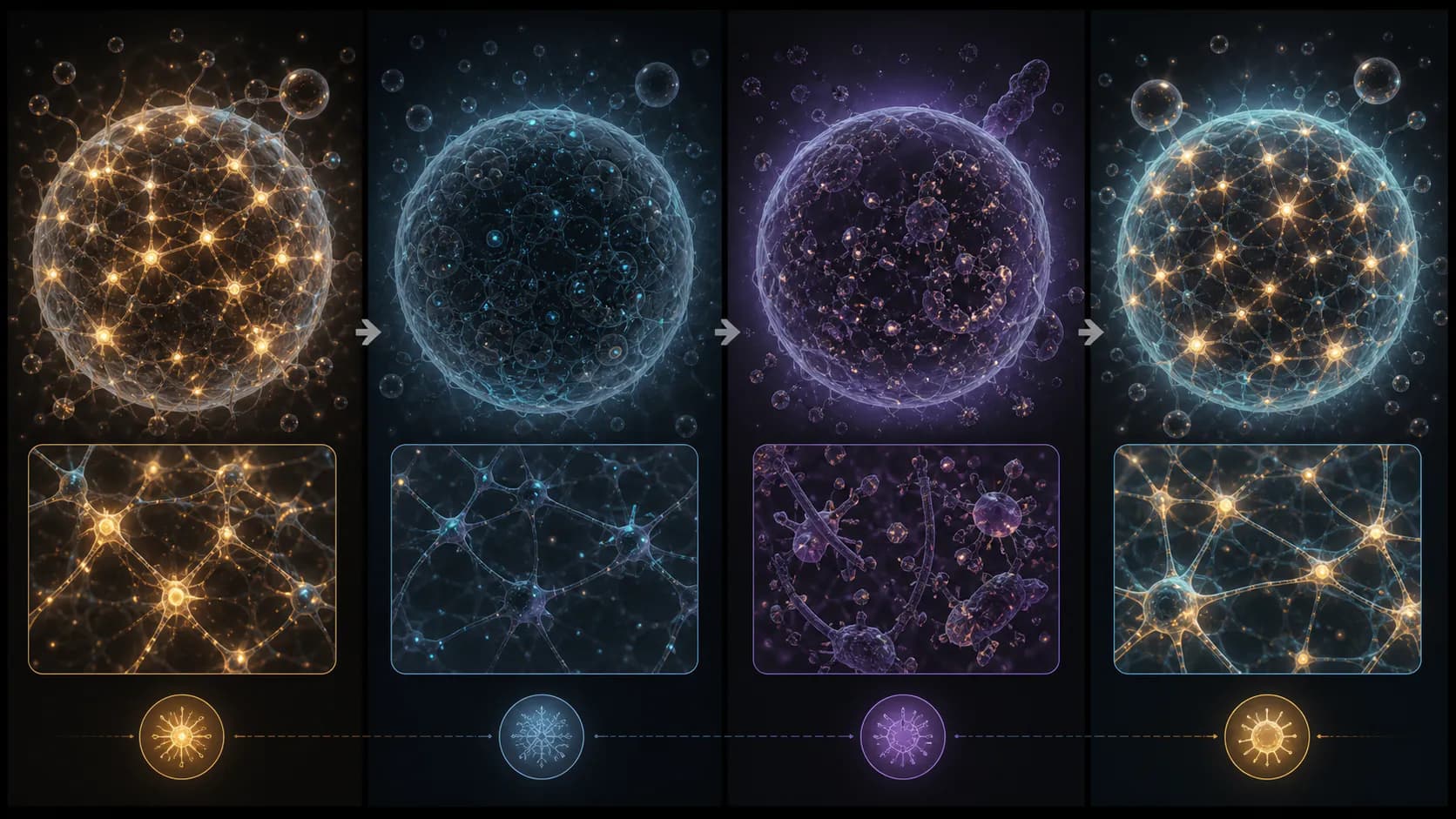
A workable system would need to reduce cellular activity, prevent ice or chemical damage, maintain tissues, and restart the body without injury. It saves life-support activity and experienced time, not external calendar time.
Human stakes
Why it matters
Sleepers can cross long journeys or political eras, but they surrender control while absent. Other people maintain the system, change the mission, inherit authority, and live through the history the sleepers skip.
Used in: 5 catalog novels
Related: Time travel and temporal displacement · Interstellar travel · Intergenerational governance
A few terms make the rest of the explanation easier to follow.
- Torpor
- A reversible state of greatly reduced metabolism and activity that occurs naturally in some animals and is being studied for medical or spaceflight use.
- Metabolic rate
- The rate at which an organism consumes energy and supports cellular maintenance, temperature control, and organ function.
- Rewarming injury
- Damage that can occur when circulation, temperature, and metabolism restart unevenly after deep cooling or reduced activity.
Use the idea while reading
Turn the definition into three observations
Do not begin by asking whether a novel is “about” suspended animation. Begin with what changes in the lives of its characters, then use the concept to explain the mechanism underneath that change.
- 01
Notice who watches, maintains, and can wake the sleepers.
- 02
Notice what physical damage or resource use suspension avoids.
- 03
Notice how contracts, relationships, and authority survive the skipped years.
Keep one question open: Is suspension chosen, coerced, or treated as the only route to survival?
Avoid the shortcut: Suspended animation does not make a ship travel faster and does not stop time. It changes the traveler's biology while the journey and the universe continue normally.
How it works, step by step
- 1
Lower metabolic demand
Cooling, medication, or biological control would reduce oxygen use, food needs, movement, and some forms of waste while preserving essential function.
- 2
Protect cells and organs
A viable system must prevent clotting, infection, pressure injury, muscle and bone loss, radiation damage, and harmful chemical or ice formation.
- 3
Maintain the inactive person
Sensors, power, circulation support, nutrition, waste handling, and an awake crew or automation remain responsible for the sleeper throughout the interval.
- 4
Restore coordinated function
Revival must rewarm tissues, normalize circulation and metabolism, and assess cognition without triggering shock or cascading organ damage.
A concrete example
A crew crosses six months in torpor
A Mars-transfer habitat places most crew members in rotating shallow torpor while one person and automated systems monitor the vehicle.
01
Reduced activity may lower habitat volume, food use, conflict, and some physiological demands, but it does not remove radiation or equipment risk.
02
The awake monitor inherits extra labor and authority, including the power to wake, medicate, or prioritize sleepers during failure.
03
Each revival becomes a medical operation, and repeated cycles must be evaluated for cognitive and organ effects.
The point
Suspension saves experienced time and some resources by transferring work into preservation, monitoring, and revival. The journey continues, and someone or something must remain responsible.
What is real, and what remains uncertain
First separate what we can observe or build today from what remains a prediction or a fictional extension.
What evidence supports it
Limited biology, speculative human application
Some organisms tolerate torpor, freezing, or metabolic slowing, and medical cooling is real. Safe long-term suspension and revival of humans is not available.
A common misunderstanding
Suspended animation does not make a ship travel faster and does not stop time. It changes the traveler's biology while the journey and the universe continue normally.
Try this example in your head
A parent enters suspension for a sixty-year mission while their child stays awake to maintain the program. On return they are nearly the same age. Who carried the cost of preserving the original plan?
Human stasis is not operational
Medical cooling and natural torpor offer partial analogues, but safe long-duration metabolic suppression and complete revival have not been demonstrated in humans.
Reduced metabolism does not stop damage
Radiation, chemical degradation, hardware failure, and some biological injury continue, so duration still matters even without wakeful experience.
How science fiction tests the idea
Stories usually test both the promise of an idea and the trouble it creates.
Its promise
Suspension lets individuals carry memory and purpose across otherwise impossible spans.
Its problem
The sleeper avoids years that societies, families, and institutions must still endure.
What to notice in a story
- 01
Who watches, maintains, and can wake the sleepers
- 02
What physical damage or resource use suspension avoids
- 03
How contracts, relationships, and authority survive the skipped years
Novels that use this idea
Cosmic scale
Dark · Demanding
Blindsight
Mission hibernation turns the crew into deployable specialists whose personal continuity is subordinate to a machine-managed journey.
Civilization scale
Hopeful · Layered
Children of Time
Cold storage lets key people cross centuries while making their relationships radically unequal: one person ages through maintenance work while another wakes only for crises and experiences history as discontinuous shocks.
Civilization scale
Dark · Layered
Dawn
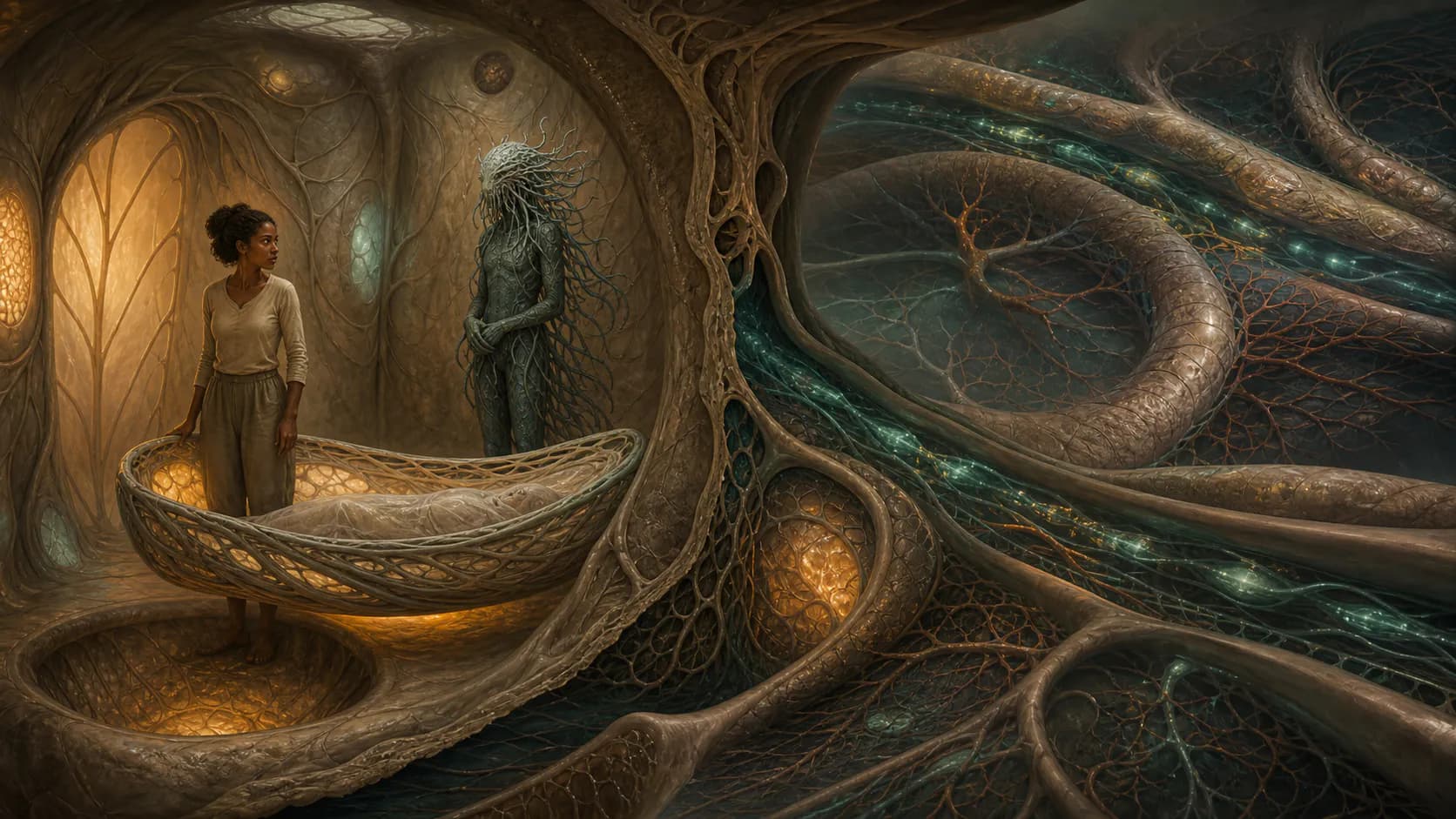
Suspension carries human bodies across centuries while transferring every decision about care, waking, and history to the Oankali.
Visual example · A room, a body, and a ship are one system
Cosmic scale
Dark · Demanding
Death’s End
Hibernation lets Cheng Xin cross eras while other people live through the institutions and consequences that develop between her awakenings.
Cosmic scale
Dark · Demanding
The Dark Forest
Hibernation lets particular strategists enter the future while institutions and ordinary lives absorb the centuries they skip.
Questions to keep thinking about
Is suspension chosen, coerced, or treated as the only route to survival?
Who is allowed to skip history and who must live through it?
Does revival restore the same social person or only the same body and memories?
Sources and further reading
These references ground the portable lesson; story interpretations remain editorial analysis.