The idea in plain English
Plain idea
What changes
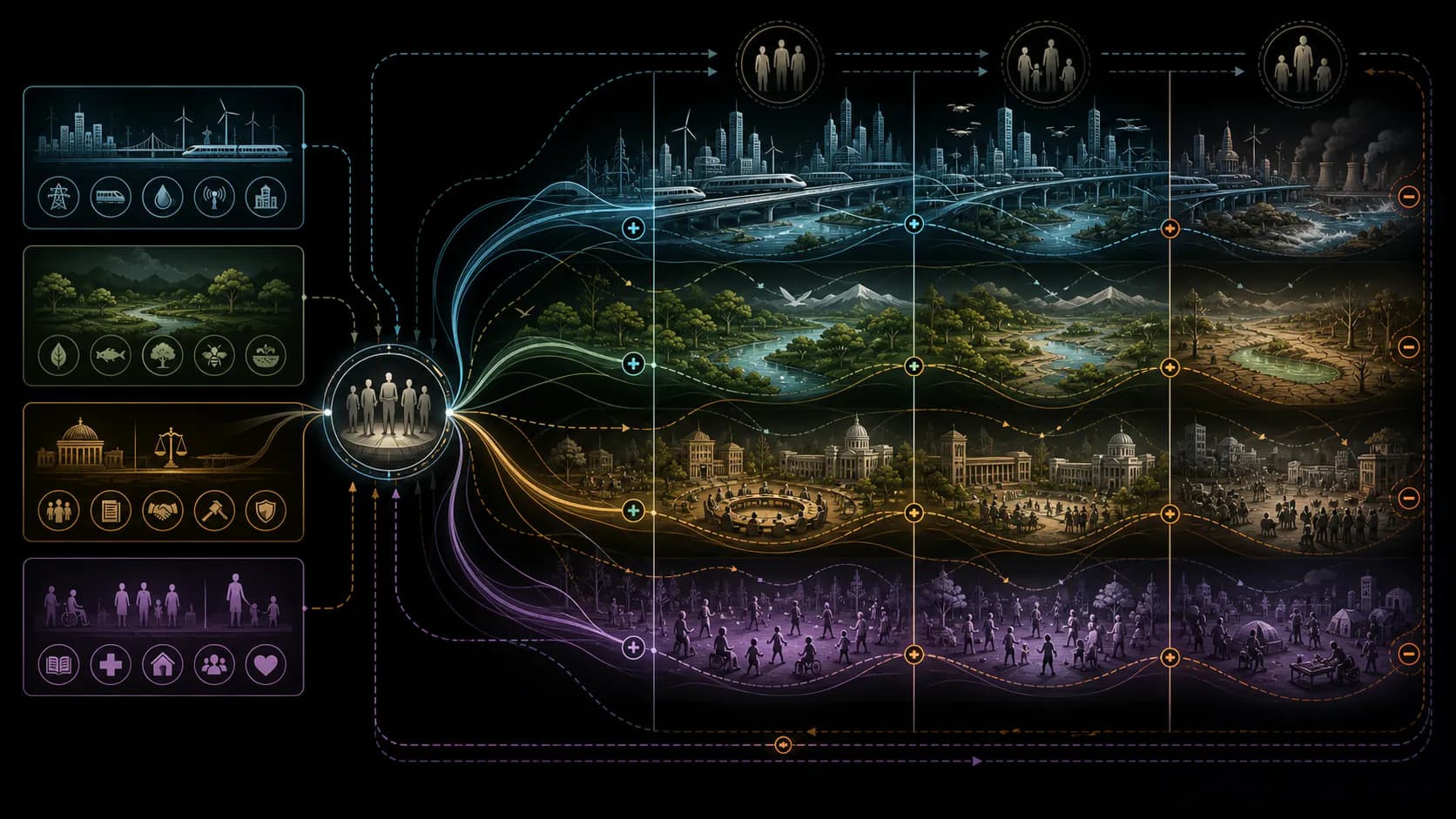
Intergenerational governance coordinates decisions whose benefits, harms, and obligations extend beyond the lifetime of the people making them.
Mechanism
How it operates
Institutions preserve knowledge, resources, commitments, and revision procedures across leadership and cultural change. They must represent future people who cannot vote now without pretending that present planners can know every future need.
Human stakes
Why it matters
Long projects can protect descendants and also conscript them into inherited goals. A durable plan needs enough continuity to work and enough adaptability to remain legitimate when conditions and values change.
Used in: 14 catalog novels
Related: Emergency governance · Science as infrastructure · Survival ethics
A few terms make the rest of the explanation easier to follow.
- Intergenerational equity
- Fairness in how present decisions distribute opportunities, risks, resources, and environmental conditions across generations.
- Option value
- The benefit of preserving choices so future people can respond to knowledge and values unavailable today.
- Institutional memory
- Records, practices, expertise, and explanations that allow an organization to retain knowledge across leadership changes.
- Revision rule
- A legitimate procedure through which later participants can update, redirect, or end an inherited commitment.
Use the idea while reading
Turn the definition into three observations
Do not begin by asking whether a novel is “about” intergenerational governance. Begin with what changes in the lives of its characters, then use the concept to explain the mechanism underneath that change.
- 01
Notice how knowledge and purpose survive leadership turnover.
- 02
Notice which decisions future people may revise or refuse.
- 03
Notice how present sacrifice and future benefit are distributed.
Keep one question open: Who speaks for people who do not yet exist?
Avoid the shortcut: Thinking long term does not mean freezing one plan forever. Responsible continuity includes checkpoints, preserved options, and legitimate ways for later generations to revise the mission.
How it works, step by step
- 1
Identify effects that outlive decision-makers
Infrastructure, pollution, debt, waste, ecosystems, missions, and constitutional rules can shape people who had no role in the original choice.
- 2
Represent future interests now
Impact assessment, youth participation, long-term institutions, preserved options, and explicit duties make delayed consequences visible in present deliberation.
- 3
Carry knowledge and resources forward
Archives, maintenance, finance, education, and succession rules keep a beneficial plan from collapsing when its founders leave.
- 4
Permit legitimate revision
Checkpoints and review prevent long-term responsibility from becoming obedience to assumptions that later evidence or communities reject.
A concrete example
A destination chosen for unborn travelers
The founders of a generation ship select a world two centuries away and write the destination into an unchangeable charter.
01
Later generations inherit the costs of life support, labor, and confinement without having consented to the original scientific purpose.
02
New observations identify a safer destination, but changing course consumes reserves and violates the founders' instructions.
03
A legitimate institution must preserve mission knowledge while giving current inhabitants authority to evaluate risk, purpose, and alternatives.
The point
Long-term governance needs continuity and revisability together. Protecting future people includes preserving their ability to choose, not only delivering a plan made on their behalf.
What is real, and what remains uncertain
First separate what we can observe or build today from what remains a prediction or a fictional extension.
What evidence supports it
Established governance challenge
Climate policy, nuclear waste, public debt, constitutional design, conservation, and infrastructure already distribute consequences across generations.
A common misunderstanding
Thinking long term does not mean freezing one plan forever. Responsible continuity includes checkpoints, preserved options, and legitimate ways for later generations to revise the mission.
Try this example in your head
A generation ship's founders choose a destination two centuries away. Midway, descendants discover a safer world but changing course would abandon the founders' scientific purpose.
Future preferences are not knowable
Present institutions can protect basic capabilities and options, but they should not pretend to know every value or priority later communities will hold.
Review can weaken commitment
Too little revision creates inherited domination; too much short-term discretion can dismantle projects whose benefits require consistent effort across generations.
How science fiction tests the idea
Stories usually test both the promise of an idea and the trouble it creates.
Its promise
Long crises require durable institutions that can preserve purpose across generations.
Its problem
Future-oriented authority can force living people to serve plans they never chose.
What to notice in a story
- 01
How knowledge and purpose survive leadership turnover
- 02
Which decisions future people may revise or refuse
- 03
How present sacrifice and future benefit are distributed
Novels that use this idea
Civilization scale
Dark · Demanding
A Canticle for Leibowitz
An order of monks preserves blueprints and shopping lists through a post-nuclear dark age, only to watch recovered knowledge rebuild the power to destroy civilization again.
Civilization scale
Hopeful · Demanding
Anathem
A young scholar raised behind monastery walls follows his exiled teacher into a planetary crisis where rival intellectual traditions must decide whether an alien ship is a visitor, a mirror, or a weapon.
Civilization scale
Balanced · Layered
Babylon's Ashes
After the attacks on Earth, the Free Navy controls the Belt and the routes to new worlds, forcing old enemies to build an alliance that can survive its own history.
Civilization scale
Hopeful · Layered
Children of Time
Human plans decay through concentrated authority and lost context, while spider knowledge moves through inherited aptitudes, teaching, institutions, dissent, and reforms that later generations can revise.
Cosmic scale
Dark · Demanding
Death’s End
Hibernation lets individuals carry authority between societies while the costs of their decisions accumulate in continuous historical time.
Civilization scale
Balanced · Layered
Foundation
A mathematician predicts imperial collapse, exiles a knowledge project to the galaxy's edge, and leaves later leaders to discover how science can become political leverage.
Civilization scale
Dark · Layered
Foundation and Empire
The Seldon Plan survives the Empire's greatest general, then fails in front of a conqueror who can change the emotions that mass prediction assumes will average out.
Cosmic scale
Balanced · Demanding
House of Suns
Two travelers from a lineage of nearly a thousand cloned selves arrive late to a reunion and find their family massacred. Their search for the killer unearths a buried galactic crime.
Civilization scale
Cautious · Demanding
Second Foundation
Two searches hunt the hidden guardians of the Seldon Plan, only to discover that every apparent victory may be the belief those guardians needed their pursuers to hold.
Civilization scale
Hopeful · Demanding
The Arrows of Time
The descendants who complete the mission must decide whether promises made by their ancestors still bind people who never consented to the voyage.
Civilization scale
Hopeful · Demanding
The Clockwork Rocket
The rescue plan transfers authority and obligation from founders to travelers who must eventually decide what the mission means for themselves.
Cosmic scale
Dark · Demanding
The Dark Forest
Plans, institutions, and military cultures must carry purpose across centuries and populations that never chose the original crisis.
Societal scale
Balanced · Demanding
The Dispossessed
Anarres must decide whether institutions founded to prevent domination can remain revisable after custom turns revolutionary memory into social authority.
Cosmic scale
Hopeful · Demanding
The Rise of Endymion
Aenea begins teaching a direct, embodied alternative to Pax resurrection while Raul crosses years of time debt to rejoin her before the Core closes its trap.
Questions to keep thinking about
Who speaks for people who do not yet exist?
Which commitments deserve durability and which require consent from every generation?
Does the institution preserve a future—or preserve its own authority?
Sources and further reading
These references ground the portable lesson; story interpretations remain editorial analysis.