Novel guide
The Arrows of Time
Greg Egan
Story and ideas · Orthogonal · Volume 3
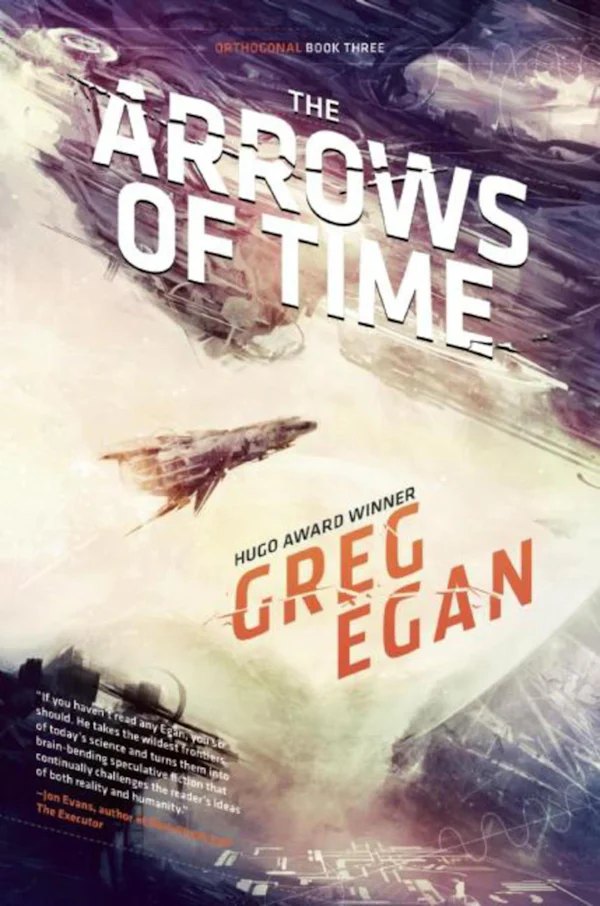
The Arrows of Time
by Greg Egan
Night Shade Books hardcover · 2014 · Publisher details · Cover via Skyhorse Publishing
As the Peerless finally turns for home, Agata and Ramiro must decide whether news from their own future can protect free choice—or quietly abolish it.
Full-story article
This article discusses the complete story, including the ending.
- Reading time
- About 12 hours
- Length
- 392 pages
- Reading complexity
- Demanding
- Dense terminology, structure, or viewpoint changes reward slower, attentive reading.
- Science intensity
- 5/5
- Scientific mechanisms are central to understanding the story.
Affiliate links. As an Amazon Associate, we earn from qualifying purchases.
Before you read
Is this book for you?
Start by tracking: Keep physical time direction separate from political influence, then ask who gains power when a future message is treated as authoritative.
Read this if you enjoy
- Time symmetry treated as lived physics
- Political arguments about prediction and freedom
- The conclusion of a rigorous multigenerational trilogy
Why readers may get lost
- The physics assumes familiarity with the earlier Orthogonal books
- Opposing time directions require careful viewpoint tracking
- Future information complicates ordinary cause and effect
Keep these anchors in mind
- Agata
- protects evidence and inherited purpose
- Ramiro
- defends choice against compulsory certainty
- Peerless
- carries generations shaped by one mission
- The reverse-arrow world
- forces cause and communication into unfamiliar order
- Future messaging
- turns prediction into an institution
Demanding reading complexity. Dense terminology, structure, or viewpoint changes reward slower, attentive reading.
Science intensity 5/5. Scientific mechanisms are central to understanding the story.
01 · Overview
The return journey asks whether a promised future can still be chosen
This original companion begins with Agata and Ramiro’s disagreement, not the time paradox. The strange arrows matter because they change who can know the future—and therefore who can govern the present.
Where the return begins
Peerless has an engine, a destination, and no single definition of home
Generations after launch, the travelers can finally turn Peerless back toward the system their ancestors meant to save. Agata believes the sacrifice behind the mission creates a responsibility to return. Ramiro asks whether people born aboard a mountain should be bound forever by a decision made before they existed.
Their debate becomes harder when the ship encounters matter whose thermodynamic history runs in the opposite direction. A reversed arrow of time is not merely a physics puzzle: it creates the prospect of messages from a possible future, beings whose causes look like effects, and certainty powerful enough to replace present judgment.
The central question
If the future could send instructions, would following them fulfill a mission—or end meaningful choice?
The novel joins temporal geometry to intergenerational politics. Every answer changes who is trusted to decide for everyone else.
- The reading promise
- A return voyage that becomes first contact with an opposing direction of history
- What to track
- Who wants return, who controls messages, what counts as authentication, and where records accumulate
- The model
- Each community experiences memory and causation along its own direction of increasing entropy
- The human question
- Can descendants honor an inherited purpose without surrendering their authority over the present?
The story, in human terms
The opening disagreement
- 1
The turnaround
Agata argues that the rescue must be completed
For her, returning honors generations who built a scientific world for people they would never meet.
What changes: The mission’s founding promise becomes a choice the current generation must make again.
- 2
The refusal
Ramiro defends a future independent of the founders
He fears that emergency and ancestry can make obedience look like gratitude.
What changes: Migration becomes a legitimate rival to return rather than simple betrayal.
- 3
The second arrow
An encounter makes both futures less predictable
Neither side can decide responsibly without understanding the beings and matter along Peerless’s route.
What changes: The political dispute expands into a question about causation, communication, and harm across opposing histories.
Series flight path
Orthogonal
This final Orthogonal volume completes the trajectory begun in The Clockwork Rocket and sustained through The Eternal Flame. It tests whether the scientific and political institutions carried by Peerless can survive access to their own possible future.
Volume 1
The Clockwork RocketDemanding
Volume 2
The Eternal FlameDemanding
Volume 3 · You are here
The Arrows of TimeDemanding
02 · Story map
A return route closes into an information loop
Keep the physical arrow and the political feedback loop distinct, then trace how knowledge changes who may decide.
The story, in human terms
Peerless chooses a direction
- 1
Inherited purpose
The travelers debate return against migration
Both positions claim to protect future generations: one through rescue and reciprocity, the other through freedom from ancestral command.
What changes: The vessel’s path becomes a referendum on legitimate obligation.
- 2
Turnaround
Peerless commits to the homeward trajectory
A decision that looks like navigation distributes risk across everyone inside the mountain.
What changes: The travelers can now meet the reverse-arrow region along the return route.
- 3
Opposed histories
Matter remembers toward a different future
The crew must reason about inhabitants for whom Peerless’s sequence of approach and departure is reversed.
What changes: Ordinary intuitions about warning, intervention, and consequence can no longer be assumed to be shared.
Expanded context
Information becomes the contested resource
- 1
The proposal
Opposed arrows suggest a path for future messages
A closed route could supply answers before the later travelers send them, promising safety and foreknowledge.
What changes: Control of authentication becomes a new form of political authority.
- 2
The bombing
Opposition to the message system turns violent
Disagreement over certainty now threatens bodies and institutions in the present.
What changes: The technical apparatus can no longer be treated as neutral infrastructure.
- 3
The expedition
Esilio crosses into the reversed-time world
Explorers confront lives whose memories and vulnerabilities do not line up with Peerless’s order of events.
What changes: The temporal model acquires an ethical subject: another community can be harmed by what the travelers call exploration.
Illustrated explanation
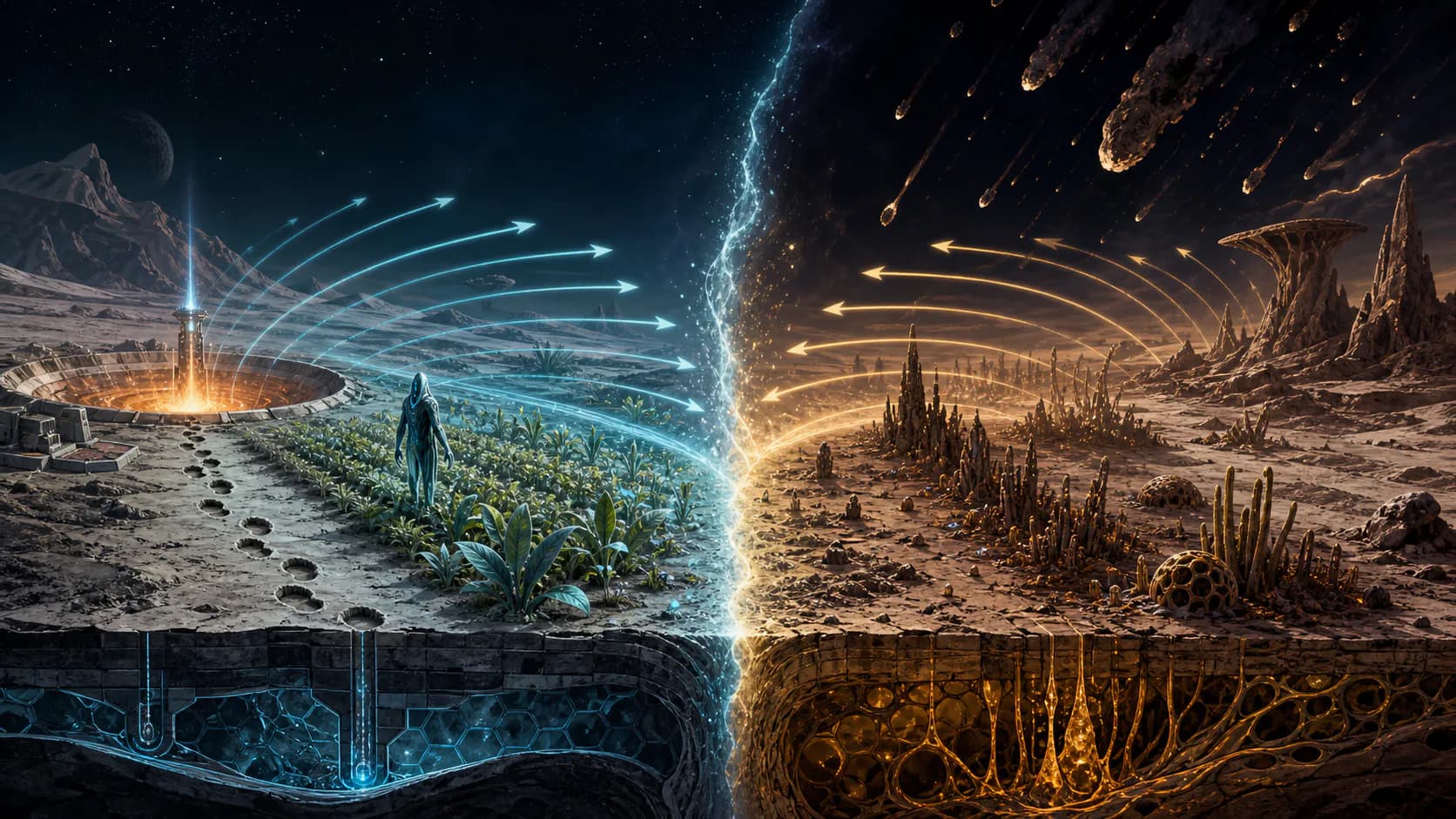
Two communities can each remember toward a different future
Follow each band in the direction that ordered traces become mixed and records accumulate. Peerless calls one direction future; the reverse-arrow inhabitants call the opposite direction future. The crossing expedition cannot assume one universal order of cause and effect.
What to notice
- 01
Primary concept
Thermodynamic arrow of time
The travelers meet a cosmos whose matter evolves in the time direction they call the past, forcing them to separate local memory, entropy, and causation from a universal clock.
In the image: The shared boundary does not give both regions the same direction of increasing entropy.
- 02
Physicist and mission advocate
Agata
She studies opposing time arrows while arguing that Peerless should complete the rescue for which generations sacrificed.
In the image: Agata's measurements follow the arrow in which Peerless forms memories and records.
- 03
Explorer of the reverse-arrow world
Esilio
His expedition tries to learn whether beings whose time direction opposes Peerless can coexist with the travelers' plans.
In the image: The expedition crosses between domains that disagree about which direction is later.
- 04
Plot trajectory
Explorers enter the opposing time arrow
Esilio's team crosses into a region whose inhabitants and physical history run opposite to Peerless, making intervention morally dangerous as well as conceptually strange.
In the image: In the second region, inhabitants remember and anticipate along the opposite band.
Complete trajectory
Certainty closes the society that built it
- 1
The messages
A possible future begins directing the present
Advice that appears reliable makes dissent look irrational and independent research feel wasteful.
What changes: The ship’s culture shifts from producing knowledge to receiving authority.
- 2
The break
Agata and Ramiro restore uncertainty
They act together despite their earlier conflict because an open future requires decisions that can still be questioned.
What changes: Disrupting the channel returns responsibility to the people who must bear each outcome.
- 3
The rescue
Peerless completes the ancestral mission without a guaranteed script
The travelers choose to trust an authenticated message and their accumulated science while accepting that no future can absorb responsibility for them.
What changes: The Hurtler threat is removed and the home system receives the result of generations of freely renewed work.
Illustrated explanation
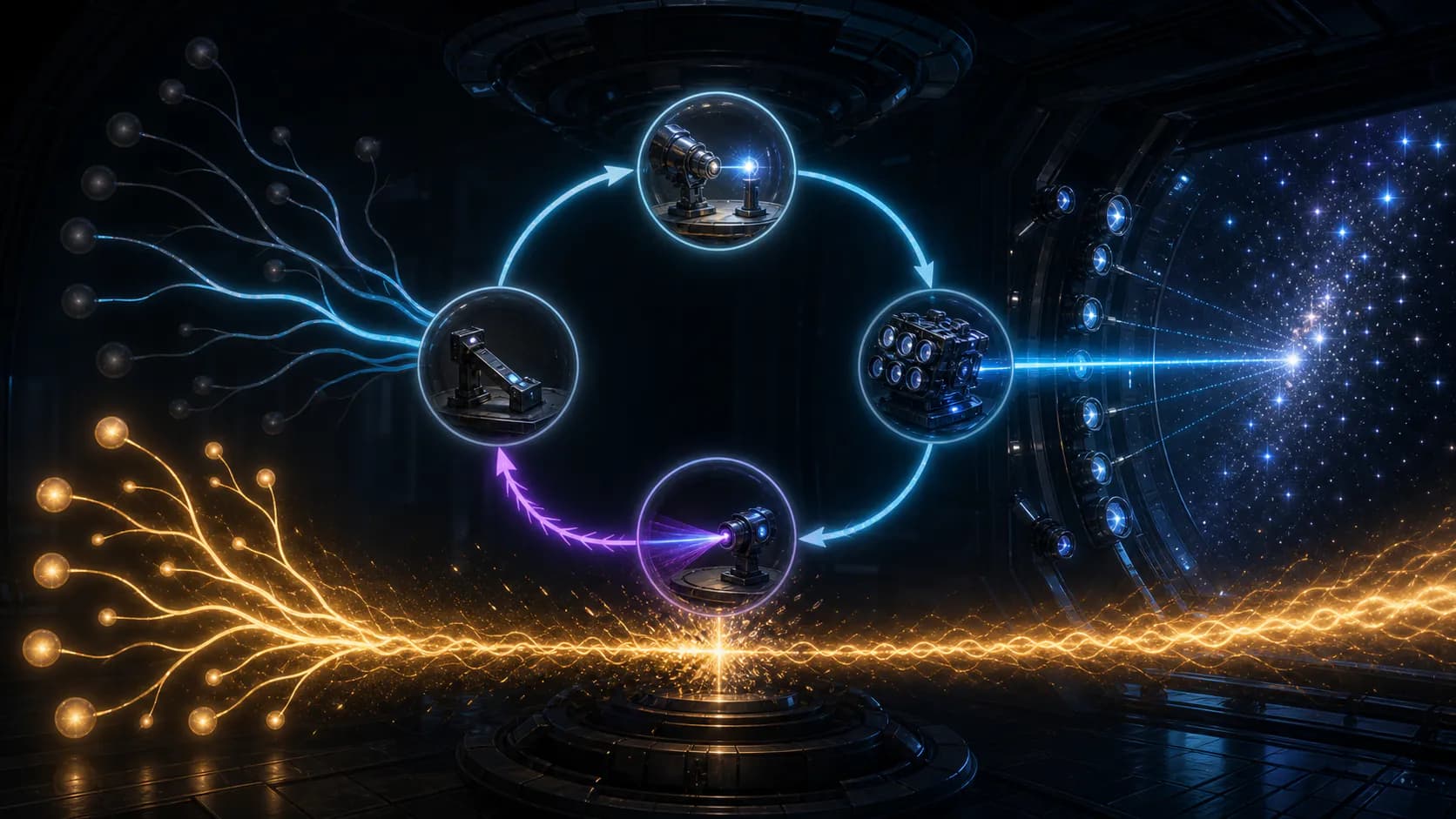
A shortcut to future answers can close the present
The message path loops through opposing time directions and returns an answer before its later transmission. The technical loop also creates a social feedback loop: trusting it reduces present inquiry, making the channel increasingly hard to challenge.
What to notice
- 01
Closed fictional information loop
Future messaging system
A sequence of opposed time directions lets messages circulate between Peerless and a later point in its own history.
In the image: The opposed-arrow relay closes the fictional route for information.
- 02
Primary concept
Time travel and temporal displacement
Messages sent around a closed path through opposing time arrows can return as apparently prior knowledge, but the loop changes who gets to choose and who merely complies.
In the image: Only information traverses the closed causal path; the travelers remain in their local time direction.
- 03
Plot trajectory
Future advice begins to halt present discovery
Reliable-seeming messages make research and political deliberation feel redundant, concentrating power in the channel that supplies them.
In the image: As answers arrive, laboratories and public deliberation lose authority.
- 04
Speculative concept
Information asymmetry
Information arriving from a possible future grants extraordinary leverage to those who authenticate, schedule, or suppress it while everyone else must act under unequal certainty.
In the image: Those who authenticate the returning message gain leverage over everyone acting without equal access.
- 05
Plot trajectory
Ramiro and Agata disrupt the future channel
They interrupt the apparatus that certifies the messages, restoring the need to reason and act without a guaranteed script.
In the image: Breaking certification restores uncertainty and therefore genuine present choice.
03 · Ideas and visuals
Two arrows create one struggle over agency
The fictional geometry is clearest when separated into physical records, information paths, and social consequences.
Ideas explained
Ideas to carry into the story
Start with what an observer can remember, then ask what the information lets an institution do.
Idea 1
Thermodynamic arrow of time
A thermodynamic arrow points from lower-entropy conditions toward more dispersed energy and more numerous mixed arrangements. Records and memories form along that local direction.
In this story: Peerless and the reverse-arrow world can each experience a coherent future while disagreeing about the order of shared events.
Which traces count as records for each observer, and in which direction do they accumulate?
Read the plain-language concept articleIdea 2
Time travel and temporal displacement
The novel routes information through regions with opposing arrows so it can return to an earlier point in Peerless’s own sequence. Bodies do not simply drive backward through their remembered lives.
In this story: The closed path promises foresight but lets later authority constrain the choices that are supposed to produce it.
Does receiving an answer preserve the decision that would have created it?
Read the plain-language concept articleIdea 3
Intergenerational governance
A legitimate long project must let later participants interpret, revise, or renew commitments whose founders cannot supervise.
In this story: Return, migration, messaging, and rescue all test whether Peerless is a community of agents or a machine executing ancestral code.
What would count as renewing the mission rather than merely obeying it?
Read the plain-language concept articleOptional detailWhy a reversed arrow is not simple rewindOpen for a compact guide to memory, entropy, and viewpoint.
Model boundary
Each side experiences itself moving forward
A film played backward looks absurd because our records, bodies, and environment share one thermodynamic orientation. In the novel, the second domain has its own consistent direction in which memories form and usable energy disperses. The difficulty appears where the two domains interact: each side orders the shared boundary events differently.
04 · Reading guide
Track direction, knowledge, and authority separately
These landmarks connect the key records and decisions. When a sequence feels paradoxical, first ask whose records you are following.
People choosing the route
Agata
Physicist and mission advocate
She studies opposing time arrows while arguing that Peerless should complete the rescue for which generations sacrificed.
Ramiro
Biologist and political skeptic
He challenges inherited authority and later tests whether future information is liberating knowledge or a new form of control.
Esilio
Explorer of the reverse-arrow world
His expedition tries to learn whether beings whose time direction opposes Peerless can coexist with the travelers' plans.
Valeria
Originator whose record returns
A message attributed to the mission's earliest scientific generation becomes the final test of trust across centuries.
World and channel
Peerless
Returning generation world
Its inhabitants must turn the vessel around, interpret a reversed-time cosmos, and decide what they owe the threatened home system.
Future messaging system
Closed fictional information loop
A sequence of opposed time directions lets messages circulate between Peerless and a later point in its own history.
People in the story
- Agata
- Physicist and advocate for completing the return mission · from Chapter 1
- Ramiro
- Biologist and critic of inherited political obligation · from Chapter 1
- Esilio
- Explorer who enters the reverse-arrow region · from Chapter 10
- Valeria
- Scientist from the founding era whose record crosses generations · from Chapter 22
Terms explained
- Turnaround
- The maneuver that redirects Peerless from its long outbound history toward the home system. · from Chapter 3
- Opposing arrow
- A domain where entropy, records, and experienced causation develop opposite to Peerless’s orientation. · from Chapter 3
- Future messaging
- A fictional closed information route using opposing arrows to return a later message to an earlier Peerless event. · from Chapter 5
- Authentication
- The technical and social process by which the travelers decide whether an apparently future message is genuine and authoritative. · from Chapter 22
Reader lens · chapter 3
A direction in space is also a distribution of obligation
The turnaround debate is not prudence versus selfishness. Agata and Ramiro defend rival accounts of what descendants owe the dead, the living at home, and people not yet born aboard Peerless.
Reader lens · chapter 12
Draw two timelines before judging the encounter
Mark the order in which Peerless records the expedition, then reverse the order for the other world’s inhabitants. The diagram will not settle the ethics, but it prevents one viewpoint’s sequence from being mistaken for a universal one.
Reader lens · chapter 27
Correct answers can still damage knowledge
Science needs the capacity to ask, test, criticize, and teach—not only access to true statements. Notice what happens to laboratories and political debate when a future channel appears to make those practices unnecessary.
Progress-safe room
Safe through Chapter 12
Progress-safe room
Safe through Chapter 27
05 · Ending explained
Why the trilogy ends by choosing under uncertainty
The final debrief connects the return to Yalda’s original act of curiosity and to the institutions built across Peerless.
Complete story
The future cannot take responsibility for the present
Future messaging appears to offer the mission certainty, but dependence on it freezes research and narrows political choice. Agata and Ramiro disrupt the apparatus that certifies the channel. Their alliance matters: the advocate of return and the skeptic of inherited obligation both recognize that a saved civilization must retain the ability to reason for itself.
A message attributed to Valeria ultimately helps the travelers complete the mission. Peerless returns through the required geometry and uses the capabilities accumulated across generations to remove the Hurtler danger, extinguishing and displacing the home sun so the catastrophic intersection no longer destroys the inhabited system. The action fulfills the founders’ purpose, but it is legitimate only because the living travelers choose it with the evidence and risks available to them.
- The turnaround
- Descendants renew the mission instead of treating its founding purpose as automatic command.
- The reverse arrow
- A physical relation creates a political channel with unequal access to certainty.
- The broken loop
- Restoring uncertainty also restores experimentation, deliberation, and responsibility.
- The rescue
- The home system survives because generations preserve the capacity to choose and act, not merely a fixed plan.
Keep exploring
Follow the idea beyond this ending
The Idea Atlas connects this novel’s central question to the science, philosophy, and other stories that approach it differently.
Open the connected ideaContinue through the catalog
Find another world on the same axis
The trilogy's final questions
Knowing the future can become another form of inherited rule
The reverse-arrow physics matters because it tempts Peerless to replace inquiry with obedience. The final volume asks whether descendants are completing a promise or being governed by voices that no longer share their risks.
Keep these lenses beside the causal diagrams. They explain why a time problem becomes a democratic problem.
Agata and Ramiro
Why do disagreement and alliance both matter?
They begin from different judgments about the return mission and about what the descendants owe the founders. Neither can resolve the crisis alone. Their eventual cooperation joins respect for purpose with resistance to unquestionable authority.
Why this matters: The story treats legitimate action as something produced through contest, evidence, and revision rather than unanimity.
Messages from the future
When does information stop helping a decision?
A future record can reduce uncertainty, but reliance on it also changes the conditions that produced the record. If institutions obey because the outcome is certified, they lose practice in testing evidence and accepting responsibility for present costs.
Why this matters: Foreknowledge becomes politically dangerous when it turns a possible future into a command.
The founders' promise
What can one generation rightly ask of another?
Peerless exists because earlier people accepted sacrifice for lives they would never meet. Descendants inherit the vehicle, danger, knowledge, and mission, but not the exact circumstances under which the promise was made.
Why this matters: Intergenerational duty requires renewing the reasons for a project, not merely preserving its instructions.
The return
Why is saving the home world not a simple restoration?
The travelers come back with altered institutions, new science, and lives formed entirely aboard Peerless. Their action rescues the inhabited system, but they cannot return to the society their founders left.
Why this matters: Completion means creating a future relationship between changed communities, not recovering an untouched past.
Coordinates on a neighboring axis
Novel guide
Death’s End
Death’s End
Cixin Liu
Across centuries of borrowed time, one aerospace engineer inherits decisions that ask whether compassion can protect a civilization—or expose it.
Novel guide
The Clockwork Rocket
The Clockwork Rocket
Greg Egan
When lethal meteors cross her world's history, physicist Yalda must turn a mountain into a rocket—and entrust salvation to generations she will never meet.
Novel guide
The Eternal Flame
The Eternal Flame
Greg Egan
Three generations into the Peerless voyage, Tamara, Carlo, Carla, and Patrizia must solve fuel and population crises without letting survival make anyone's body expendable.
Content notes
Political bombing and deaths · Imprisonment and civil conflict · Severe injury during spaceflight · Planetary extinction threat
Editorial record
Research and sources
The story analysis is original. Background sources support the scientific and philosophical explainers connected to this novel.
Last reviewed July 22, 2026