
The idea in plain English
Plain idea
What changes
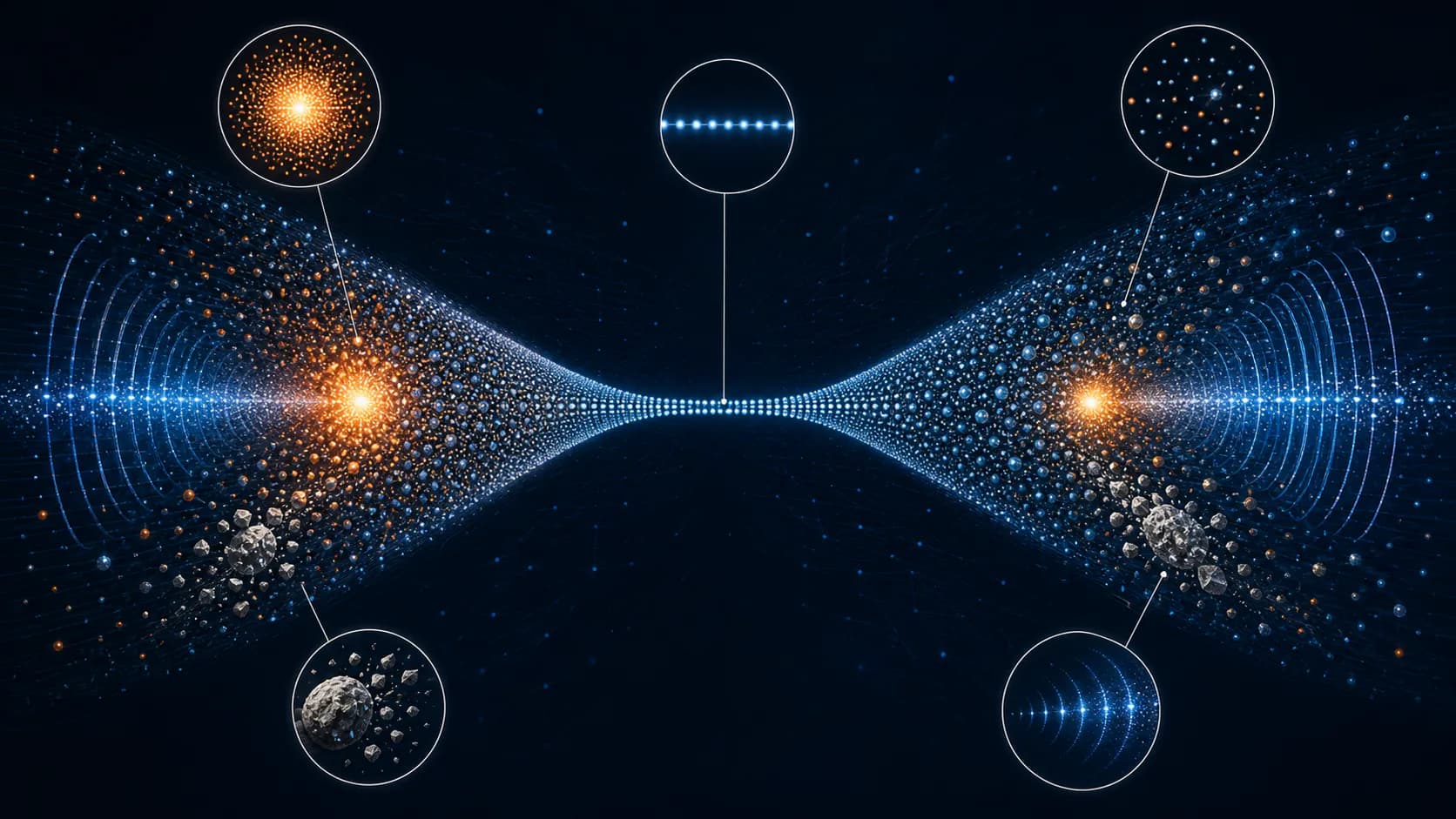
The thermodynamic arrow is the observed direction from unusually ordered, low-entropy conditions toward macroscopic states compatible with many more microscopic arrangements.
Mechanism
How it operates
Microscopic laws often allow both time directions, but a system beginning in a special low-entropy state will almost always evolve into larger, more typical sets of configurations. Heat spreads, fragments disperse, and stable records form in the same direction because each process exports entropy into its surroundings.
Human stakes
Why it matters
Memory, evidence, aging, engines, ecosystems, and prediction all depend on a reliable difference between records of the past and possibilities for the future. If neighboring systems carried opposite arrows, even exchanging heat or growing food across their boundary would become a causal problem.
Used in: 1 catalog novel
Related: Time travel and temporal displacement · Closed-loop life support · Science as infrastructure
A few terms make the rest of the explanation easier to follow.
- Macrostate
- A coarse description such as temperature, pressure, or density that can correspond to many detailed microscopic arrangements.
- Microstate
- A detailed specification of the particles or degrees of freedom compatible with a system's macroscopic condition.
- Entropy
- A physical quantity connected to how many microscopic configurations are compatible with a macrostate and to limits on useful energy conversion.
- Past hypothesis
- The proposal that the observed arrow depends on an exceptionally low-entropy boundary condition in the universe's past.
Use the idea while reading
Turn the definition into three observations
Do not begin by asking whether a novel is “about” thermodynamic arrow of time. Begin with what changes in the lives of its characters, then use the concept to explain the mechanism underneath that change.
- 01
Notice where low-entropy conditions come from and which direction records accumulate.
- 02
Notice how heat, radiation, memory, growth, or damage mark one direction.
- 03
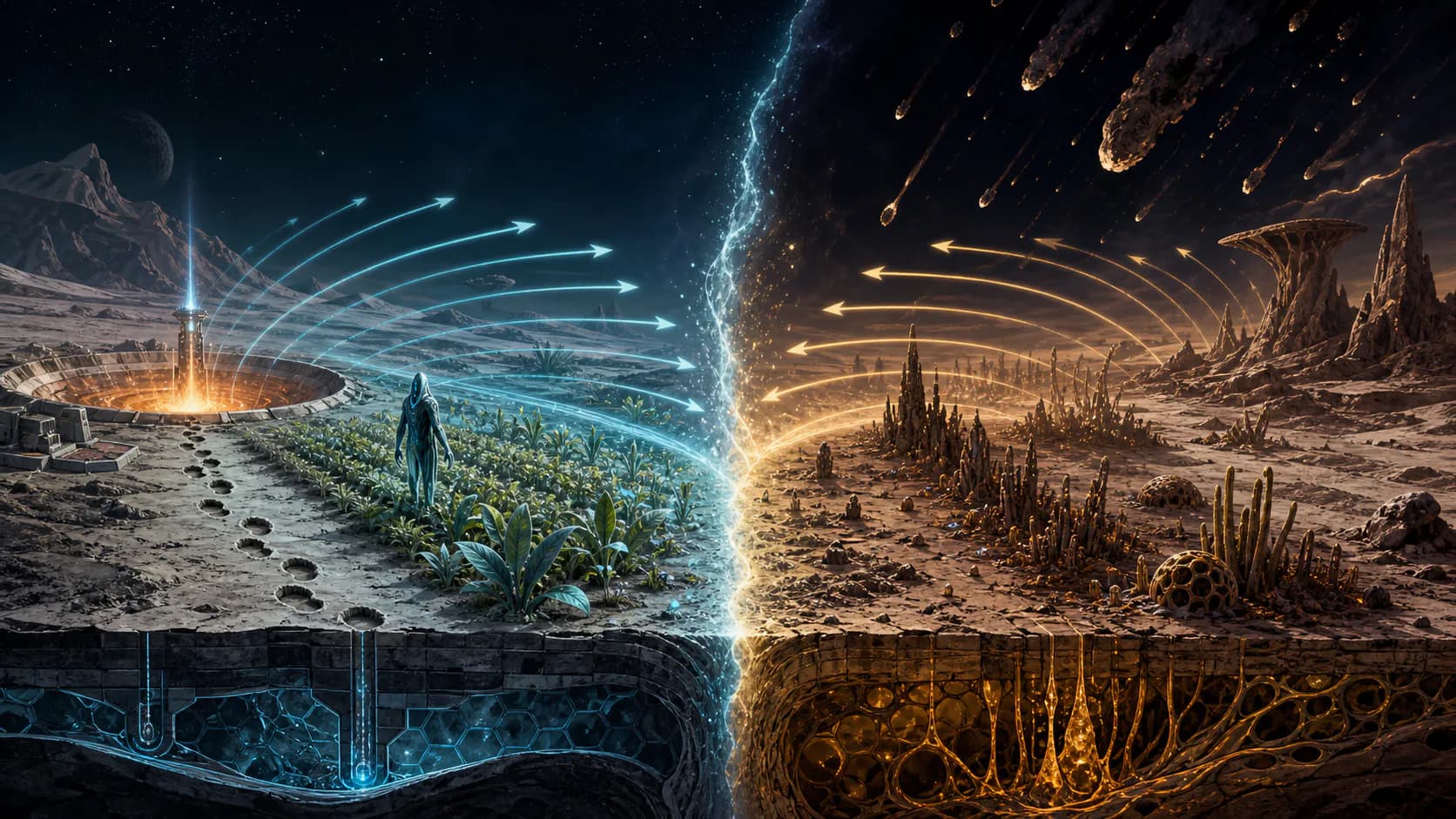
Notice what happens when systems with different boundary conditions exchange matter or information.
Keep one question open: Which physical records distinguish past from future in this story?
Avoid the shortcut: Entropy is not simply visible mess, and the second law does not say microscopic motion can never reverse. It is a statistical claim about overwhelmingly more numerous macrostates under a particular boundary condition.
How it works, step by step
- 1
Begin from a constrained state
Energy, particles, or correlations occupy a relatively small and special set of the configurations allowed by the macroscopic constraints.
- 2
Allow microscopic dynamics to unfold
Collisions and interactions follow laws that often work in either time direction at the small scale.
- 3
Move toward overwhelmingly numerous macrostates
Diffused heat, mixed particles, and dispersed fragments correspond to vastly more microscopic arrangements than their concentrated starting conditions.
- 4
Create records while exporting entropy
Memories, photographs, fossils, engines, and living repair processes form stable traces by consuming free energy and releasing heat into their surroundings.
A concrete example
Gas leaves one corner of a box
A partition is removed from a box whose gas molecules initially occupy only one small region.
01
Ordinary collisions spread molecules through the available volume because almost all compatible configurations look well mixed.
02
The reverse motion is allowed by microscopic equations, but it would require an extraordinarily precise coordination of every molecular velocity.
03
A machine that restores the gas to the corner must measure, sort, and expend work, increasing entropy elsewhere rather than erasing the cost.
The point
The arrow is statistical and conditional, not a rule that each particle knows the future. Macroscopic irreversibility emerges because high-entropy arrangements dominate and reversal requires exceptional information and control.
What is real, and what remains uncertain
First separate what we can observe or build today from what remains a prediction or a fictional extension.
What evidence supports it
Established thermodynamics, open cosmological explanation
Entropy increase and irreversible macroscopic processes are measured throughout physics. Why the universe began in a sufficiently low-entropy state, and how all arrows align, remains a foundational question.
A common misunderstanding
Entropy is not simply visible mess, and the second law does not say microscopic motion can never reverse. It is a statistical claim about overwhelmingly more numerous macrostates under a particular boundary condition.
Try this example in your head
Imagine a film of gas spreading from one corner of a box. Microscopic collisions work in either direction, yet the reverse film is fantastically unlikely. What special information would be required to prepare every molecule for that reversal?
Entropy is not visible mess
Order in everyday language can be misleading; entropy is defined through thermodynamic or statistical structure, system boundaries, and accessible macrostates.
The cosmological origin remains open
Local entropy increase is well established, while the explanation for the universe's unusually low-entropy boundary condition remains a foundational question.
How science fiction tests the idea
Stories usually test both the promise of an idea and the trouble it creates.
Its promise
The arrow of time makes records, memory, growth, and causal explanation possible even when microscopic laws are nearly time-symmetric.
Its problem
Treating one familiar arrow as inevitable can hide its dependence on unusual boundary conditions and the scale at which observers describe a system.
What to notice in a story
- 01
Where low-entropy conditions come from and which direction records accumulate
- 02
How heat, radiation, memory, growth, or damage mark one direction
- 03
What happens when systems with different boundary conditions exchange matter or information
Novels that use this idea
Questions to keep thinking about
Which physical records distinguish past from future in this story?
Does reversed behavior come from reversed laws, a boundary condition, or deliberate control?
What entropy cost is displaced when a character seems to undo an irreversible process?
Sources and further reading
These references ground the portable lesson; story interpretations remain editorial analysis.
Stanford Encyclopedia of Philosophy
Thermodynamic Asymmetry in Time
MechanismReality checkLimitsU.S. Department of Energy
Thermodynamics, Heat Transfer and Fluid Flow — Volume 1
MechanismReality checkLimitsFoundations of Physics
Is the Low-Entropy Initial State Necessary for Explaining the Arrow of Time?
Reality checkLimits