
The idea in plain English
Plain idea
What changes
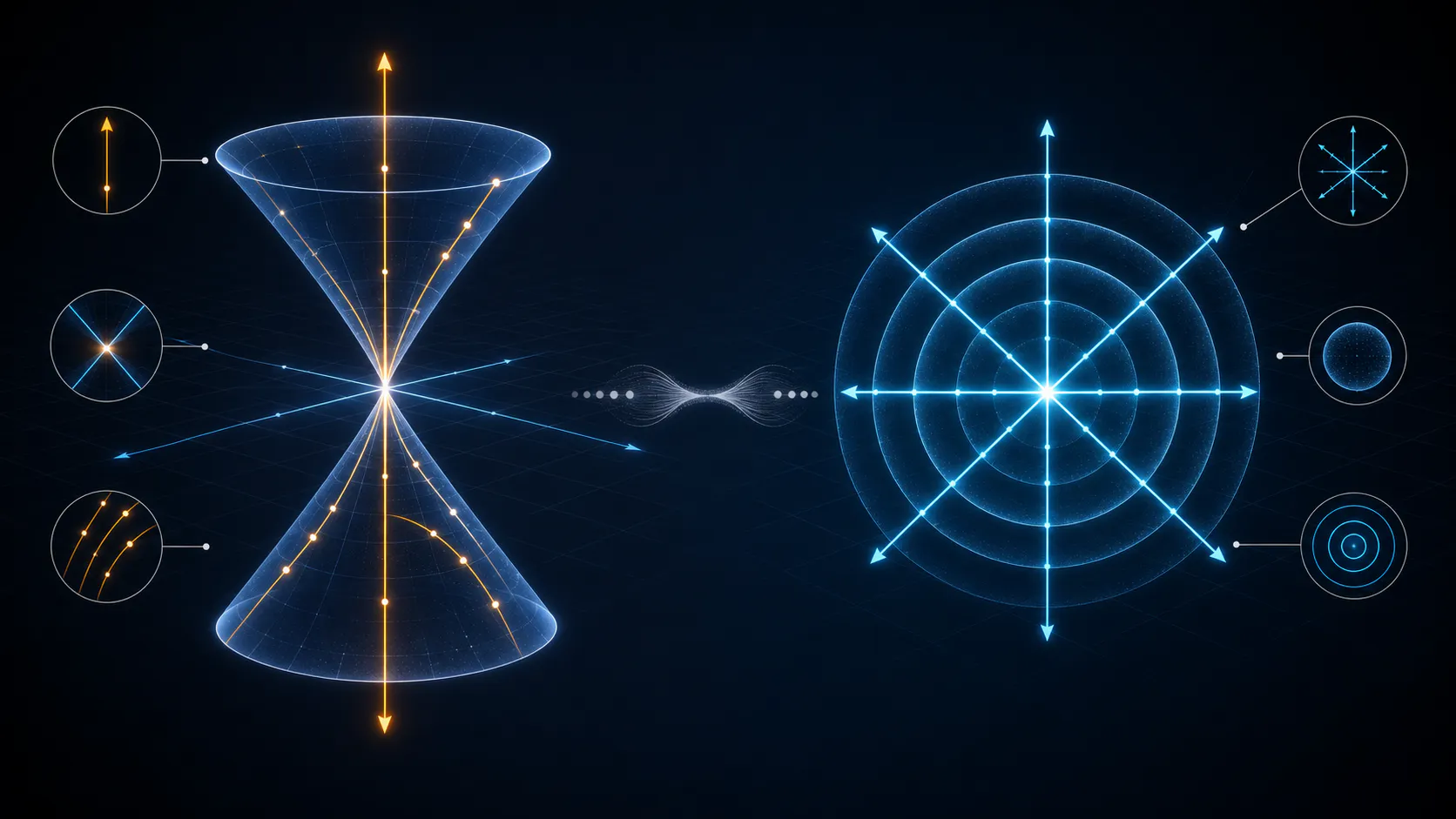
Riemannian spacetime is a speculative model in which time is measured geometrically more like another spatial direction than the distinct time direction in ordinary relativity.
Mechanism
How it operates
In special relativity, the metric gives time and space opposite signs, producing light cones and a universal invariant speed. With an all-positive Riemannian signature, that cone disappears: rotations can mix the coordinate called time with spatial coordinates, and a world can require new rules for waves, energy, stable matter, and causality.
Human stakes
Why it matters
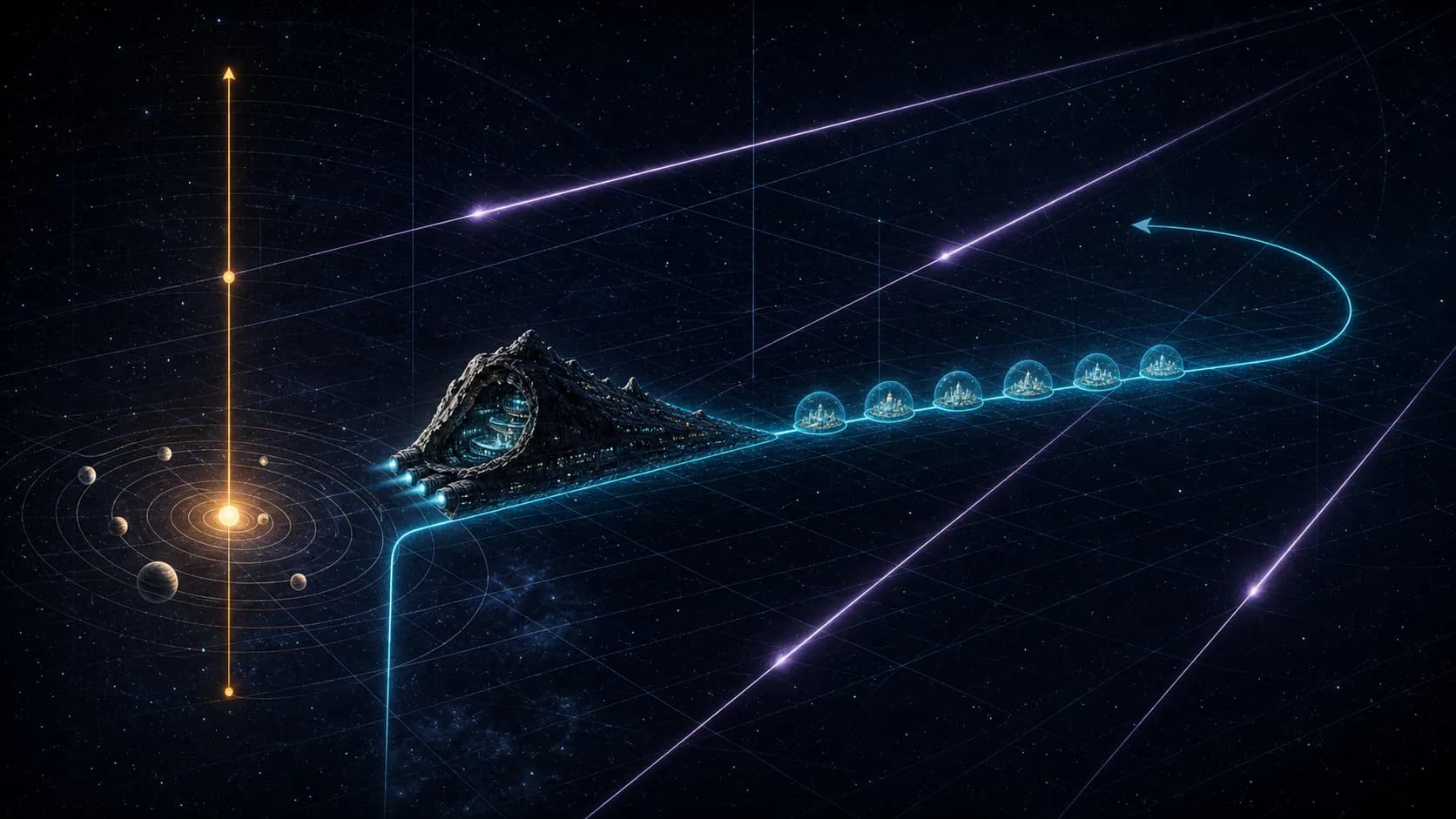
The changed geometry can reverse familiar travel costs and separate communities onto histories that intersect in surprising ways. It also shows readers that speed limits, simultaneity, and causal order are structural features of a physical theory rather than universal common sense.
Used in: 1 catalog novel
Related: Time travel and temporal displacement · Relativistic time dilation · Interstellar travel
A few terms make the rest of the explanation easier to follow.
- Metric signature
- The pattern of positive and negative signs in a metric that distinguishes spatial and temporal directions in a spacetime theory.
- Lorentzian geometry
- The indefinite-signature geometry used by relativity, where light cones separate timelike, lightlike, and spacelike directions.
- Riemannian geometry
- Positive-definite geometry in which all local coordinate directions enter the distance rule with the same sign.
- Causal structure
- The rules determining which events can influence which other events through physically allowed signals or trajectories.
Use the idea while reading
Turn the definition into three observations
Do not begin by asking whether a novel is “about” riemannian spacetime. Begin with what changes in the lives of its characters, then use the concept to explain the mechanism underneath that change.
- 01
Notice whether the story replaces light cones with another causal structure.
- 02
Notice how waves, energy, and stable matter change with the metric signature.
- 03
Notice which observers accumulate more or less history along different geometric paths.
Keep one question open: Which familiar consequence comes from geometry and which requires an added physical law?
Avoid the shortcut: Riemannian spacetime does not simply mean curved space, and it is not a loophole for faster-than-light travel in our universe. The signature changes the theory's causal foundation, not merely the shape of one route.
How it works, step by step
- 1
Compare the interval rules
Ordinary relativity subtracts the time contribution from spatial contributions, while an all-positive model treats every coordinate direction symmetrically.
- 2
Observe the loss of light cones
Without an indefinite signature, geometry alone no longer supplies the familiar boundary separating possible causal influence from spacelike separation.
- 3
Add matter, waves, and thermodynamics
A fictional universe needs field equations and boundary conditions that produce stable particles, radiation, records, energy, and a locally shared time direction.
- 4
Derive motion from the complete theory
Acceleration, wavelength, energy exchange, and intersecting histories follow from the metric plus those additional laws, not from changing one sign in isolation.
A concrete example
A map with no privileged time axis
Draw a four-dimensional local geometry in which rotating the coordinate called time into a spatial coordinate leaves the interval rule unchanged.
01
Unlike Lorentzian spacetime, the geometry does not create a light cone that labels some directions as timelike and others as unreachable.
02
Material worldlines can still select a practical local time direction when nearby matter moves in a common bundle.
03
The theory must explain waves, stable matter, entropy, and records so observers do not gain unrestricted contradictory influence merely from the symmetric metric.
The point
Riemannian spacetime is a disciplined fictional change to causal geometry. The sign change removes familiar structure, and a complete world requires replacement physical laws.
What is real, and what remains uncertain
First separate what we can observe or build today from what remains a prediction or a fictional extension.
What evidence supports it
Established mathematics, speculative physical universe
Riemannian geometry is foundational mathematics and Euclidean-signature methods are used in physics calculations. Our observed spacetime has Lorentzian signature; a habitable all-positive-signature cosmos remains speculative.
A common misunderstanding
Riemannian spacetime does not simply mean curved space, and it is not a loophole for faster-than-light travel in our universe. The signature changes the theory's causal foundation, not merely the shape of one route.
Try this example in your head
Draw a map where every direction can be rotated into every other direction, then try to mark which events can influence a chosen event. Without a light cone, what additional physical rule would keep causes, records, and observers coherent?
Established mathematics is not observed cosmology
Positive-definite geometry is standard mathematics and useful in physics calculations, but measured spacetime has Lorentzian causal structure.
The Orthogonal model is a constructed universe
Its particles, light, energy, and time arrows are carefully derived fictional additions, not predictions that an all-positive metric describes our universe.
How science fiction tests the idea
Stories usually test both the promise of an idea and the trouble it creates.
Its promise
Changing one sign in spacetime geometry can provide a disciplined laboratory for discovering which physical intuitions depend on our universe's structure.
Its problem
A mathematically consistent geometry does not guarantee a physically habitable universe or make its fictional consequences evidence about our own.
What to notice in a story
- 01
Whether the story replaces light cones with another causal structure
- 02
How waves, energy, and stable matter change with the metric signature
- 03
Which observers accumulate more or less history along different geometric paths
Novels that use this idea
Questions to keep thinking about
Which familiar consequence comes from geometry and which requires an added physical law?
How does the story prevent unrestricted paths from destroying causal coherence?
What human obligation changes when one journey contains generations for travelers but years for home?
Sources and further reading
These references ground the portable lesson; story interpretations remain editorial analysis.