
The idea in plain English
Plain idea
What changes
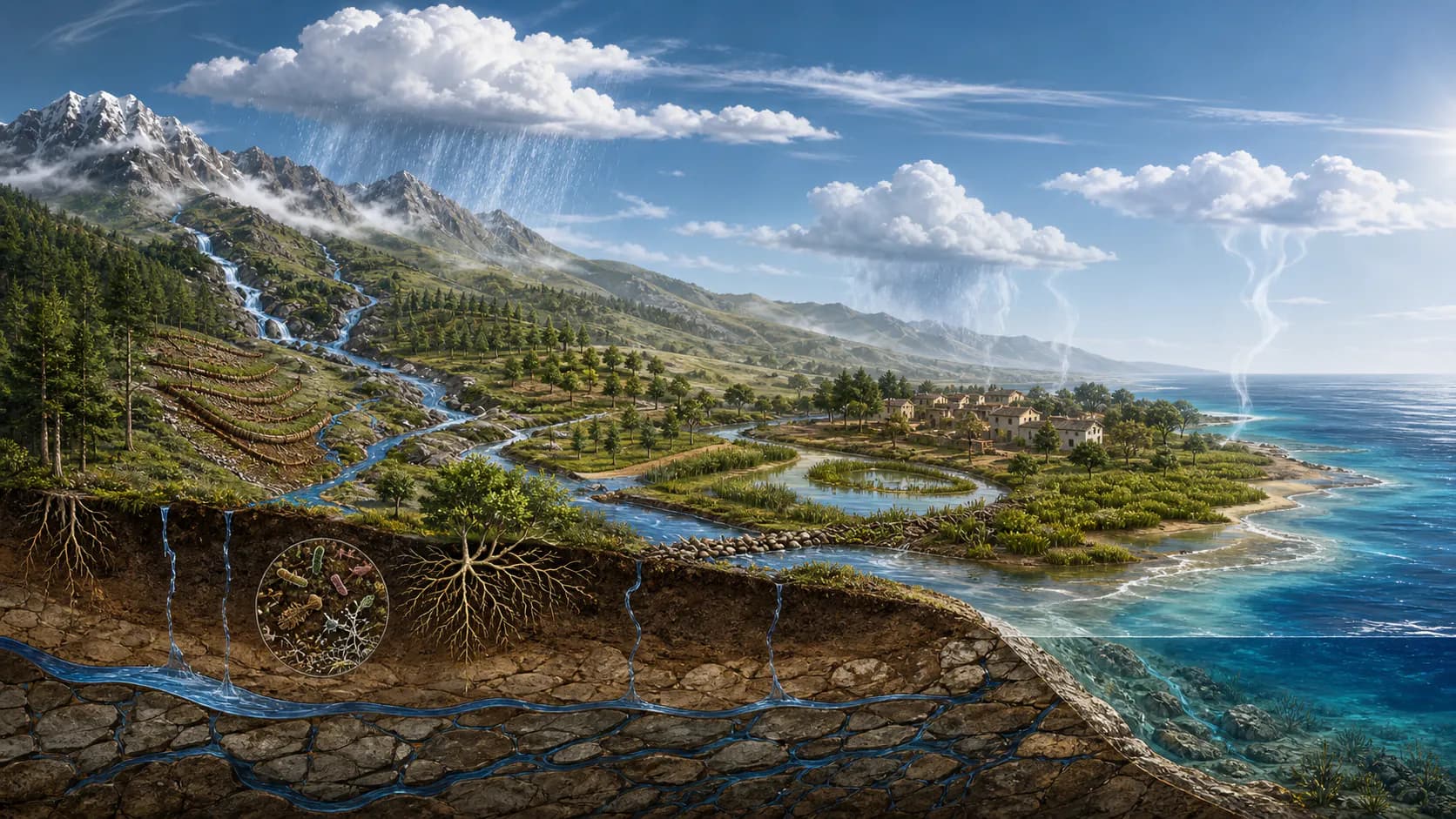
Planetary ecosystem engineering means intentionally changing connected environmental systems—water, soil, climate, living communities, and human infrastructure—so a world becomes more habitable over long periods.
Mechanism
How it operates
A planet moves matter and energy through linked spheres. Rain changes rivers and groundwater; plants alter soil, humidity, and carbon; organisms cycle nutrients; settlements redirect water and fragment habitats. An intervention changes one flow, then feedbacks carry the effect elsewhere. Effective engineering therefore combines observation, models, staged experiments, protected reserves, and repeated correction rather than relying on one dramatic machine.
Human stakes
Why it matters
Changing a whole environment changes who can live where, which species or cultures persist, and who controls scarce land and water. A technically successful project can still be politically violent if one group defines the target climate, accepts risks for others, or treats existing inhabitants as obstacles.
Used in: 5 catalog novels
Related: Climate survival · Closed-loop life support · Intergenerational governance
A few terms make the rest of the explanation easier to follow.
- Earth system
- The interacting atmosphere, hydrosphere, biosphere, geosphere, and cryosphere through which energy and matter move.
- Feedback
- A change that alters the process producing it, either amplifying the original shift or damping it.
- Restoration
- Assisting recovery of a degraded ecosystem while recognizing that exact return to an earlier state may be impossible or undesirable.
- Adaptive management
- Treating intervention as a monitored sequence whose next decision changes in response to observed outcomes and uncertainty.
Use the idea while reading
Turn the definition into three observations
Do not begin by asking whether a novel is “about” planetary ecosystem engineering. Begin with what changes in the lives of its characters, then use the concept to explain the mechanism underneath that change.
- 01
Notice which water, nutrient, and energy flows the intervention changes first.
- 02
Notice who chooses the target environment and whose present home counts.
- 03
Notice whether monitoring can reveal slow feedbacks before they become irreversible.
Keep one question open: Does the story treat the planet as a machine, a community, or both?
Avoid the shortcut: Ecosystem engineering is not simply adding water or vegetation until a barren place turns green. Habitability depends on energy, chemistry, nutrient cycles, soils, atmosphere, biodiversity, timescale, and feedbacks that can reverse or redirect an intervention.
How it works, step by step
- 1
Map coupled flows
Observers track water, energy, nutrients, species, soils, atmosphere, infrastructure, and human use to identify connections rather than one isolated shortage.
- 2
Choose a bounded intervention
A project changes a limited pathway—such as erosion, wetland storage, groundwater recharge, or habitat connectivity—with an explicit target and affected community.
- 3
Watch feedbacks and distribution
Monitoring asks not only whether the target improved but where water, heat, organisms, labor, and risk moved as the system adjusted.
- 4
Revise, buffer, or stop
Staged work, refuges, redundancy, and decision thresholds preserve the ability to correct a harmful trajectory instead of defending sunk costs.
A concrete example
Greening a dry basin
A settlement proposes reservoirs, groundwater pumping, planted forests, and restored wetlands to make a dry basin cooler and more productive.
01
Engineers first trace seasonal inflow, evaporation, aquifer recharge, soil salinity, native species, and downstream users rather than counting only stored water.
02
A small wetland and erosion-control trial improves water retention, but dense tree planting draws more groundwater than expected and reduces flow beyond the project boundary.
03
The plan shifts toward native vegetation, protected dryland habitat, water budgets, and staged expansion with thresholds that pause work when the aquifer falls.
The point
Planetary ecosystem engineering is feedback governance as much as construction. The transferable skill is preserving the ability to learn while the intervention changes the system being measured.
What is real, and what remains uncertain
First separate what we can observe or build today from what remains a prediction or a fictional extension.
What evidence supports it
Real restoration, speculative planetary control
People already restore wetlands, forests, soils, rivers, and coastal systems, while Earth-system science measures interactions across atmosphere, water, rock, ice, and life. Deliberately transforming an entire planet with predictable results remains speculative.
A common misunderstanding
Ecosystem engineering is not simply adding water or vegetation until a barren place turns green. Habitability depends on energy, chemistry, nutrient cycles, soils, atmosphere, biodiversity, timescale, and feedbacks that can reverse or redirect an intervention.
Try this example in your head
A desert basin can support a new forest if engineers import water for fifty years. The trees cool the surface but lower downstream flow and replace a native dryland ecosystem. Has the project created habitability, moved scarcity, or imposed one preferred landscape?
Whole-world prediction is limited
Models simplify ecosystems and climate, while rare events, evolution, migration, and social response can create outcomes outside the tested range.
Habitability is not one universal target
Conditions favorable to one species, economy, or settlement can damage another, so technical optimization cannot replace political choice and consent.
Restoration does not erase history
Some extinctions, soil losses, contamination, and cultural displacement cannot be reversed even when ecological functions partly recover.
How science fiction tests the idea
Stories usually test both the promise of an idea and the trouble it creates.
Its promise
Careful long-term intervention can restore damaged feedbacks and widen the conditions in which life can flourish.
Its problem
Treating a planet as a controllable machine can hide uncertainty, unequal costs, and the value of ecosystems that resist a preferred design.
What to notice in a story
- 01
Which water, nutrient, and energy flows the intervention changes first
- 02
Who chooses the target environment and whose present home counts
- 03
Whether monitoring can reveal slow feedbacks before they become irreversible
Novels that use this idea
Civilization scale
Cautious · Demanding
Children of Strife
A traumatized researcher and a mantis-shrimp captain descend to a living world where uploaded terraformers have spent millennia fighting through evolution itself.
Civilization scale
Hopeful · Layered
Children of Time
A world designed as a controlled uplift experiment becomes an ecosystem with its own evolutionary history, making the original engineering plan only the first event in a much longer planetary relationship.
Societal scale
Cautious · Layered
Cibola Burn
On the first contested colony beyond the Rings, refugees and a corporate expedition fight over one world while its alien systems begin waking beneath them.
Civilization scale
Dark · Layered
Dawn
Earth's restoration demonstrates extraordinary ecological care while giving the restorers practical authority over who may return and under what conditions.
Civilization scale
Dark · Demanding
Dune
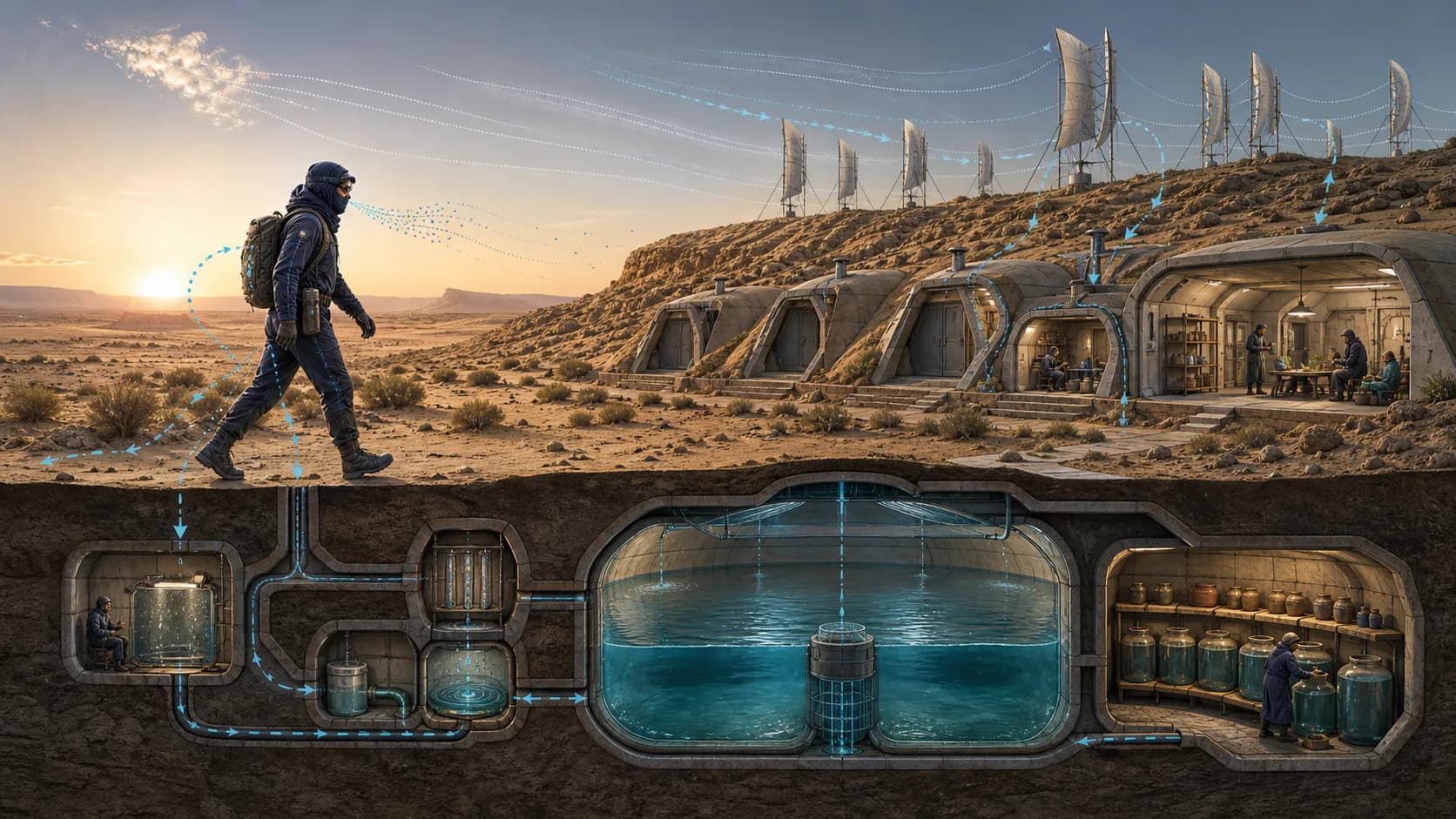
Arrakis makes ecology a political timescale: water discipline, species relationships, and a multigenerational planetary plan decide who can imagine a different world.
Visual example · Water survival is a shared accounting system
Questions to keep thinking about
Does the story treat the planet as a machine, a community, or both?
Which benefits appear quickly while costs emerge across generations?
Can the project be revised, or does success depend on an irreversible commitment?
Sources and further reading
These references ground the portable lesson; story interpretations remain editorial analysis.
NASA
Earth System Science Research
MechanismReality checkLimitsUnited Nations Environment Programme
Ecosystem Restoration
MechanismReality checkHuman stakesLimitsNOAA Integrated Ecosystem Assessment
Ecosystem-Based Management
MechanismHuman stakesLimitsNASA Astrobiology
What Determines If a Planet Can Have Life?
Reality checkLimits