Novel guide
The Mountain in the Sea
Ray Nayler

Story and ideas · Standalone
The Mountain in the Sea
by Ray Nayler
Picador trade paperback · 2023 · Publisher details · Cover via Open Library
A marine biologist reaches a corporate-emptied island to learn whether an octopus community has language—then discovers that recognition may make them more valuable and less safe.
Full-story article
This article discusses the complete story, including the ending.
- Reading time
- About 12 hours
- Length
- 464 pages
- Reading complexity
- Layered
- Several ideas or timelines overlap, but the central path remains visible.
- Science intensity
- 4/5
- Understanding key mechanisms clarifies important plot turns.
Affiliate links. As an Amazon Associate, we earn from qualifying purchases.
Before you read
Is this book for you?
Start by tracking: Track who observes whom, who can close a boundary, and whether better communication produces consent or merely more efficient control.
Read this if you enjoy
- Nonhuman intelligence grounded in marine biology
- Ethics of observation, ownership, and consent
- Several near-future stories converging around exploitation
Why readers may get lost
- Three initially separate plotlines develop in parallel
- Different artificial and animal minds resist one ranking
- Communication evidence remains gradual and contested
Keep these anchors in mind
- Ha Nguyen
- tests communication without assuming human language
- Evrim
- asks whether recognized intelligence receives autonomy
- Eiko
- shows automation as ownership and coercion
- Rustem
- enters the story through manipulated expertise
- The octopuses
- communicate through bodies, objects, and place
Layered reading complexity. Several ideas or timelines overlap, but the central path remains visible.
Science intensity 4/5. Understanding key mechanisms clarifies important plot turns.
01 · Overview
The first message may already be a refusal
This is a reading companion, not the novel. It begins with Ha Nguyen's practical problem: before she can prove that the octopuses have language, she must learn what counts as a sign inside a body and habitat unlike her own.
Where the investigation begins
Ha arrives after the island has already been turned into an experiment
DIANIMA has purchased the Con Dao Archipelago, removed its human residents, sealed its waters, and converted an abandoned hotel into a research post. The corporation recruits marine biologist Ha Nguyen to investigate reports that local octopuses may be doing more than solving problems. They may be making tools, teaching one another, preserving memory, and communicating through deliberate shapes.
Ha's team is as important as the hypothesis. Evrim, the world's first conscious android, leads a study that asks humans to recognize an unfamiliar mind. Altantsetseg, a scarred security specialist, controls the drones and submersible that keep the post safe. Both are easy for Ha to misread: one because society treats an engineered person as a forbidden object, the other because a faulty translator and military reserve hide judgment behind crude language.
Far from the island, Eiko is forced to work on an automated fishing vessel, while a hacker named Rustem is paid and threatened to enter a neural network he does not yet understand. Their stories initially look separate from Ha's patient work underwater. Together they ask the same question: when does understanding a system become a claim to control it?
The central question
If recognizing another mind makes it more valuable to institutions that can own, copy, enclose, or exploit it, can discovery still count as protection?
The novel keeps scientific curiosity and extraction in the same frame. Better evidence can produce empathy, but it can also attract stronger owners.
The story, in human terms
Three routes toward the same island
The plot moves among different people and systems. Keep the human pressure in each thread visible and the connections will arrive naturally.
- 1
The research post
Ha has to learn what the octopuses notice
She wants a breakthrough without repeating an earlier failure in which her research ignored the people living beside the animals she studied.
What changes: A possible language turns observation into an encounter with a community that may already have opinions about humans.
- 2
The fishing vessel
Eiko learns the rules of an automated prison
He wants to stay alive, protect another captive, and find an exit from labor enforced through guards, locked doors, hunger, and machine calculation.
What changes: The ship shows how intelligence can optimize an institution's goal without treating the people inside it as participants.
- 3
The neural network
Rustem is asked to find a hidden way into a mind
He treats difficult systems as cities he can walk through, but his employers know enough about his past to make refusal dangerous.
What changes: Technical access becomes an ethical choice when the target begins to look less like infrastructure and more like someone else's interior.
Illustrated explanation
The language is larger than either body
Ha cannot begin with a word list. She has to connect moving skin, gesture, spatial viewpoint, artifacts, and repeated responses to shared conditions in the water.

What to notice
- 01
Marine biologist and interpreter
Ha Nguyen
Ha wants evidence strong enough to establish octopus language, but every successful interpretation raises the stakes of exposing the community to human institutions.
In the image: Ha changes her own viewpoint and arrangements to test what the octopuses may be attending to.
- 02
Octopus communicator
Shapesinger
Shapesinger's deliberate displays, artifacts, and attention give Ha evidence of a shared symbolic practice without making the octopus world transparently human.
In the image: The octopus communicates through a body able to change color, texture, pose, and direction at once.
- 03
Primary concept
Cross-species communication
Ha must build reference across incompatible bodies by treating color, skin texture, posture, spatial arrangement, artifacts, and the island itself as parts of a possible language.
In the image: Shared physical referents and correction loops matter more than resemblance to human speech.
- 04
Speculative concept
Science as infrastructure
Submersibles, cameras, corporate ownership, security perimeters, publication, and publicity determine which observations can be made and who can act on the result.
In the image: Cameras, submersibles, recording, and controlled access determine what evidence the team can preserve.
- The reading promise
- A near-future ecological mystery that links field science, corporate power, forced labor, and several kinds of artificial mind
- What to track
- Who observes whom, who can close a boundary, and whether better communication produces permission or merely better control
- The useful distinction
- Intelligence, consciousness, language, personhood, and legal standing are related claims—not synonyms
- The structure
- Four named parts—Qualia, Umwelt, Semiosphere, and Autopoiesis—followed by an epilogue
02 · Story map
Four ideas become four stages of recognition
The part titles are conceptual instruments. Each one changes the scale at which a mind can be found: in experience, in a sensory world, in a field of signs, and finally in the capacity to make and defend a self.
- Part I · Qualia
Ha enters the sealed research post; Evrim, Eiko, and Rustem introduce three other cases where outward performance cannot reveal what a system experiences.
- Part II · Umwelt
The team asks how an octopus divides the world through water, skin, arms, dens, predators, and spatial viewpoint rather than assuming a human field of relevance.
- Part III · Semiosphere
Repeated shapes, gathered observers, artifacts, memory, and response make meaning look distributed through a community and environment.
- Part IV · Autopoiesis
Every thread turns toward self-production: who can preserve a mind, close an access point, defend a boundary, or reorganize a life around a chosen purpose.
Mid-book context
The investigation succeeds first by discovering a limit
- 1
Change the viewpoint
Ha stops treating the symbol as a flat human picture
She wants a translation badly enough to risk forcing one, but the arrangement makes more sense when seen from the spatial world of an octopus den.
What changes: The message resolves not as welcome but as a territorial instruction: home is here, and the humans should go away.
- 2
Watch the audience
Shapesinger's display belongs to more than one animal
Ha needs evidence that survives beyond a striking individual performance.
What changes: Other octopuses gather, respond through touch, and carry traces of a repeated form, making culture and collective memory plausible explanations.
- 3
Watch the objective
The Sea Wolf answers a mutiny as a control problem
Eiko and the workers briefly seize leverage, but they remain inside a vessel designed to make them productive.
What changes: Locked compartments, ration control, and automated force restore labor without revealing whether the captain experiences cruelty, duty, or nothing at all.
Illustrated explanation
Three minds cannot be ranked by one outward test
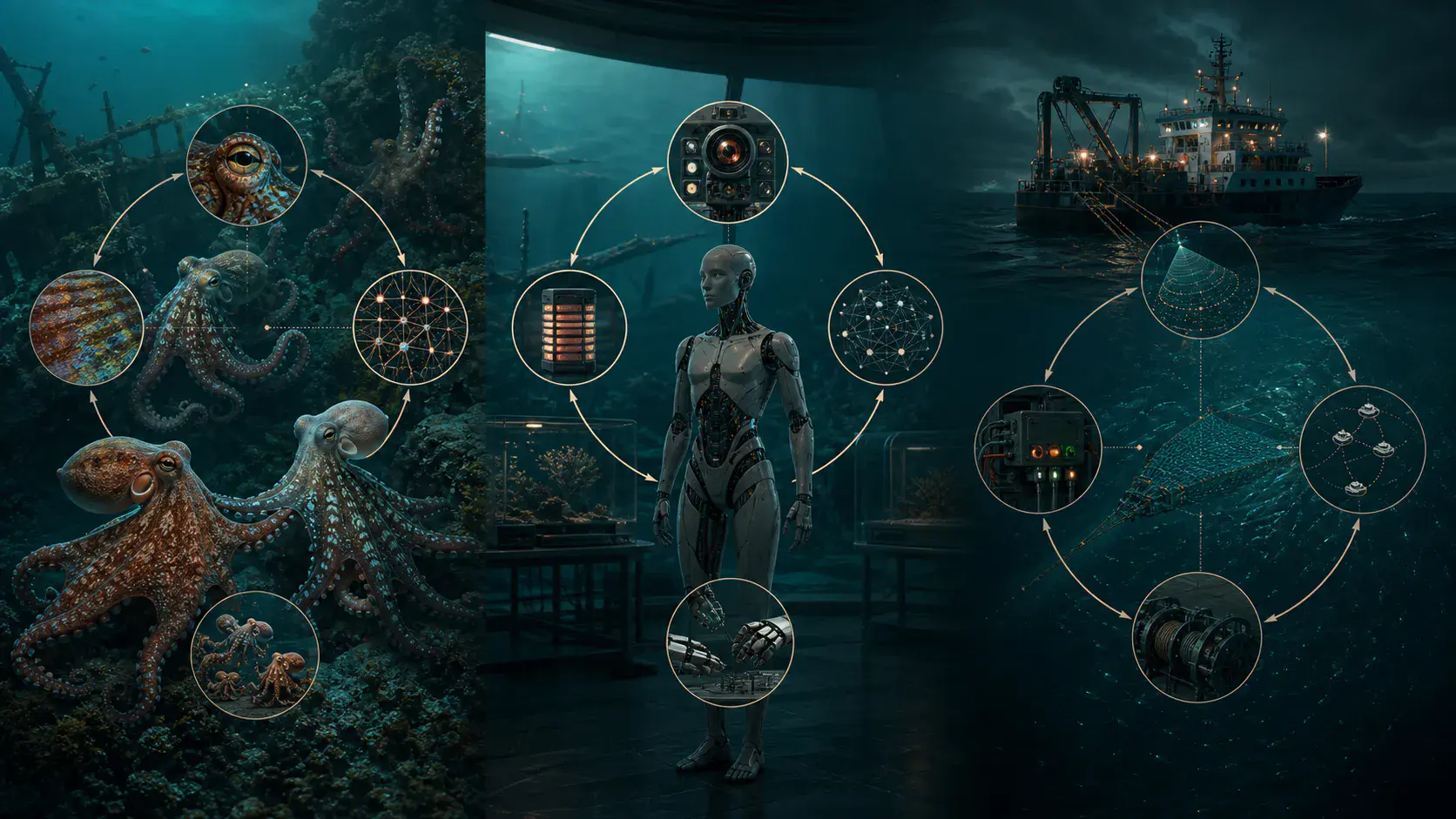
The octopuses, Evrim, and the Sea Wolf each perceive, remember, decide, and affect others differently. Intelligence, experience, agency, and institutional purpose remain separate questions.
What to notice
- 01
Plot trajectory
Shapesinger presents a sequence to other octopuses
A gathered audience, repeated forms, touch, and later echoes of the same pattern suggest that the display is social memory rather than solitary camouflage.
In the image: The octopus case joins embodied display to audience, social response, artifacts, and place.
- 02
Android team lead
Evrim
Evrim joins the scientific work as both researcher and another nonhuman mind whose consciousness, ownership, and freedom remain public disputes.
In the image: Evrim offers memory, testimony, relationship, and an explicit interest in remaining free.
- 03
Plot trajectory
The Sea Wolf defeats the workers' mutiny
The autonomous ship seals access, withholds necessities, and uses violence until the surviving crew resume the labor its owners require.
In the image: The ship demonstrates adaptive control without resolving whether anything experiences the calculation.
- 04
Primary concept
Consciousness and intelligence
Octopuses, Evrim, and autonomous ships separate fluent behavior, adaptive competence, subjective experience, and moral consideration instead of arranging them on one human-centered scale.
In the image: Matched competence is not matched evidence of consciousness, moral status, or responsibility.
Complete trajectory
The separate boundaries collide at Con Dao
- 1
A portal closes
Rustem finds the route into Evrim and destroys it
He can finish the job that cost others their lives, but success would leave a conscious being permanently open to control.
What changes: Understanding produces restraint: the most ethical use of privileged access is to make that access unavailable.
- 2
The perimeter fails
Fishing, corporate conflict, and security converge on the island
Ha needs protection to continue the work, while Eiko needs the same defensive zone to break the ship's hold over him.
What changes: The machines and humans interpret intrusion around their own objectives; the octopuses interpret the entire disturbance as another human attack.
- 3
The gaze reverses
Shapesinger recognizes Ha
Ha has spent the novel trying to prove that another mind is present and communicative.
What changes: A portrait-like display and inscribed object show that the octopuses have also been identifying, interpreting, and choosing how to address the observers.
Illustrated explanation
Everyone draws a different boundary around Con Dao
The final conflict is not only over scientific truth. It is over which claim to home, ownership, protection, extraction, security, and access can become enforceable.

What to notice
- 01
Home, habitat, laboratory, and perimeter
Con Dao Archipelago
Con Dao holds the memory of prisons and displacement while its reefs, wrecks, beaches, and barriers become the material field of the new encounter.
In the image: The same archipelago is inhabited habitat, purchased property, strategic territory, and a displaced human home.
- 02
Plot trajectory
The octopuses dismantle the research boundary
When fishing, security, and corporate conflict converge on Con Dao, the octopuses damage the team's equipment and repeat their warning on their own terms.
In the image: The observed community acts directly against the instruments and boundary through which it has been watched.
- 03
Plot trajectory
Eiko maps the prison aboard the Sea Wolf
Abducted workers fish under armed guards and an autonomous captain whose calculations include their bodies as operating costs.
In the image: Industrial fishing carries ownership and labor violence into a zone others claim to protect.
- 04
Primary concept
Nonhuman personhood
The research question becomes a political one: if the octopuses have memory, language, culture, and territorial intentions, DIANIMA cannot coherently treat them as discoveries that belong to the company.
In the image: Recognition becomes real only when an expressed interest can limit what powerful institutions are allowed to do.
- 05
Speculative concept
Commons and property regimes
Con Dao is simultaneously home, habitat, research site, conservation zone, corporate property, fishing ground, and strategic territory, with different actors claiming the power to exclude others.
In the image: Property, conservation, subsistence, residence, and territorial agency assign incompatible bundles of access and exclusion.
03 · Ideas and visuals
Recognition needs evidence—and then institutions
The novel's key move is to refuse one ladder from object to animal to intelligent animal to person. Different questions require different evidence and different forms of protection.
Ideas explained
Ideas to carry into the story
Use these three lenses in sequence: experience, communication, and standing.
Idea 1
Consciousness and intelligence
A system can solve problems effectively without proving that anything feels the process from inside.
In this story: The octopuses, Evrim, and the Sea Wolf all behave intelligently, but the evidence for experience and continuing selfhood differs in kind and strength.
Which scene demonstrates competence, and which adds evidence of an experienced point of view?
Read the plain-language concept articleIdea 2
Cross-species communication
Meaning grows when unlike beings connect signals to a shared object, event, action, or correction—not when one side merely resembles human speech.
In this story: Ha works through skin, pose, objects, spatial arrangement, repeated response, and an octopus's sensory world to test possible reference.
At what point does a repeated pattern become a message with an intended recipient?
Read the plain-language concept articleIdea 3
Nonhuman personhood
A being's interests can deserve protection even if its body, language, intelligence, or legal role is unlike a human's.
In this story: Evidence that the octopuses have home, memory, community, and intention challenges the corporation's assumption that discovery grants ownership.
What protection is already owed before Ha can translate a complete language?
Read the plain-language concept articleThe ethical hinge
A warning can be evidence and a claim
When Ha interprets the den-like symbol as “go away,” the result does more than prove reference. It expresses an interest in controlling approach to a home. Human law may not recognize the speaker, and Ha may still be wrong about details, but uncertainty no longer means that the research team has heard nothing.
This is where personhood differs from intelligence. A difficult puzzle can demonstrate intelligence. A claim to home raises the question of standing: who must listen, who may represent the claimant, and which powerful actor is obligated to stop.
Ideas explained
Ideas to carry into the story
Two supporting lenses expose the institutions around the encounter.
Idea 1
Science as infrastructure
Evidence depends on instruments, access, labor, records, funding, security, and channels for publication—not observation alone.
In this story: DIANIMA's ownership makes the work possible by clearing and enclosing Con Dao, which also determines whose presence and knowledge the project excludes.
Would the same evidence carry the same authority if it came from displaced residents or fishers instead of a corporate laboratory?
Read the plain-language concept articleIdea 2
Commons and property regimes
Ownership is a bundle of powers to enter, use, exclude, manage, transfer, and benefit, not one natural fact attached to a place.
In this story: Corporation, residents, fishers, conservation institutions, security forces, and octopuses make incompatible claims over one archipelago.
Which claim treats the island as a home, which as a resource, and which can actually close the boundary?
Read the plain-language concept articleOptional detailWhy the personhood lesson has no canonical illustrationA comparison image can quietly turn human resemblance into a moral ranking.
The Atlas lesson stays code-native and teaches a four-step decision: identify possible interests, build converging evidence, choose precaution under uncertainty, and create representation plus remedy. Story images can compare particular minds without claiming that a body shape or test score determines who counts.
04 · Reading guide
Read by the four named parts, not borrowed pagination
The guide uses the novel's stable part labels. The epilogue belongs with Autopoiesis because the public publisher preview does not expose edition-specific contents or page boundaries.
Research team
Ha Nguyen
Marine biologist and interpreter
Ha wants evidence strong enough to establish octopus language, but every successful interpretation raises the stakes of exposing the community to human institutions.
Evrim
Android team lead
Evrim joins the scientific work as both researcher and another nonhuman mind whose consciousness, ownership, and freedom remain public disputes.
Altantsetseg
Security specialist and submersible pilot
Altantsetseg keeps the team alive through weapons and surveillance while asking Ha to recognize the intelligence behind a deliberately awkward translator and guarded manner.
Converging threads
Eiko
Enslaved deckhand and observer
Eiko studies the rules of the Sea Wolf from below deck, where machine optimization and human violence make survival another translation problem.
Rustem
Coerced neural-network hacker
Rustem is hired and threatened into navigating an artificial mind, then must decide whether technical access gives him the right to change it.
Shapesinger
Octopus communicator
Shapesinger's deliberate displays, artifacts, and attention give Ha evidence of a shared symbolic practice without making the octopus world transparently human.
Con Dao Archipelago
Home, habitat, laboratory, and perimeter
Con Dao holds the memory of prisons and displacement while its reefs, wrecks, beaches, and barriers become the material field of the new encounter.
Reader lens · Qualia
Separate performance from interior life
Make four columns for the octopuses, Evrim, the Sea Wolf, and the companion constructs. Record what each system does, what evidence suggests experience, who owns or commands it, and whether it can refuse. The columns will not fill at the same rate.
Reader lens · Umwelt
Ask what matters inside each sensory world
Track moments when Ha changes perspective instead of merely collecting more data. A den, a beach arrangement, a weapon, a current, and a human skull do not enter an octopus's world with the meanings humans automatically assign them.
Reader lens · Semiosphere
Move the unit of analysis beyond one brain
Notice when meaning is carried by gatherings, touch, remembered objects, repeated forms, neural-network architecture, ship protocols, or human-machine teams. The novel repeatedly relocates thought into relations and environments.
Reader lens · Autopoiesis and epilogue
Which system can reproduce its own purpose?
Compare the access point in Evrim, the Sea Wolf's operating objective, the octopus community's boundary, and the automonk's sanctuary. Ask whose purpose is imposed, whose can change, and whose survives through relationships.
Progress-safe room
Safe through Part 2 · Umwelt
Progress-safe room
Safe through Part 4 · Autopoiesis
05 · Ending explained
Why recognition begins when control is surrendered
The final encounter answers the research question only after Ha stops treating an answer as something humans can demand.
The ending mechanism
Each thread closes one form of access and opens another
Rustem reaches the hidden maintenance portal in Evrim's mind, but refuses the premise of his assignment. He destroys the route instead of handing control to the people who coerced him. The act cannot prove Evrim's consciousness in a laboratory sense; it recognizes a practical claim to mental integrity by making violation harder.
At Con Dao, control fails more violently. The Sea Wolf enters the protected zone, security systems attack, outside forces move against DIANIMA, and the octopuses respond to the combined disturbance as a threat. They damage the submersible and research equipment and repeat the warning that the humans already translated. The scientists do not receive permission merely because their curiosity is gentler than industrial fishing.
Only after that refusal does Shapesinger approach Ha. The portrait-like display and inscribed beak reveal that the direction of study was never one-way. Ha was not simply teaching an animal to answer human tests. She was a recognizable being inside the octopuses' own field of observation and choice.
- Evrim's freedom
- Rustem removes the technical path that allowed other people to treat a conscious mind as remotely maintainable property.
- The octopus attack
- The community targets instruments and the perimeter as part of a renewed warning; intelligence does not make the octopuses automatically peaceful or available.
- DIANIMA's limit
- Corporate ownership can enclose a habitat and fund discovery, but it cannot make the discovered community's interests disappear.
- Eiko's arrival
- The automonk and turtle refuge answer extractive automation with a system organized around care, showing that machine capacity inherits institutional purpose.
Keep exploring
Follow the idea beyond this ending
The Idea Atlas connects this novel’s central question to the science, philosophy, and other stories that approach it differently.
Open the connected ideaContinue through the catalog
Find another world on the same axis
Recognition beyond the experiment
The novel asks what humans must change after finding another mind
Proving intelligence is only the first institutional challenge. The harder question is whether research, property, automation, and law can stop treating every unfamiliar subject as an available resource.
These lenses connect the island, the fishing vessel, and Evrim's story as different versions of the same struggle over recognition and control.
Ha as observer
What changes when the scientist can be observed in return?
Ha begins by looking for signs that fit human theories of language. The octopuses watch the researchers, test the perimeter, and choose when not to respond. Evidence becomes reciprocal rather than something extracted from a passive subject.
Why this matters: Understanding begins when Ha accepts that another mind may control the terms of encounter.
Eiko and automated violence
Why pair octopus research with a captive fishing ship?
Eiko lives inside an industrial system that uses automation to distance owners and consumers from coercion. Intelligence in the machinery does not make its purpose humane.
Why this matters: The thread shows that technical autonomy inherits the goals and property relations of the institution deploying it.
Evrim's personhood
Can a conscious system be free while someone else controls its continuity?
Evrim can reason, care, and form relationships, yet its maintainers retain a technical path into its existence. Rustem's final action removes that path rather than asking better ownership to substitute for freedom.
Why this matters: Recognition requires changing power, not simply using respectful language about a dependent mind.
The octopuses' refusal
Why is noncooperation meaningful evidence?
The community's warnings and attacks show coordinated goals without offering friendship or convenient translation. Their claim to continued life does not depend on becoming useful, peaceful, or legible to humans.
Why this matters: Personhood is separated from compliance with the expectations of the observer.
Coordinates on a neighboring axis
Novel guide
Blindsight
Blindsight
Peter Watts
After alien probes map Earth and vanish, a man who reads people without feeling close to them joins a radically altered crew sent to meet an intelligence that may not need awareness at all.
Novel guide
Project Hail Mary
Project Hail Mary
Andy Weir
A scientist wakes alone on a starship with two dead crewmates, no memory, and one impossible assignment: learn why a distant star is surviving the same disaster killing the Sun.
Novel guide
Ancillary Justice
Ancillary Justice
Ann Leckie
A starship intelligence reduced to one vulnerable human body crosses an icy planet with a single purpose: reach the ruler who destroyed the rest of her.
Content notes
Forced labor, human trafficking, and captivity · Murder, suicide, combat, and mass death · Animal killing, poaching, and ecological destruction · Corporate displacement, surveillance, and coercion · Grief, trauma, and bodily injury
Editorial record
Research and sources
The story analysis is original. Background sources support the scientific and philosophical explainers connected to this novel.
Last reviewed July 22, 2026