
The idea in plain English
Plain idea
What changes
A property regime is the working set of rules that decides who may enter, use, change, share, sell, inherit, maintain, or exclude others from something. Private property, public administration, a governed commons, and open access distribute those powers differently.
Mechanism
How it operates
A community or authority first defines the resource and its users, then assigns a bundle of rights and duties rather than one simple label of ownership. Boundaries identify who may participate; allocation rules limit use; monitoring makes activity visible; sanctions and conflict resolution make commitments credible; and revision allows the arrangement to adapt. A knowledge commons adds rules for attribution, access, contribution, preservation, privacy, and reuse because information can be copied even when attention, infrastructure, and trust remain scarce.
Human stakes
Why it matters
These rules shape ordinary freedom. They decide whether a farmer can reach water, whether a tenant can remain housed, whether researchers can inspect a result, and who must repair shared infrastructure. A regime may protect long-term stewardship or concentrate exclusion. Calling a resource public, private, or common does not reveal whether the people affected can understand, contest, or change its rules.
Used in: 8 catalog novels
Related: Critical resource dependence · Science as infrastructure · Information asymmetry
A few terms make the rest of the explanation easier to follow.
- Bundle of rights
- The separable permissions and responsibilities to access, use, manage, transfer, exclude, or derive benefit from a resource.
- Common-pool resource
- A resource from which excluding users is difficult while one person's use can reduce what remains for others.
- Governed commons
- A shared resource managed through defined membership, rules, monitoring, conflict resolution, and maintenance obligations.
- Open access
- A condition in which people are not effectively excluded, whether or not rules exist to prevent overuse or fund upkeep.
Use the idea while reading
Turn the definition into three observations
Do not begin by asking whether a novel is “about” commons and property regimes. Begin with what changes in the lives of its characters, then use the concept to explain the mechanism underneath that change.
- 01
Notice who may use, refuse, transfer, or exclude—and who only performs maintenance.
- 02
Notice whether formal ownership matches practical control, prestige, and access.
- 03
Notice how rules change when scarcity, outsiders, or new knowledge alter the resource.
Keep one question open: Which separate rights are being compressed into the word ownership?
Avoid the shortcut: A commons is not an unowned free-for-all. Many commons have clear members, boundaries, duties, monitoring, and penalties. Open access instead means that exclusion is absent or impractical; without governance, use can become crowded or maintenance can disappear.
How it works, step by step
- 1
Define the resource and boundary
People decide what is being governed, which uses interact, who counts as a legitimate participant, and where outside effects enter the system.
- 2
Separate rights from the ownership label
Access, withdrawal, management, exclusion, transfer, maintenance, and benefit can belong to different actors instead of one all-powerful owner.
- 3
Make rules observable and contestable
Monitoring, records, proportionate sanctions, accessible dispute resolution, and meaningful participation connect written rules to everyday behavior.
- 4
Adapt across scales and generations
Nested institutions revise allocation and stewardship when populations, technologies, ecological limits, or external authorities change the resource.
A concrete example
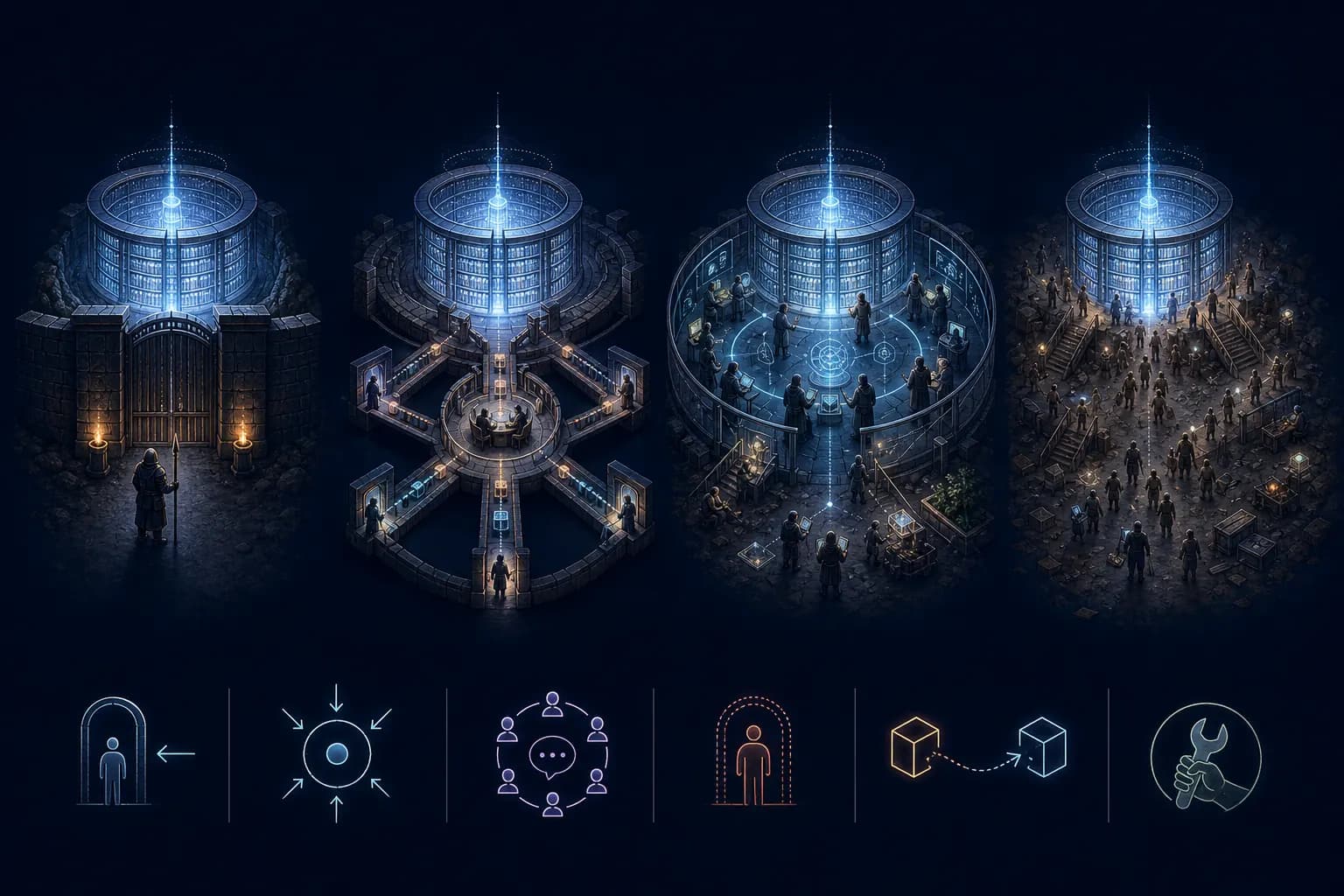
One research archive, four regimes
A publicly funded archive contains valuable climate observations, sensitive community knowledge, costly servers, and contributions from hundreds of researchers.
01
A private owner can sell access and fund maintenance, but may block scrutiny or price out communities that helped create the record.
02
A public agency can guarantee a mandate and legal accountability, yet budget cycles and political direction may narrow what remains accessible.
03
A governed commons can give contributors and affected communities roles in access, attribution, privacy, and upkeep, but participation and enforcement require continuing labor.
04
Unrestricted downloads maximize immediate reach; they do not by themselves protect sensitive material, credit contributors, or pay for preservation.
The point
The useful question is not simply who owns the archive. It is how rights, responsibilities, voice, and costs are distributed—and whether people can revise that distribution when it fails.
What is real, and what remains uncertain
First separate what we can observe or build today from what remains a prediction or a fictional extension.
What evidence supports it
Observed institutional diversity
Research on forests, fisheries, irrigation, land tenure, and scientific knowledge shows that workable governance can combine community, state, market, and open-access elements. Outcomes depend on context, enforcement, participation, and power rather than one universally superior ownership label.
A common misunderstanding
A commons is not an unowned free-for-all. Many commons have clear members, boundaries, duties, monitoring, and penalties. Open access instead means that exclusion is absent or impractical; without governance, use can become crowded or maintenance can disappear.
Try this example in your head
Four towns depend on identical reservoirs. One sells access, one assigns it through an agency, one lets recognized users make and enforce rules, and one leaves entry unrestricted. The water is physically the same. Which rights, duties, and failures differ before any drought begins?
No regime eliminates power
Community rules can exclude minorities, states can become unaccountable, and markets can concentrate control. Governance must be evaluated through actual voice, outcomes, and remedies.
Resources differ materially
Ideas can be copied while water is depleted, but knowledge still depends on finite labor, infrastructure, privacy, attention, and institutional trust.
Local success does not automatically scale
Rules that work among known users may fail when ecological effects, supply chains, platforms, or scientific collaboration cross jurisdictions and generations.
How science fiction tests the idea
Stories usually test both the promise of an idea and the trouble it creates.
Its promise
Durable commons depend on enforceable membership, monitoring, maintenance, and conflict-resolution rules rather than the absence of rules.
Its problem
Every property regime can hide unequal power in who writes its boundaries, receives its benefits, and bears its upkeep.
What to notice in a story
- 01
Who may use, refuse, transfer, or exclude—and who only performs maintenance
- 02
Whether formal ownership matches practical control, prestige, and access
- 03
How rules change when scarcity, outsiders, or new knowledge alter the resource
Novels that use this idea
Societal scale
Cautious · Layered
A Memory Called Empire
The Emperor treats Lsel's imago method as a strategic asset that can be exchanged for temporary sovereignty, exposing how control over knowledge can become control over a polity's future.
Societal scale
Dark · Demanding
Altered Carbon
A stored soldier is transmitted into a stranger's body to investigate a rich man's death in a society where immortality is real only for people who can afford its infrastructure.
Societal scale
Dark · Demanding
Broken Angels
Takeshi Kovacs deserts a planetary war for a corporate salvage mission whose prize is a functioning gateway to an ancient Martian starship.
Societal scale
Cautious · Layered
Cibola Burn
On the first contested colony beyond the Rings, refugees and a corporate expedition fight over one world while its alien systems begin waking beneath them.
Societal scale
Cautious · Layered
Parable of the Sower
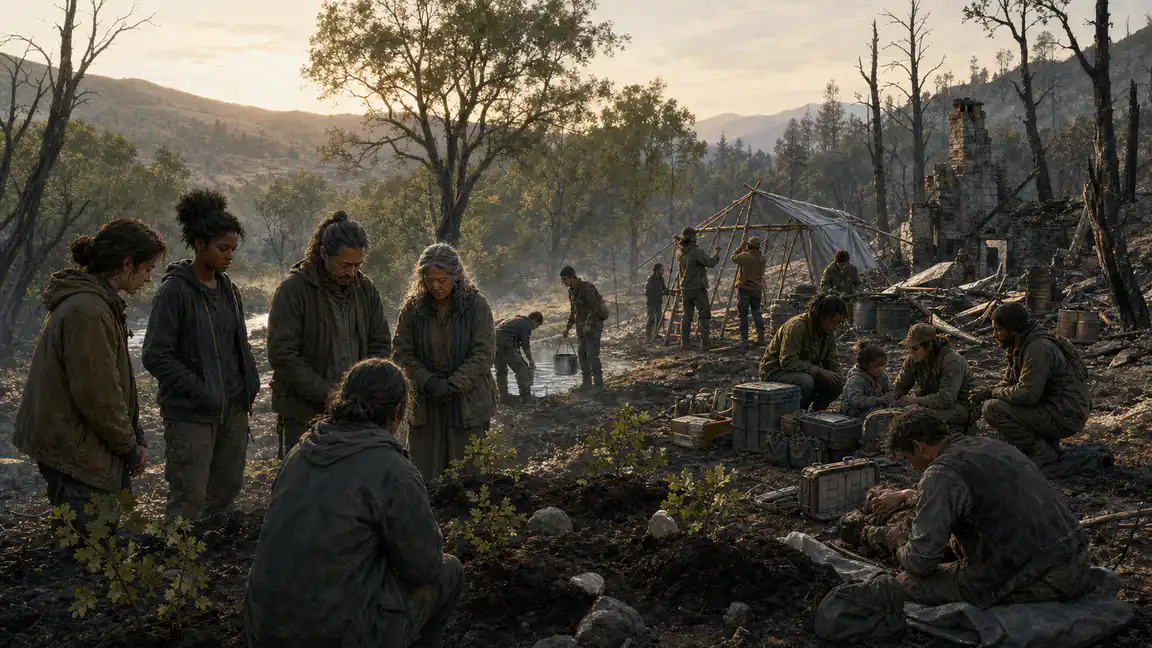
Walls, company towns, abandoned land, privately held water, and Bankole's acreage turn property into a bundle of powers: the ability to admit, exclude, extract, shelter, and decide what a place will become.
Visual example · Acorn begins because refuge does not
Societal scale
Balanced · Demanding
The Dispossessed
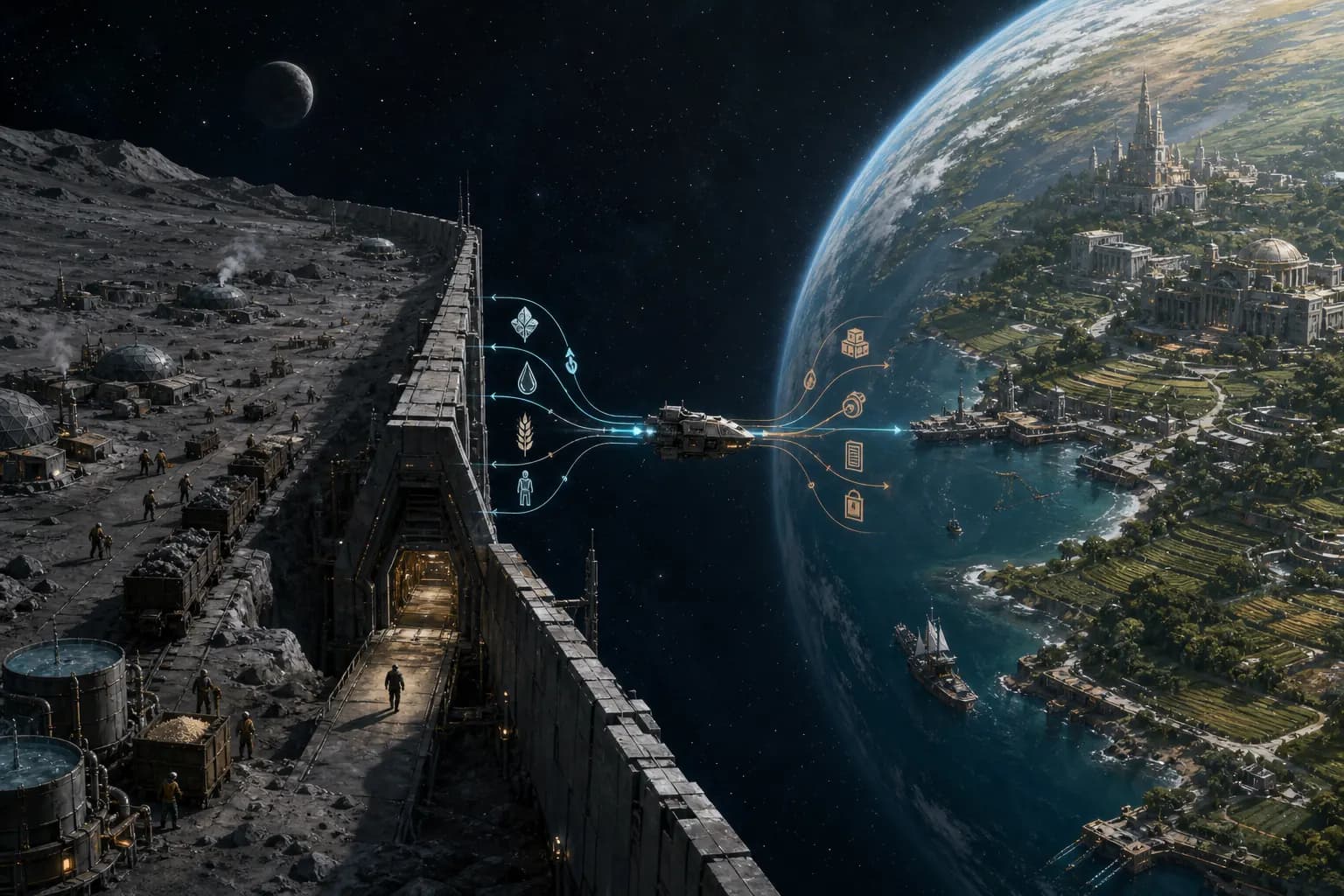
The paired worlds show that abolishing legal ownership changes everyday life without automatically abolishing exclusion, status, gatekeeping, or the labor required to maintain shared systems.
Visual example · Two worlds share one narrow door

Societal scale
Cautious · Layered
The Mountain in the Sea
Con Dao is simultaneously home, habitat, research site, conservation zone, corporate property, fishing ground, and strategic territory, with different actors claiming the power to exclude others.
Visual example · Everyone draws a different boundary around Con Dao
Societal scale
Dark · Demanding
Woken Furies
Back on Harlan's World, Kovacs protects a deCom leader who may contain a dead revolutionary while a younger copy of himself is sent to hunt them both.
Questions to keep thinking about
Which separate rights are being compressed into the word ownership?
Who can challenge the rules without losing access to basic needs?
Does wider access include a credible plan for care, credit, privacy, and repair?
Sources and further reading
These references ground the portable lesson; story interpretations remain editorial analysis.
The Nobel Prize
Beyond Markets and States: Polycentric Governance of Complex Economic Systems
MechanismReality checkLimitsThe Nobel Prize
Economic Governance: The Organization of Cooperation
MechanismReality checkHuman stakesFood and Agriculture Organization of the United Nations
Voluntary Guidelines on the Responsible Governance of Tenure
Reality checkHuman stakesLimitsUNESCO
Recommendation on Open Science
MechanismHuman stakesLimits