
Novel guide
Parable of the Sower
Octavia E. Butler

Story and ideas · Parable · Volume 1
Parable of the Sower
by Octavia E. Butler
Grand Central trade paperback · 2019 · Publisher details · Cover via Open Library
Lauren Olamina knows the walls around her neighborhood cannot hold forever, so she prepares to survive a collapse the adults around her refuse to imagine.
Full-story article
This article discusses the complete story, including the ending.
- Reading time
- About 9 hours
- Length
- 368 pages
- Reading complexity
- Layered
- Several ideas or timelines overlap, but the central path remains visible.
- Science intensity
- 2/5
- Scientific ideas support the setting and a few decisions.
Affiliate links. As an Amazon Associate, we earn from qualifying purchases.
Before you read
Is this book for you?
Start by tracking: Track which forms of safety depend on walls, money, weapons, useful skills, trusted relationships, or the power to welcome and exclude.
Read this if you enjoy
- Climate fiction grounded in everyday systems
- A survival journey centered on trust and community
- Political and religious ideas tested through action
Why readers may get lost
- The violence is frequent, intimate, and sometimes directed at children
- Dated journal entries jump across months and years
- Lauren can be compassionate and deliberately unsentimental at once
Keep these anchors in mind
- Lauren Olamina
- the teenage diarist preparing for change
- Reverend Olamina
- her father and Robledo's practical leader
- Robledo
- the walled neighborhood losing its buffers
- Hyperempathy
- Lauren physically shares witnessed pain and pleasure
- Earthseed
- the belief system Lauren writes and tests
Layered reading complexity. Several ideas or timelines overlap, but the central path remains visible.
Science intensity 2/5. Scientific ideas support the setting and a few decisions.
The opening
Lauren sees a system failing before she sees a way out
Butler begins close to home: one teenager, one guarded neighborhood, and a widening gap between the life adults remember and the one their children must survive.
Robledo, 2024
A wall can hide change without stopping it
Fifteen-year-old Lauren Olamina lives in Robledo, a walled neighborhood near Los Angeles. Inside are families, gardens, guns, church, lessons, and a rota for night watch. Outside, water costs more than fuel, fire moves easily through dry country, police protection has become a service many people cannot afford, and desperate travelers fill the roads. Lauren's father—a Baptist minister and college dean—helps hold the neighborhood together through authority, teaching, and practical rules.
Robledo is therefore neither an intact suburb nor a simple bunker. Its residents can defend a boundary, but they still need work, food, water, transport, medicine, and information from a region that is coming apart. The adults respond by preserving routines. Lauren responds by asking what she will need when the routines stop.
Her perspective is sharpened and complicated by hyperempathy, a condition inherited from her mother's drug exposure. When Lauren witnesses someone else's pain or pleasure, her body mirrors it. Hyperempathy does not give her access to another mind, and it does not make her morally pure. It makes violence physically dangerous to her and prevents suffering from remaining abstract.
The central question
What can a person carry when a whole way of life becomes unsafe?
Lauren's answer begins with water, knowledge, money, clothing, and weapons. The novel gradually adds less portable necessities: people who can trust one another, rules they can revise, and a purpose larger than reaching the next safe place.
Illustrated explanation
The wall protects a place, not the systems that keep it alive
Robledo can delay direct violence, but water, jobs, food, transport, and authority all cross its boundary. Lauren prepares for the moment those external links fail together.
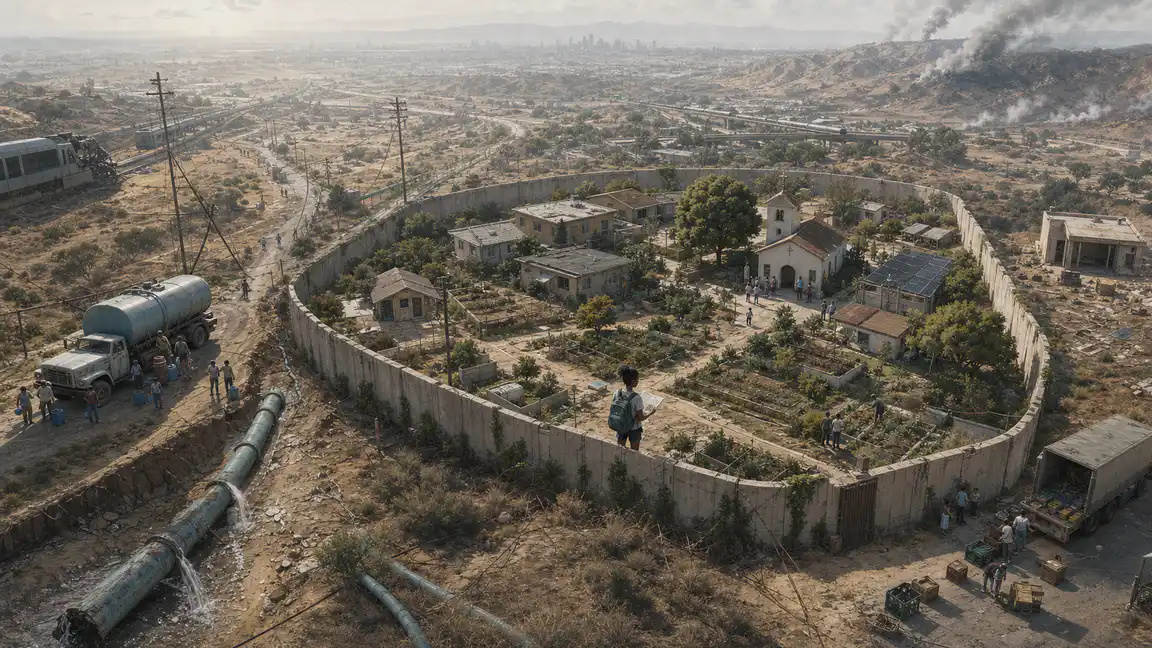
What to notice
- 01
Walled home and failing system
Robledo
Robledo pools defense and familiarity inside its walls while remaining dependent on an increasingly violent region for work, water, trade, education, and every route outward.
In the image: Families share watch, tools, teaching, and familiarity inside a defensible boundary.
- 02
Speculative concept
Critical resource dependence
Water, employment, transport, housing, weapons, medicine, and trustworthy information become levers of control because most people cannot replace the systems that supply them.
In the image: Water, food, employment, and transport remain controlled by increasingly unreliable systems outside.
- 03
Speculative concept
Emergency governance
As public authority fragments, neighborhood patrols, armed travelers, corporations, landowners, and ad hoc groups make rules about protection and exclusion without a stable institution able to guarantee rights.
In the image: Police and public services no longer provide a dependable layer of protection around the neighborhood.
- 04
Plot trajectory
Lauren plans for the failure of Robledo's walls
She studies survival skills, saves portable supplies, practices shooting, and imagines routes north while the adults around her still organize for continuity inside the neighborhood.
In the image: Lauren turns a system diagnosis into knowledge and supplies she can carry.
The story
The collapse of a neighborhood becomes the formation of a community
The plot moves north, but its deeper direction is from inherited safety to chosen obligation. Each new loss removes a structure Lauren expected to rely on; each new relationship tests whether preparation can become collective rather than merely personal.
The story, in human terms
The turns that change the story
The dates and journal entries create a record of pressure accumulating, then compressing into a journey where every encounter can change the group's size and chances.
- 1
Chapters 1–5
Lauren prepares for a failure no one can schedule
She loves her family and understands why her father protects normal life, yet she cannot make herself believe Robledo will last. She studies plants, medicine, survival, and routes north; saves money; assembles an emergency pack; and practices with guns despite the danger hyperempathy adds.
What changes: Preparation gives Lauren options, but it also isolates her. She can describe the approaching failure more clearly than she can persuade anyone else to leave before it arrives.
- 2
Chapters 6–11
The surrounding economy turns protection into ownership
Robledo's residents hear that the coastal town of Olivar may accept corporate purchase. The offer promises employment, armed security, and functioning services. It also ties wages, homes, debt, and movement to one company. Safety is real enough to tempt people precisely because public alternatives have become so weak.
What changes: The proposal shows that collapse does not remove government and markets; it creates new bundles of power. Lauren becomes more certain that a refuge controlled by one institution can become another trap.
- 3
Chapters 12–14
First Lauren loses her father, then Robledo burns
Reverend Olamina disappears while traveling outside the wall. Searchers find no answer, and the neighborhood loses both a parent and the person who coordinates much of its trust. Soon attackers breach Robledo during a night of fire, theft, and killing. Lauren escapes through pain she cannot keep outside her own body.
What changes: The future Lauren planned for arrives in its worst form. The fixed community is gone. Her emergency supplies matter, but only because she also finds Harry Balter and Zahra Moss alive and chooses not to travel alone.
- 4
Chapters 15–17
Three survivors invent rules while walking
Lauren cuts her hair and travels as a man; the three pool resources, take watch, hide vulnerability, buy carefully, and learn the social geography of the highway. Harry brings loyalty and moral discomfort. Zahra brings experience of poverty, abuse, and street danger that Lauren's books could not teach.
What changes: Their pact demonstrates the novel's first portable institution. It has membership, information, shared risk, and procedures—but must expand if it is to offer more than a temporary alliance.
- 5
Chapters 18–20
A traveling group grows by accepting complicated people
They join with Travis, Natividad, and their baby; meet the doctor Taylor Bankole; and later take in others carrying children, trauma, skills, and secrets. Every addition can attract danger or consume scarce resources. Every addition also brings more eyes, knowledge, labor, care, and reasons to plan beyond individual escape.
What changes: Lauren begins explaining Earthseed. The belief system is no longer only a private journal. Other people can misunderstand it, challenge it, accept pieces of it, or decide whether Lauren's purpose is compatible with their own.
- 6
Chapters 21–23
Fire and enslavement expose the orders forming on the road
An earthquake and wildfire send people into chaotic movement. The group encounters survivors of brutal control, including people constrained through electronic collars and violence. Lauren's companions combine water, observation, medical skill, weapons, deception, and mutual defense to survive and help newcomers.
What changes: The group now carries responsibilities it could have avoided. Its strength comes not from matching people but from building enough trust that different capacities can be coordinated under pressure.
- 7
Chapters 24–25
The promised land is burned, so the travelers make a beginning
Bankole leads them to his family's northern property. The buildings have burned and his relatives are dead. Some members want to continue toward Canada; others see cultivable land, water, distance from the highway, and a chance to stop walking. They bury the people they lost and plant acorns over the graves.
What changes: They name the settlement Acorn. The ending supplies no intact sanctuary. It turns land, grief, mixed skills, and negotiated commitment into the first materials of a community.
Illustrated explanation
The group survives by becoming more than a crowd
Numbers alone are not resilience. The travelers become safer when different people can observe, teach, heal, carry, question, decide, and take over one another's roles.
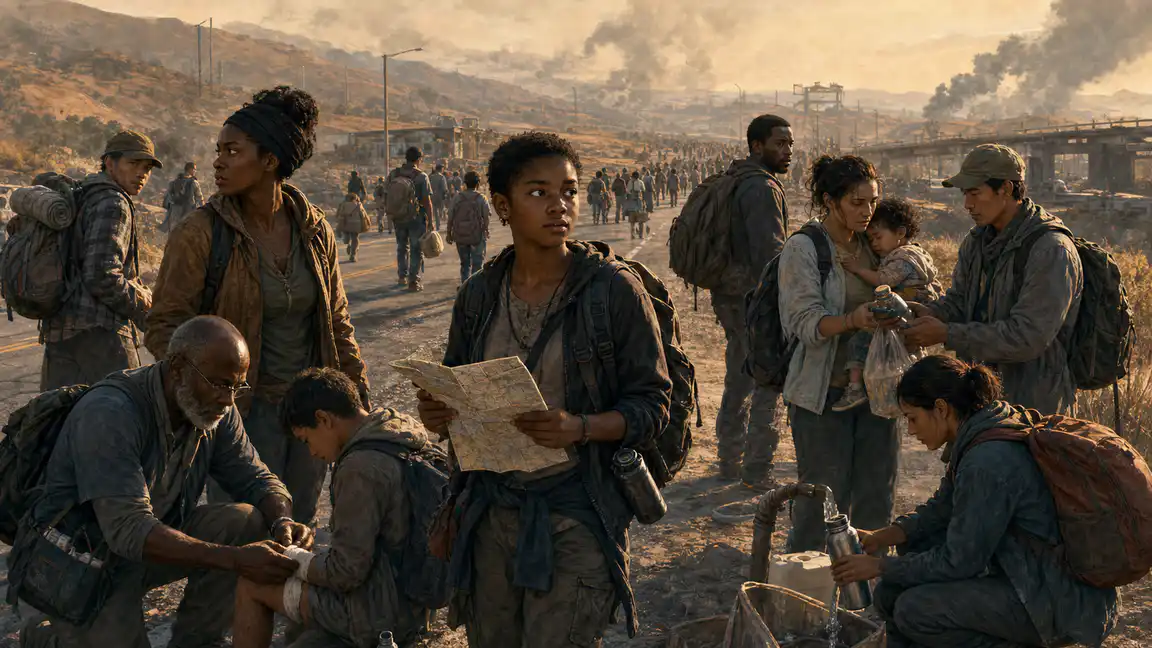
What to notice
- 01
Diarist, survivor, and founder
Lauren Olamina
Lauren notices the dependencies beneath Robledo's apparent safety, prepares for their failure, and gradually turns a private set of verses into a practice for building a future with other people.
In the image: Lauren contributes preparation, literacy, direction, and a willingness to revise the group as it grows.
- 02
Neighbor, survivor, and practical judge
Zahra Moss
Zahra's experience of poverty and abuse gives the group knowledge Lauren's books and preparation cannot supply, especially about reading danger and people.
In the image: Zahra contributes judgment shaped by dangers that Robledo's more protected residents did not understand.
- 03
Doctor and bearer of a destination
Taylor Bankole
Bankole adds medical knowledge and a possible refuge, but his northern land can become a community only after private ownership is joined to shared purpose.
In the image: Bankole contributes medical skill, experience, and a possible destination without becoming the group's sole authority.
- 04
Plot trajectory
The three travelers become a larger group
Families and solitary survivors join because the road is safer with more eyes, skills, information, labor, and people willing to protect children and one another.
In the image: New members add needs and risks, but they also add capacities the original three could not manufacture alone.
- 05
Primary concept
Community resilience
Robledo's walls delay danger, but the capacities that survive are portable: practiced skills, shared watch, useful supplies, honest information, flexible roles, and relationships able to include new people.
In the image: Shared roles, information, and trust turn individual resources into a flexible collective capacity.
The ideas
Survival is a network, not a wall
The novel's speculative future works through ordinary dependencies. Butler asks what climate pressure does when it meets inequality and weak institutions, then follows the practical and moral work of building capacity among people who did not begin as one community.
Ideas explained
Ideas to carry into the story
Three central ideas clarify why Lauren's emergency pack is necessary but insufficient.
Idea 1
Climate survival
Climate danger moves through connected systems: heat and drought intensify fire, scarcity changes prices, weak services deepen exposure, and displacement places more people in dangerous conditions.
In this story: The climate rarely appears as one villain or one disaster. It is the altered baseline beneath water costs, burning settlements, dangerous travel, exploitative work, and the retreat of public protection.
When does adaptation protect people, and when does it merely help those with money transfer risk to everyone else?
Read the plain-language concept articleIdea 2
Community resilience
A resilient community can keep essential functions going, route around failures, learn, and change because skills, information, care, resources, and authority are not trapped in one person or system.
In this story: Robledo has cohesion and a wall but depends heavily on Reverend Olamina and on failing external services. The road group has no wall, yet gradually develops distributed watch, medicine, knowledge, childcare, defense, and decision-making.
Which matters more in a crisis: the strength of a boundary or the quality of the relationships that can move across it?
Read the plain-language concept articleIdea 3
Survival ethics
Survival ethics asks what people owe one another when every act of welcome, refusal, sharing, or force can affect who lives.
In this story: Lauren is neither an unlimited rescuer nor an isolated survivalist. She calculates risk, sometimes harshly, while recognizing that a group unable to accept new obligations cannot become the future she wants.
How much danger may a group accept for a stranger before care becomes recklessness—and who gets to decide?
Read the plain-language concept articleOptional detailCommunity resilience is not the same as climate adaptationClimate survival focuses on changing physical hazards, exposure, and vulnerability. Community resilience focuses on collective capacity across many disruptions, whether the trigger is fire, violence, infrastructure failure, displacement, or the loss of a leader.
Robledo can improve one adaptation—a defensive perimeter—while remaining brittle as a community system. Lauren's traveling group has almost no durable infrastructure, but it develops redundancy. More than one person stands watch. Different members understand medicine, plants, firearms, childcare, street danger, reading, negotiation, and routes. New knowledge can alter a plan.
The distinction matters because a community can become better at enduring harm without making the larger system just. Olivar may be more orderly and materially secure than the highway, yet its company-town structure concentrates control over work, housing, and debt. Resilience language becomes dangerous when it celebrates people for coping with risks that powerful institutions could have reduced.
Supporting systems
Scarcity is political because dependence is organized
Water matters in the novel not only because bodies need it, but because price, access, storage, and transport determine who can obtain it safely. The same is true of work, housing, medical care, and weapons. A resource becomes a lever when one supplier controls several necessities at once or when refusing bad terms means losing everything together.
That is why the Olivar offer and the road's collar-based enslavement belong on the same continuum without being identical. Each joins essential needs to concentrated authority. Olivar presents the arrangement as rescue and employment; the collars enforce it openly through violence. Butler keeps asking who controls the bundle and whether the protected person retains a meaningful ability to leave.
Property carries the same double edge. A wall protects Robledo by excluding. Bankole's deed gives the group a destination that displaced travelers without land cannot claim. Yet the ending does not treat ownership as sufficient. Acorn begins only when the group debates staying, joins labor to place, remembers its dead, and accepts obligations among people whose beliefs are not identical.
The ending
Acorn is a commitment made in the absence of rescue
The final chapters resolve the journey's direction, not the world's danger. Butler makes the settlement meaningful by refusing to make it safe, complete, or unanimous.
What happens
They reach land and find another loss
Bankole's property cannot deliver the reunion he imagined. Fire has destroyed the home, and his family has been killed. The group faces an honest choice: keep moving north toward rumors of better conditions, or use damaged land to create something none of them can guarantee will last.
Staying is not Lauren's decision alone. That matters. Earthseed may supply the name and long purpose, but the settlement depends on people who approach the faith differently. They discuss the soil, water, location, danger, labor, and children. Practical agreement precedes any claim of spiritual unity.
The burials prevent the ending from turning catastrophe into a clean origin story. The dead are not a price the novel forgets once the survivors acquire land. Planting acorns over the graves links grief to a life cycle slower than emergency. An oak requires care and time; the planter acts for a future not yet visible.
Illustrated explanation
Acorn begins because refuge does not
The travelers reach land, not safety. Burial acknowledges what cannot be restored; planting and shared work turn damaged private property into the first infrastructure of a chosen community.
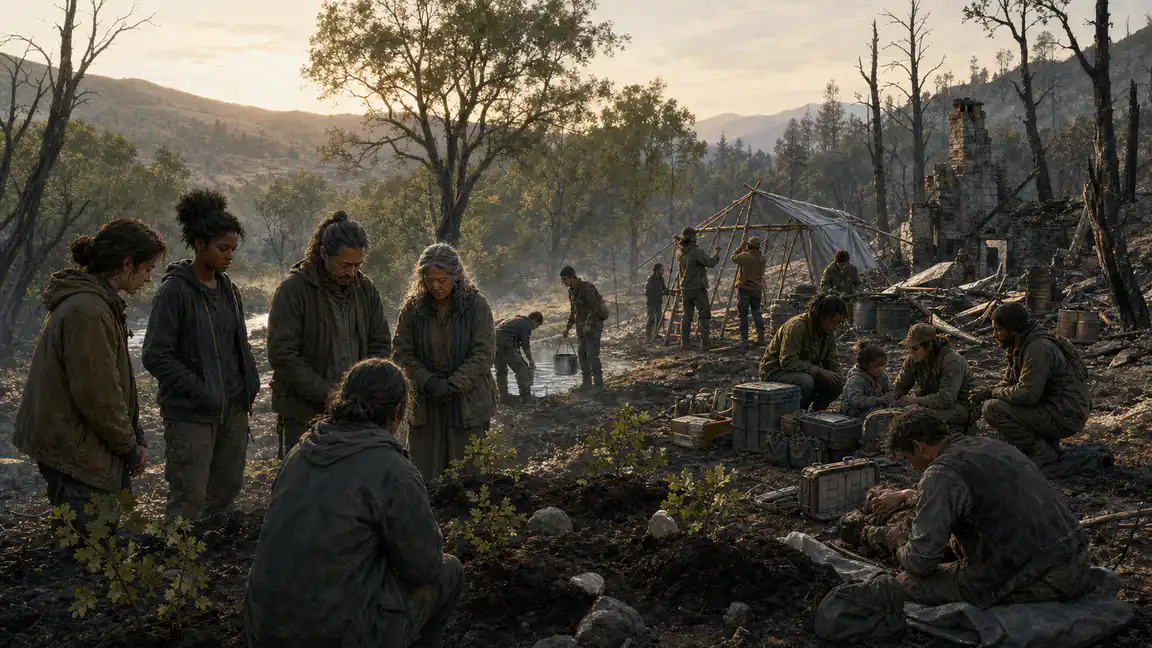
What to notice
- 01
Plot trajectory
The group names its settlement Acorn
At Bankole's burned property, the travelers bury the dead, plant acorns, and choose the difficult work of making a shared home where no intact refuge awaited them.
In the image: Graves and acorns join memory to a commitment whose results the planters may not live to see.
- 02
Doctor and bearer of a destination
Taylor Bankole
Bankole adds medical knowledge and a possible refuge, but his northern land can become a community only after private ownership is joined to shared purpose.
In the image: Bankole's title creates access to land, but cannot by itself create home, trust, or continuity.
- 03
Lauren's adaptive belief system
Earthseed
Earthseed treats change as unavoidable and shaping as a responsibility, giving Lauren language for preparation, learning, collective action, and a future beyond mere endurance.
In the image: Earthseed gives the group a language for accepting change while still choosing what to shape.
- 04
Speculative concept
Commons and property regimes
Walls, company towns, abandoned land, privately held water, and Bankole's acreage turn property into a bundle of powers: the ability to admit, exclude, extract, shelter, and decide what a place will become.
In the image: A deed becomes socially meaningful through decisions about belonging, labor, stewardship, and exclusion.
- 05
Primary concept
Community resilience
Robledo's walls delay danger, but the capacities that survive are portable: practiced skills, shared watch, useful supplies, honest information, flexible roles, and relationships able to include new people.
In the image: Recovery is the creation of new capacity, not a return to the system that already failed.
More ways into the novel
Four lenses that change how the journey reads
Butler's future remains powerful because the plot is also a study of form, embodiment, belief, and institutions. These lenses return to details the survival narrative can make easy to rush past.
Each lens asks what Lauren's account makes visible—and what a future community must learn to do differently.
The journal as portable infrastructure
Why tell a collapse through dated entries?
The journal stores observations, plans, grief, Earthseed verses, and changes of mind. Dates let Lauren compare the world adults remember with the rate at which conditions worsen. Writing is not merely self-expression; it is a compact system for preserving knowledge when schools, news, family continuity, and public records can no longer be assumed.
Why this matters: Lauren carries more than facts north. She carries a method for turning experience into lessons that can be questioned and shared, which is one foundation for Earthseed and Acorn.
Hyperempathy without moral innocence
Does sharing pain automatically create goodness?
Lauren cannot witness injury without bodily consequence, but she still prepares weapons, judges strangers, conceals information, and sometimes accepts violence as necessary. Her condition makes interdependence physical without solving the decisions it creates. It can expose her to an enemy's pain and leave her unable to help everyone she encounters.
Why this matters: The novel separates feeling another person's suffering from knowing the right action. Empathy becomes a vulnerability and a source of attention, while ethics still requires judgment, boundaries, and collective rules.
Earthseed as a practice under revision
Is Lauren discovering a truth or founding an institution?
At first Earthseed exists in private verses. The road changes it because companions ask what its language means for grief, God, destiny, children, work, and membership. Lauren has unusual conviction, but she cannot create a durable community from conviction alone. Other people must be able to interpret, dissent, contribute, and remain more than instruments of her mission.
Why this matters: The question to carry into Acorn is not only whether Earthseed inspires people. It is whether a faith centered on shaping change can also distribute power and allow itself to be changed by the community it forms.
Walls, collars, and deeds
What do the novel's boundaries have in common?
Robledo's wall, Olivar's employment terms, electronic collars, traveling disguises, and Bankole's deed all regulate movement and belonging. Some boundaries create needed protection; others make people property or trap them through dependence. No boundary is judged only by whether it is strong. The novel asks who designed it, who can cross it, what resources it controls, and whether those inside can revise its rules.
Why this matters: Acorn's hardest future problem is already present at its founding: it must make a safe place with membership and defense without reproducing the forms of domination from which its people fled.
Coordinates on a neighboring axis
Novel guide
The Dispossessed
The Dispossessed
Ursula K. Le Guin
A physicist leaves an austere anarchist moon for its wealthy rival world, hoping to free a theory that both societies have learned to contain.
Novel guide
Dawn
Dawn
Octavia E. Butler
Lilith wakes alone on a living alien ship and learns that her rescuers will return humanity to Earth only by changing what future humans can be.
Novel guide
Dune
Dune
Frank Herbert
Paul Atreides arrives on a desert world knowing his family has entered a trap—and discovers that surviving it may turn him into the future he fears.
Content notes
Climate disaster, poverty, and displacement · Murder, gun violence, and mass death · Sexual violence and coerced sex work · Enslavement and exploitative labor · Drug use, arson, and graphic fire injuries · Child abuse and child death · Racism, religious conflict, and family loss
Editorial record
Research and sources
The story analysis is original. Background sources support the scientific and philosophical explainers connected to this novel.
Last reviewed July 23, 2026