The idea in plain English
Plain idea
What changes
A scientific blockade prevents an opponent from developing future knowledge or capability, even if its present machines and territory remain intact.
Mechanism
How it operates
The blocker targets research bottlenecks: experiments, instruments, data, education, communication, materials, or confidence in results. Corrupting the path to discovery can be more durable than destroying one finished technology.
Human stakes
Why it matters
The attack steals possible futures. People may keep everyday life running while losing the ability to understand a threat, replace complex systems, or create capabilities their opponent cannot predict.
Used in: 2 catalog novels
Related: Science as infrastructure · Cosmic sociology · Galactic empire
A few terms make the rest of the explanation easier to follow.
- Research bottleneck
- A scarce instrument, material, dataset, skill, facility, or verification step that many future discoveries depend upon.
- Epistemic sabotage
- Deliberate interference with the production, checking, preservation, or communication of reliable knowledge.
- Data poisoning
- The insertion of misleading or corrupted examples into a dataset so later analysis or models become unreliable.
- Redundancy
- Independent people, instruments, routes, or archives that can continue checking claims when one part of the system fails.
Use the idea while reading
Turn the definition into three observations
Do not begin by asking whether a novel is “about” scientific blockade. Begin with what changes in the lives of its characters, then use the concept to explain the mechanism underneath that change.
- 01
Notice which discovery bottleneck the opponent targets.
- 02
Notice whether false data, missing tools, fear, or isolation causes the delay.
- 03
Notice how researchers verify results without the compromised system.
Keep one question open: Is the goal secrecy, delay, dependence, or permanent incapacity?
Avoid the shortcut: A blockade need not hide all existing knowledge. It can succeed by making frontier results unreliable or preventing the next generation of tools and experts from emerging.
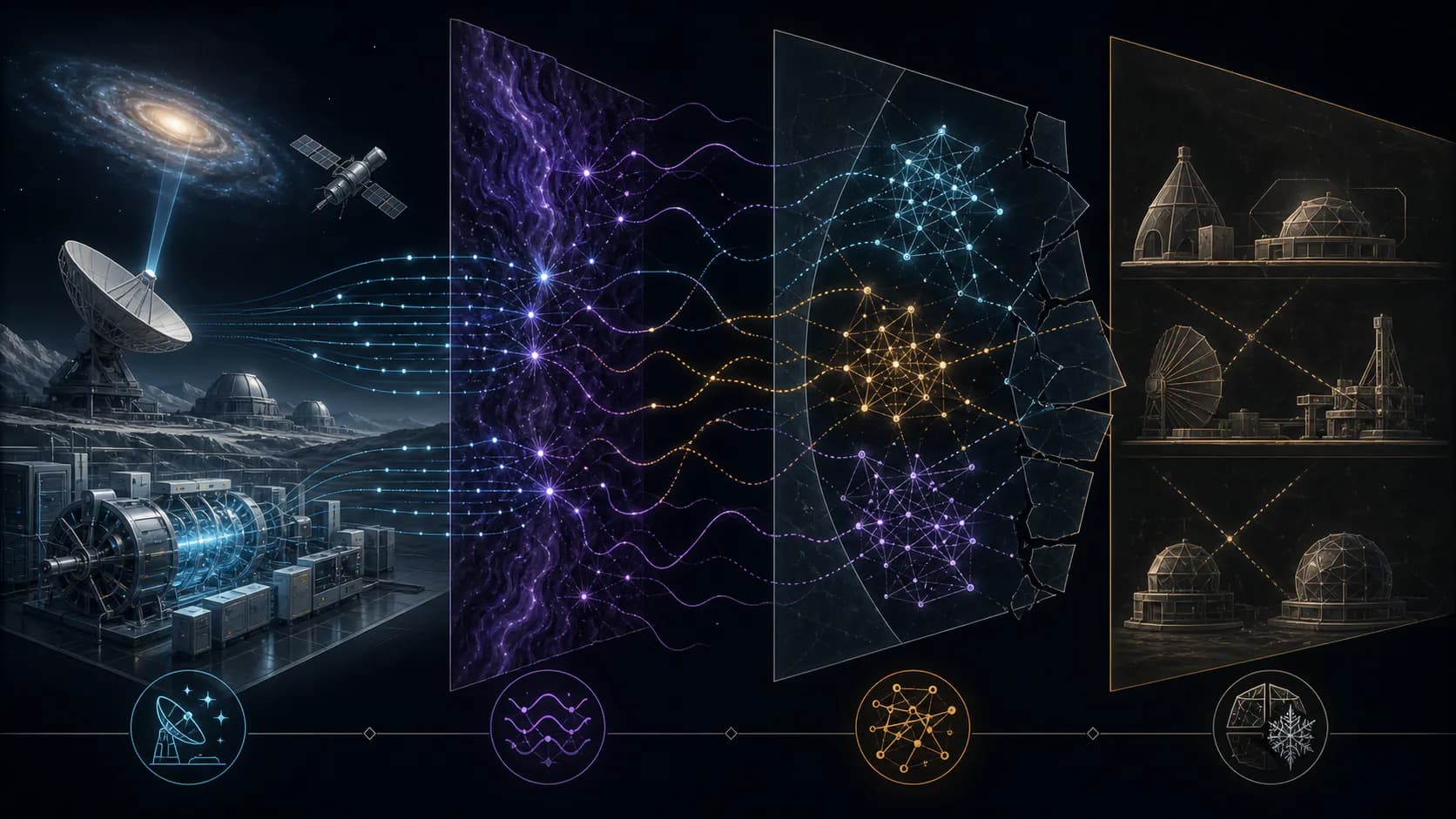
How it works, step by step
- 1
Identify the opponent's dependency chain
An attacker maps how observations become theories, trained experts, materials, prototypes, and operational capabilities.
- 2
Target a high-leverage bottleneck
Interference may corrupt measurements, restrict equipment, isolate researchers, destroy education, or make communication and replication unsafe.
- 3
Convert uncertainty into delay
Researchers spend resources checking contradictions and cannot confidently build the next layer of engineering on unstable foundations.
- 4
Maintain the capability gap
The attacker benefits when the opponent remains dependent on imported tools, outdated knowledge, or verification channels the attacker can observe or control.
A concrete example
One false result in every thousand
An adversary can alter a small, unpredictable fraction of readings from frontier instruments without disabling the laboratories.
01
Each anomaly could represent new physics, ordinary error, or sabotage, so researchers cannot simply discard every surprising result.
02
Replication consumes scarce facilities and still fails if the hidden interference affects the shared sensor or calibration chain.
03
Established technologies keep operating, but theory and advanced engineering stall because teams cannot identify which foundations are safe.
The point
A scientific blockade succeeds by raising the cost of confidence. It attacks the transition from evidence to future capability rather than every fact or present machine.
What is real, and what remains uncertain
First separate what we can observe or build today from what remains a prediction or a fictional extension.
What evidence supports it
Strategic extrapolation
Knowledge suppression, export controls, sabotage, and attacks on education are historical realities. Fiction extends them to fundamental science and civilization-scale competition.
A common misunderstanding
A blockade need not hide all existing knowledge. It can succeed by making frontier results unreliable or preventing the next generation of tools and experts from emerging.
Try this example in your head
An adversary cannot destroy laboratories, so it alters one result in every thousand. Researchers cannot tell which findings are corrupted and gradually stop trusting entire fields.
Knowledge systems can route around damage
Independent instruments, open methods, diverse institutions, preserved archives, and cross-checking make total control harder than attacking one centralized facility.
Ordinary uncertainty is not sabotage
Scientific disagreement and failed experiments occur naturally; identifying a blockade requires evidence of patterned adversarial interference rather than frustration alone.
How science fiction tests the idea
Stories usually test both the promise of an idea and the trouble it creates.
Its promise
Control of knowledge can matter more than control of territory.
Its problem
Distributed inquiry may survive pressure that defeats centralized research.
What to notice in a story
- 01
Which discovery bottleneck the opponent targets
- 02
Whether false data, missing tools, fear, or isolation causes the delay
- 03
How researchers verify results without the compromised system
Novels that use this idea
Cosmic scale
Dark · Demanding
The Dark Forest
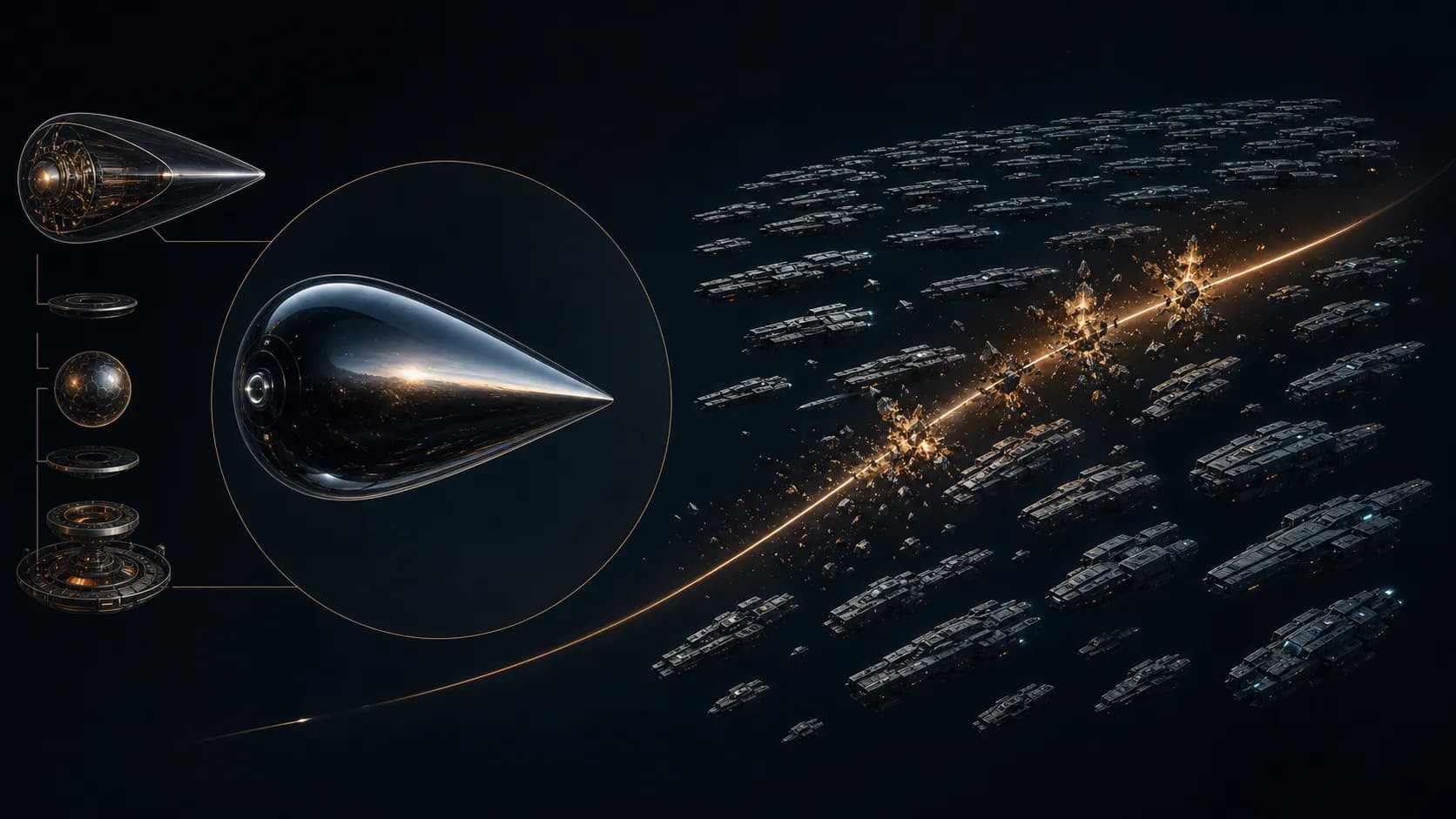
The sophon lock preserves a material capability gap even while humanity develops impressive applied engineering.
Visual example · A tiny probe measures the technology gap

Civilization scale
Dark · Demanding
The Three-Body Problem
Interference with frontier experiments is designed to freeze future capability rather than destroy present machines.
Visual example · Observation becomes a blockade
Questions to keep thinking about
Is the goal secrecy, delay, dependence, or permanent incapacity?
Which parts of inquiry can decentralize and which require large shared infrastructure?
How much uncertainty is enough to collapse scientific confidence?
Sources and further reading
These references ground the portable lesson; story interpretations remain editorial analysis.