
The idea in plain English
Plain idea
What changes
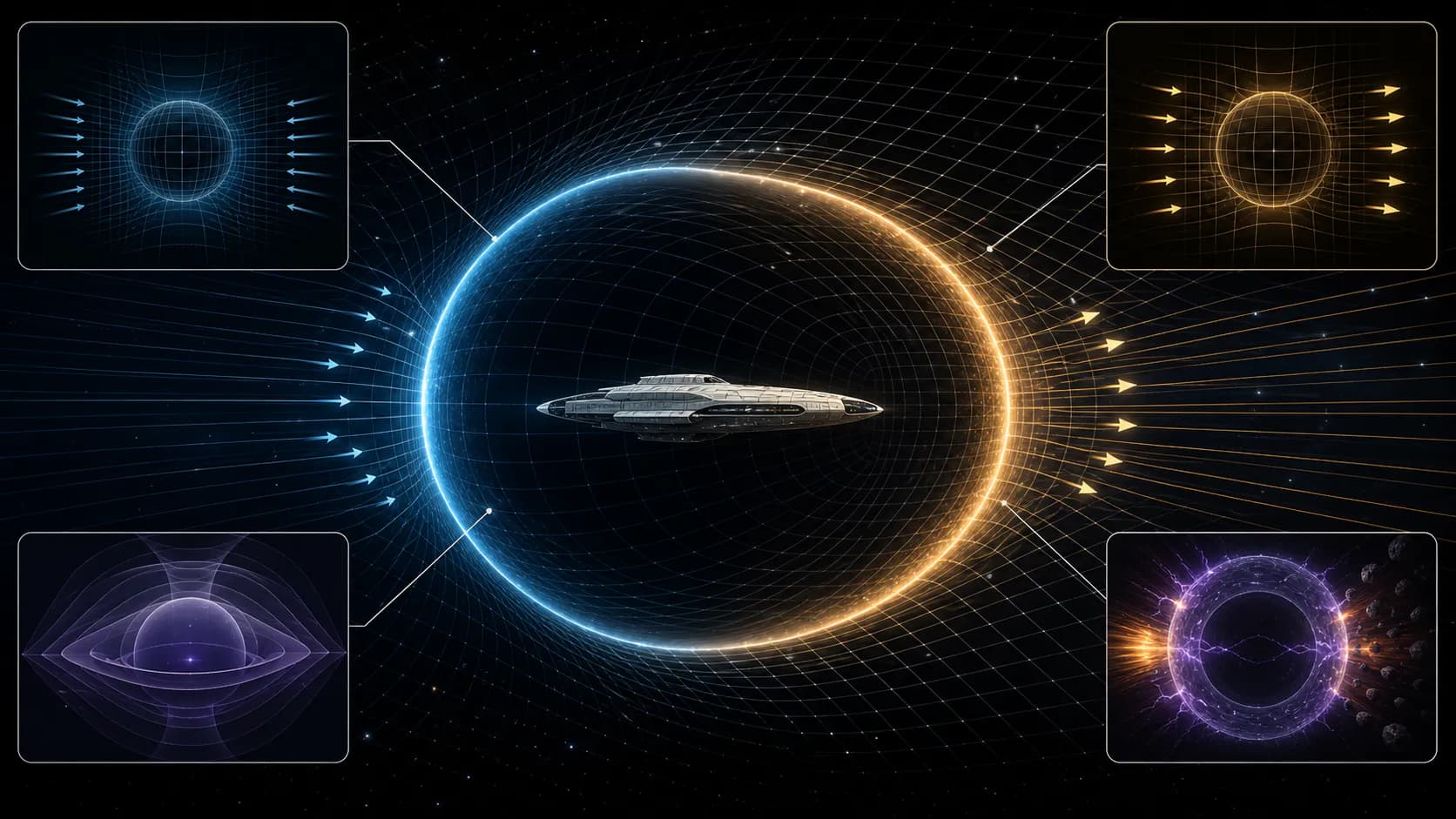
Curvature propulsion imagines moving a spacecraft by reshaping the spacetime around it rather than accelerating it only by throwing reaction mass backward.
Mechanism
How it operates
The fictional or theoretical drive changes distances or creates a moving region of geometry while the craft remains locally inside it. The hard problem moves into producing, controlling, starting, stopping, and containing the required spacetime configuration.
Human stakes
Why it matters
If geometry becomes infrastructure, interstellar travel may become practical—but a route can also alter the environment, expose destinations, or turn the same capability into a weapon.
Used in: 1 catalog novel
Related: Spacecraft propulsion · Interstellar travel · Relativistic time dilation
A few terms make the rest of the explanation easier to follow.
- Metric
- The mathematical rule that defines intervals, geometry, and causal relationships between nearby events in spacetime.
- Warp bubble
- A proposed region whose geometry moves relative to distant observers while a craft remains locally inside it.
- Energy condition
- A constraint used in general relativity to describe physically reasonable distributions of energy and momentum.
- Horizon
- A causal boundary across which signals may be unable to travel in the direction needed for control or warning.
Use the idea while reading
Turn the definition into three observations
Do not begin by asking whether a novel is “about” curvature propulsion. Begin with what changes in the lives of its characters, then use the concept to explain the mechanism underneath that change.
- 01
Notice what physical quantity the drive changes around the craft.
- 02
Notice how the geometry begins, ends, and interacts with matter.
- 03
Notice whether the route leaves detectable, dangerous, or irreversible effects.
Keep one question open: Which constraint has actually disappeared and which has been renamed?
Avoid the shortcut: A mathematical spacetime solution is not an engineering blueprint. It may require unavailable matter or energy, unstable boundaries, or conditions that cannot be created or controlled.
How it works, step by step
- 1
Specify a desired spacetime geometry
Theoretical work begins with a metric describing a compact region and how distances or motion around it would appear to distant observers.
- 2
Derive the required stress and energy
Einstein's equations connect the chosen geometry to the matter and energy distribution that would have to create it.
- 3
Test control and causality
Researchers ask whether the bubble can start, steer, stop, communicate across its boundary, and avoid horizons or causal contradictions.
- 4
Evaluate environmental effects
Radiation, concentrated energy, wake effects, arrival conditions, and the same geometry's destructive uses matter even if the equations permit a path.
A concrete example
A mathematical bubble without an engine
A metric describes a craft locally at rest inside a region that crosses a distant separation faster than an external light signal.
01
The geometry demonstrates that general relativity contains less intuitive travel solutions than ordinary rocket motion.
02
Solving the field equations reveals energy requirements or conditions that may not correspond to controllable matter available in nature.
03
A complete drive would still need a process to create the bubble, command it from inside, terminate it safely, and handle energy at the boundary.
The point
A valid spacetime solution is a question posed to physics, not a machine design. Curvature propulsion moves the central problem from propellant into matter, energy, causality, and control.
What is real, and what remains uncertain
First separate what we can observe or build today from what remains a prediction or a fictional extension.
What evidence supports it
Highly speculative physics
General relativity describes curved spacetime and permits mathematical geometries with unusual travel properties. No known method can create a usable drive, and proposed models face severe energy and control problems.
A common misunderstanding
A mathematical spacetime solution is not an engineering blueprint. It may require unavailable matter or energy, unstable boundaries, or conditions that cannot be created or controlled.
Try this example in your head
A drive shortens a journey but leaves a measurable geometric wake that any observer can track and that later ships must avoid. Did it overcome distance or convert distance into environmental debt?
No demonstrated metric engineering
General relativity accurately describes curved spacetime, but no experiment has created a macroscopic travel bubble or the required controlled stress-energy distribution.
Mathematical variants do not share one verdict
Different warp metrics have different speeds, energy requirements, horizons, and stability problems, so claims about one model should not be generalized to all.
How science fiction tests the idea
Stories usually test both the promise of an idea and the trouble it creates.
Its promise
Changing spacetime can make interstellar distance an engineering problem rather than a lifetime barrier.
Its problem
A drive that alters geometry may leave physical and strategic consequences far beyond the ship itself.
What to notice in a story
- 01
What physical quantity the drive changes around the craft
- 02
How the geometry begins, ends, and interacts with matter
- 03
Whether the route leaves detectable, dangerous, or irreversible effects
Novels that use this idea
Questions to keep thinking about
Which constraint has actually disappeared and which has been renamed?
Can the same geometry move a ship and damage a world?
Who controls access when spacetime itself becomes engineered infrastructure?
Sources and further reading
These references ground the portable lesson; story interpretations remain editorial analysis.