
The idea in plain English
Plain idea
What changes
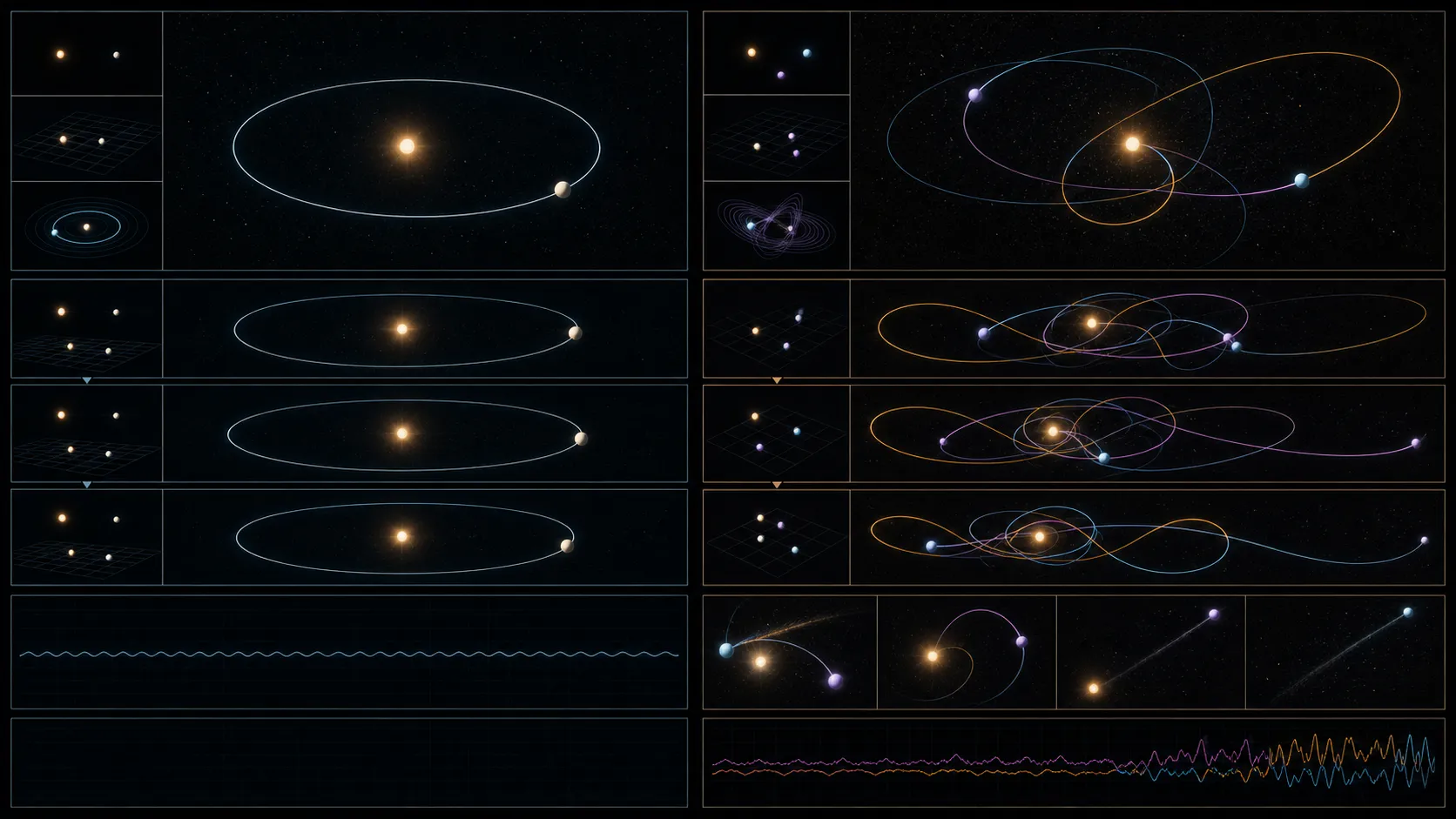
Orbital instability describes motion that follows gravitational laws but becomes difficult to predict far ahead because tiny differences can grow into very different paths.
Mechanism
How it operates
Several bodies continuously change one another's motion. In a chaotic regime, a minute uncertainty in position or velocity expands over time, so calculations that are accurate nearby lose long-range predictive power.
Human stakes
Why it matters
A civilization under an unreliable sky cannot treat seasons, orbits, or habitable periods as permanent. Prediction, preservation, migration, and political legitimacy become matters of survival.
Used in: 1 catalog novel
Related: Climate survival · Cosmic sociology
A few terms make the rest of the explanation easier to follow.
- Initial conditions
- The measured positions and velocities from which a model begins calculating a system's later motion.
- Deterministic chaos
- Law-governed evolution in which very small differences in starting conditions grow into large differences over time.
- Prediction horizon
- The timescale beyond which accumulated uncertainty makes a forecast too broad to support a particular decision.
- Stability region
- A part of the system's possible configurations where small disturbances remain bounded rather than rapidly producing a different outcome.
Use the idea while reading
Turn the definition into three observations
Do not begin by asking whether a novel is “about” orbital instability. Begin with what changes in the lives of its characters, then use the concept to explain the mechanism underneath that change.
- 01
Notice how measurement uncertainty grows across forecast time.
- 02
Notice what warning or preservation systems exist for unstable eras.
- 03
Notice who gains authority by claiming to predict the unpredictable.
Keep one question open: Is the real problem unstable motion, limited measurement, or political overconfidence?
Avoid the shortcut: Chaos does not mean lawlessness or pure randomness. The system is deterministic, but imperfect knowledge of its starting state limits reliable long-range prediction.
How it works, step by step
- 1
Measure positions and velocities
Observers estimate the current state of every important body, always with finite precision and incomplete knowledge of smaller influences.
- 2
Integrate mutual gravitational effects
Each body changes the acceleration of the others continuously, producing coupled trajectories rather than one object orbiting a fixed center.
- 3
Watch uncertainty expand
Close approaches and resonances can amplify minute measurement differences until initially similar calculations predict substantially different paths.
- 4
Plan around ranges, not one future
Useful institutions track ensembles of possibilities, update measurements, identify warning signs, and avoid treating a long-range trajectory as a certain calendar.
A concrete example
Two almost identical three-body forecasts
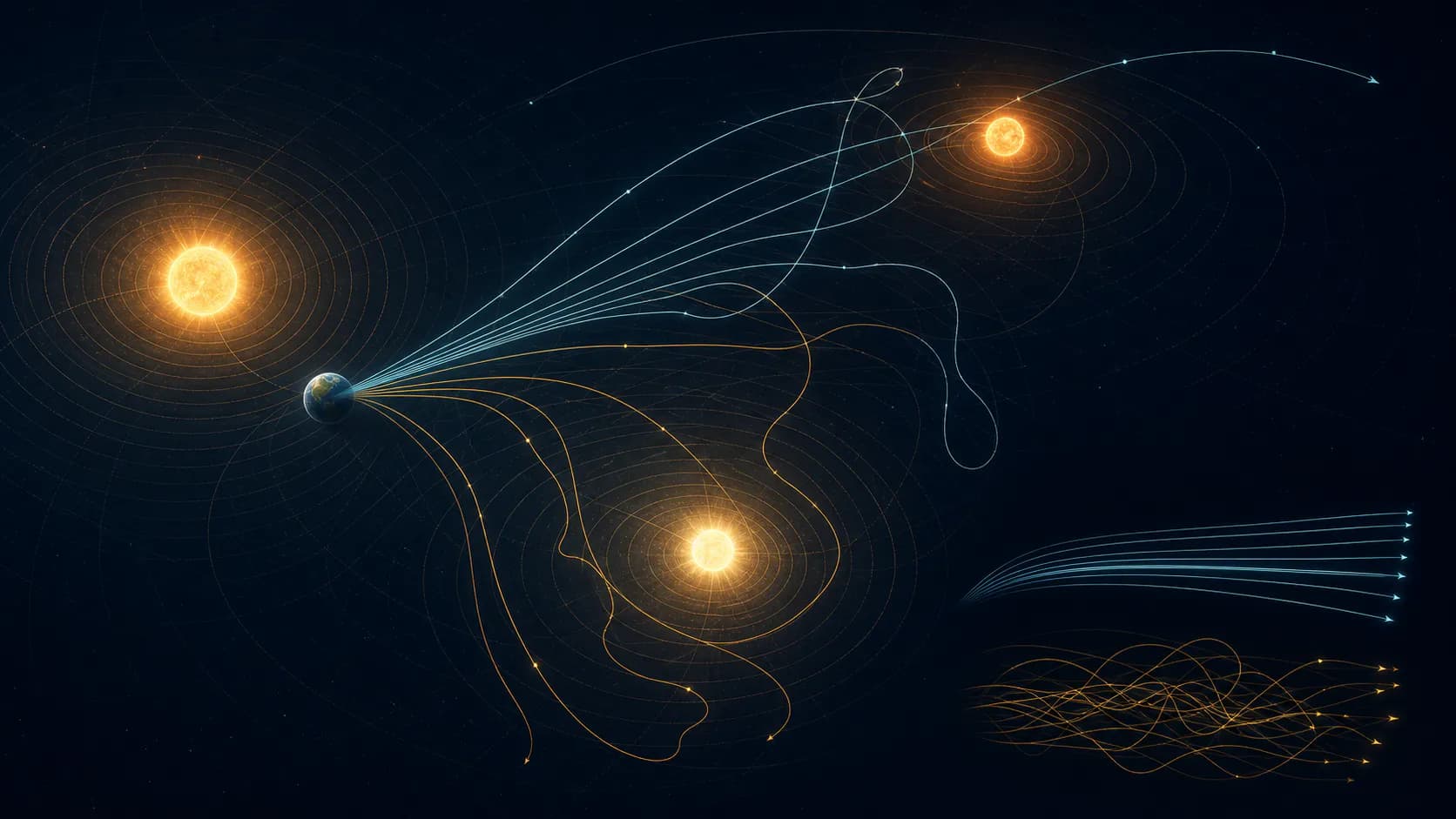
Two observatories measure a small body's position with a difference far below ordinary visual resolution and run the same gravitational laws.
01
For the near future, both calculations agree closely enough to guide observation and short-term decisions.
02
After repeated close interactions, the small starting difference changes the timing of encounters and the exchange of orbital energy.
03
Farther ahead, one forecast retains the body while another predicts collision or ejection, revealing a limited prediction horizon.
The point
Chaos is not missing law. It is the practical loss of precise long-range prediction when finite measurement error is repeatedly amplified by lawful dynamics.
What is real, and what remains uncertain
First separate what we can observe or build today from what remains a prediction or a fictional extension.
What evidence supports it
Established nonlinear dynamics
Multi-body gravity and chaotic sensitivity are well-established. Fictional systems may exaggerate their timescales, habitability, or the severity of orbital changes.
A common misunderstanding
Chaos does not mean lawlessness or pure randomness. The system is deterministic, but imperfect knowledge of its starting state limits reliable long-range prediction.
Try this example in your head
Two observatories measure a planet's position with errors smaller than a grain of dust. Centuries later their forecasts place it in different climate regimes, even though both used the same laws.
Not every three-body system is equally unstable
Special configurations, hierarchies, resonances, and Lagrange regions can remain regular or useful for long periods despite three gravitating bodies.
Fiction may compress the timescale
A real system's instability, habitability, and forecast horizon depend on masses, distances, velocities, and perturbations rather than the number three alone.
How science fiction tests the idea
Stories usually test both the promise of an idea and the trouble it creates.
Its promise
Unpredictability makes preservation civilization’s central project.
Its problem
A chaotic environment can become a political justification rather than a destiny.
What to notice in a story
- 01
How measurement uncertainty grows across forecast time
- 02
What warning or preservation systems exist for unstable eras
- 03
Who gains authority by claiming to predict the unpredictable
Novels that use this idea
Questions to keep thinking about
Is the real problem unstable motion, limited measurement, or political overconfidence?
How does repeated catastrophe change memory and institutions?
Does uncertainty justify control, humility, migration, or experimentation?
Sources and further reading
These references ground the portable lesson; story interpretations remain editorial analysis.