
The idea in plain English
Plain idea
What changes
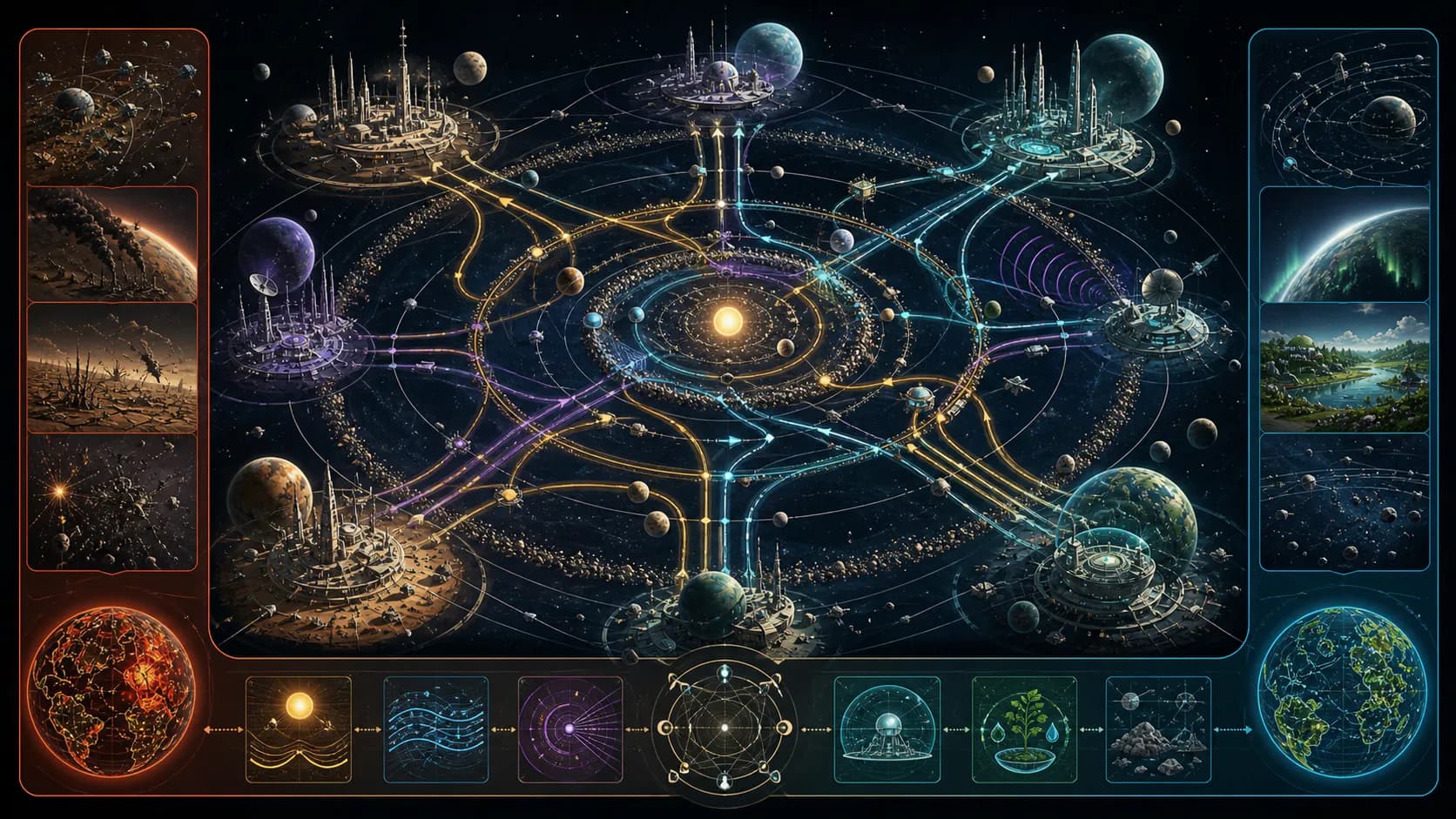
The cosmic commons treats habitable worlds, safe routes, stable dimensions, or the universe's long-term conditions as shared resources no civilization should destroy for private advantage.
Mechanism
How it operates
A commons creates benefits that cross borders and harms that one actor can impose on everyone. Protection requires shared norms, monitoring, restraint, and some response to actors who gain by damaging what others preserve.
Human stakes
Why it matters
At cosmic scale there may be no government capable of repair or enforcement. A defensive act that saves one civilization can consume resources or destabilize conditions needed by countless unknown futures.
Used in: 1 catalog novel
Related: Survival ethics · Weaponized physics · First contact
A few terms make the rest of the explanation easier to follow.
- Common-pool resource
- A shared resource that is difficult to exclude users from and can be diminished or degraded through use.
- Externality
- A cost or benefit imposed on others that the actor creating it does not fully bear in the decision.
- Stewardship
- Long-term responsibility for maintaining conditions that support present users, future users, and ecological or physical resilience.
- Monitoring
- Shared observation that makes use, damage, compliance, and recovery visible enough for rules to function.
Use the idea while reading
Turn the definition into three observations
Do not begin by asking whether a novel is “about” cosmic commons. Begin with what changes in the lives of its characters, then use the concept to explain the mechanism underneath that change.
- 01
Notice which resource or physical condition is shared across societies.
- 02
Notice how one actor's use creates distant or delayed costs.
- 03
Notice what monitoring, reciprocity, or enforcement could preserve the commons.
Keep one question open: Who counts as a stakeholder when many users are unknown or not yet born?
Avoid the shortcut: Calling something a commons does not mean nobody may use it. The problem is creating fair access and limits so one user's benefit does not destroy the shared conditions of future use.
How it works, step by step
- 1
Identify the shared condition
Habitable environments, stable orbits, low debris, safe routes, dimensions, energy flows, or cosmic matter support multiple users across distance and time.
- 2
Map subtractive or degrading use
One actor's extraction, pollution, traffic, weapon, or shortcut changes the availability or safety experienced by others.
- 3
Create rules matched to the system
Boundaries, access, monitoring, graduated response, restoration, and participation must fit the scale and feedback of the resource.
- 4
Sustain cooperation under temptation
Institutions must address actors who gain immediate safety or power by defecting while others pay to preserve the shared condition.
A concrete example
A corridor weakened by every crossing
Starships can cross a stable spacetime corridor rapidly, but each passage permanently reduces its capacity.
01
Early users benefit most and can treat the corridor as empty infrastructure because later losses are invisible at departure.
02
Unrestricted travel eventually eliminates the route for civilizations that arrive later or lack alternative technology.
03
Monitoring, quotas, restoration research, and representation of future users can preserve access, but only if powerful travelers accept limits.
The point
A cosmic commons is not a claim that nobody may use space. It is a governance problem created when independent users depend on one condition that individual advantage can degrade.
What is real, and what remains uncertain
First separate what we can observe or build today from what remains a prediction or a fictional extension.
What evidence supports it
Legal and ethical framework
Common-pool resources, environmental law, oceans, Antarctica, orbital space, and planetary protection provide real analogies. A civilization-spanning cosmic regime is speculative.
A common misunderstanding
Calling something a commons does not mean nobody may use it. The problem is creating fair access and limits so one user's benefit does not destroy the shared conditions of future use.
Try this example in your head
Every starship can cross a stable corridor quickly, but each trip permanently weakens it. Early civilizations can prosper by traveling often and leave no safe route for later ones.
Scale complicates enforcement
Civilizations separated by years or centuries may lack shared law, timely monitoring, common identity, or any institution capable of repairing damage.
Commons do not require one central ruler
Research on shared resources shows that user-created and layered institutions can work, but their rules must match local knowledge, boundaries, and accountability.
How science fiction tests the idea
Stories usually test both the promise of an idea and the trouble it creates.
Its promise
Civilizations share an obligation not to damage the conditions that make any future possible.
Its problem
Without trust or enforceable rules, appeals to a common universe may have little strategic force.
What to notice in a story
- 01
Which resource or physical condition is shared across societies
- 02
How one actor's use creates distant or delayed costs
- 03
What monitoring, reciprocity, or enforcement could preserve the commons
Novels that use this idea
Questions to keep thinking about
Who counts as a stakeholder when many users are unknown or not yet born?
Can restraint survive when defection brings immediate safety or power?
What must civilizations preserve even when doing so reduces their own chance of survival?
Sources and further reading
These references ground the portable lesson; story interpretations remain editorial analysis.